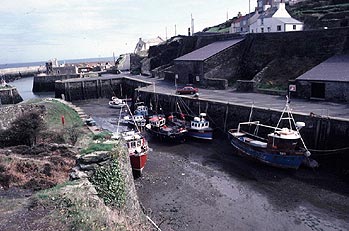
Amlych (Gwynedd, Anglesey)
This small harbour on the north coast of Anglesey was once the place from where much of the world’s copper was shipped, for a short period in the late 18th century. Following the discovery of the Great Golden Venture Lode on Parys Mountain nearby in 1768 - one of the richest seams of copper ore ever found in Britain - massive opencast mining was undertaken here, employing over 5,000 men.
During this period 3.5 million tons of ore were extracted, producing 130,000 tons of copper. Much of this was used to sheath the hulls of warships, as a protection against the Toredo shipworm and general fouling, enabling the ships to stay at sea for long periods of time, and increase their speed. The technique was first applied in 1761, and HMS Victory, for example, had over 3,500 copper sheets, weighing 13 tons, used in her construction. Copper sheathing was one of the most significant innovations to influence the course of naval warfare during the Napoleonic wars.
The harbour at Amlych was improved by a private act in 1793, and two short piers and a dry dock were constructed. A further longer pier was added in 1816, with a small lighthouse at its end (the present one dates to 1853). Sheds were built there to store the copper ore, before it was shipped out. Mining in the area continued underground during the 19th century, when the surface deposits had been exhausted, but this had ended by the end of the century. There have been recent attempts to revive some copper mining on the site, and to promote the mountain, with its extraordinary colours and remains, and its associated harbour, as one of the most important industrial archaeological sites in Wales.