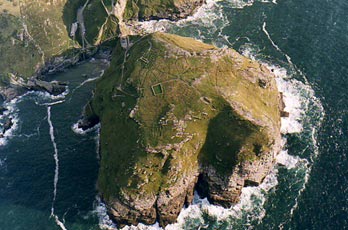
Tintagel Castle (Cornwall)
The ruins of the medieval castle of Tintagel are located on a granite stack that juts out into the Atlantic Ocean. It is a site of myth and folklore, and one that has important Dark Age, as well as medieval, remains. In the 19th century, the site was romantically portrayed in Tennyson’s Idylls of the Kings.
There was little reason to build a castle here, except because of its association with Arthur and other Dark Age kings. The 'History of the Kings of Britain', written by Geoffrey of Monmouth c.1137, is the earliest source to mention Tintagel, where the magical conception of Arthur is located. Most of the castle dates to c.1227-33, when it was built by Earl Richard of Cornwall, who sought a connection to its presumed ancient origin. Maybe this was an attempt to create a medieval Camelot, and the square garden (shown in the centre of the photograph) may have been a hortus conclusus.
For all the myth, Tintagel is a genuine, and singularly important early medieval site. Large quantities of imported Byzantine pottery (dating from the fifth to mid-sixth centuries AD) have been found here, and many of the 100 or so rectangular buildings visible on the hill top and terraces are thought to date to this period. In 1998 an inscription cut into a piece of slate was found, covering a drain from one of these houses, which included the name ARTOGNOV, that some have seen as cognate with 'Arthur'.
Opinions have varied as to the function of this site. Early archaeologists thought it was a Celtic monastery, but modern opinion is split between a high status or royal site, and a community of traders, possibly involved in the export of Cornish tin to merchants from the Mediterranean. Most of the site remains unexcavated, and is only known from surveys of its earthworks and aerial photographs.