Clovelly (Devon)
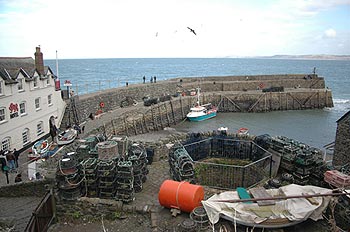
The small fishing village of Clovelly, nestling under the 400ft-high cliffs of the north Devon coast, is one of the quintessential images of maritime England. A cobbled main street leads down a steep hill, flanked by picturesque, flower-strewn houses. The hill leads to a miniature harbour with a curving breakwater, where there are a few small boats at anchor, and the carefully placed nets and traps of the local fishermen.
The whole effect is carefully managed by the local estate, which owns everything. No cars are permitted, and manhandled sledges and donkeys are used to carry goods into the village from the top of the hill.
In reality, Clovelly as we see it today is the largely early-20th-century creation of Mrs Christine Hamlyn, and careful observation will locate date stones on the houses ranging from 1914-25. Behind these facades there are earlier houses, but little research has been undertaken on them. The harbour breakwater was built by George Cary in 1587 to encourage herring fishing, and the oldest houses, including the Red Lion Inn, are probably those nearest to the harbour. There is also a limekiln, a common feature of the Devon coast, where lime was used to improve the acidic soils in the 18th century.
Clovelly survives today through its tourism, its fishing industry and the occasional visiting yacht. Much of it seems in a way like make-believe, but the village is nevertheless one of the most memorable places on Britain's coast.