St Catherine’s Lighthouse (Isle of Wight)
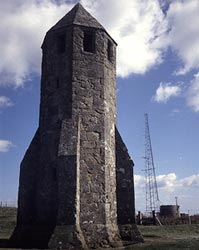
A rather curious rocket-shaped building, located on the downs on the most southerly point of the Isle of Wight, is Britain’s only surviving medieval lighthouse. Known locally as the ‘pepper pot’, the tower would have had an internal light that acted as a beacon for passing shipping. A small chapel or oratory was once attached to one side, where prayers were offered for the souls of shipwrecked mariners, but this was demolished around 1547. The building was probably completed by 1328, although an earlier structure is documented on the site in 1312.
The Ship of the Blessed Virgin was driven ashore here on 22 April 1313, carrying 174 barrels of wine from Aquitaine. The locals, led by the lord of the manor, Walter de Godeton, were able to acquire a fair quantity of the wine. Walter apparently constructed the lighthouse as a penance, imposed by the Church, with an endowment for a priest to say masses and tend a light. Located high on the down, the building must have proved ineffective, as it is frequently shrouded in fog. Nearby are the foundations of another lighthouse, begun in 1785. This was never completed, as it too proved ineffective. The present working lighthouse was built closer to sea-level in 1840.
Lighthouses in Britain go back to Roman times (one survives at Dover, while others may have existed at Flint and Holyhead), but medieval lights were often housed in religious buildings, established by benefactors on hilltops near to the coast. With the grant of a charter to Trinity House in 1516, the building of private lights was encouraged, funded by the collection of 'light dues' from passing shipping. By the 19th century these dues were a farthing per ton of cargo. The great era of lighthouse construction came during the late 18th and 19th centuries, and in 1836 Trinity House (with the Northern Lighthouse Board in Scotland) was empowered to purchase privately owned lights and to limit exorbitant demands on ship owners.