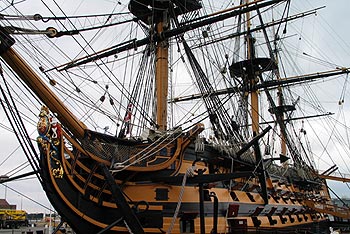
HMS 'Victory' / Portsmouth Harbour (Hampshire)
The imposing hull, masts and rigging of HMS Victory, resting in 2 dry dock of the historic Portsmouth dockyard, is the most important survival from Britain's Georgian Navy. The ship is the oldest surviving commissioned warship in the world, and remains the flagship of Britain's Second Sea Lord. To coincide with the Trafalgar 200 celebrations to mark the bicentenary of the Battle of Trafalgar, a major programme of restoration of the Victory has recently been completed, with public access to areas never before available. The ship's appearance is now as close as possible to that of 1805, when the ship led the Royal Navy into battle under the command of Admiral Nelson.
HMS Victory was already an old ship in 1805. Laid down in 1759 in Chatham, and launched on 7 May 1765, the ship was one of the largest and most expensive vessels of the British Navy, costing £63,175 to build, with three gun decks and 104 cannon. The full complement of crew was 850. It was commissioned in 1778. Even before Trafalgar, the Victory had played a major role in two great naval battles at Ushant and St Vincent.
Strong sentiment to preserve this icon of naval warfare meant that the ship was not broken up, as was normal, when it ceased active service in 1812. The Victory remained afloat in Portsmouth harbour, undergoing sporadic repairs, until 1922, when she was moved into the present dry dock, and a major restoration programme was undertaken which has continued until today. As timbers have been replaced, piece by piece, only a relatively small proportion of the actual timbers from Nelson’s day survive.
HMS Victory rests within one of the largest and best-preserved dockyards of the 18th and 19th centuries, a yard that includes dry docks and basins (dating from 1691), the block works, ship shops and foundries. At present, only limited areas can be accessed by the public, and it is to be hoped that further areas will be opened up in the future, as interest in Naval history increases.