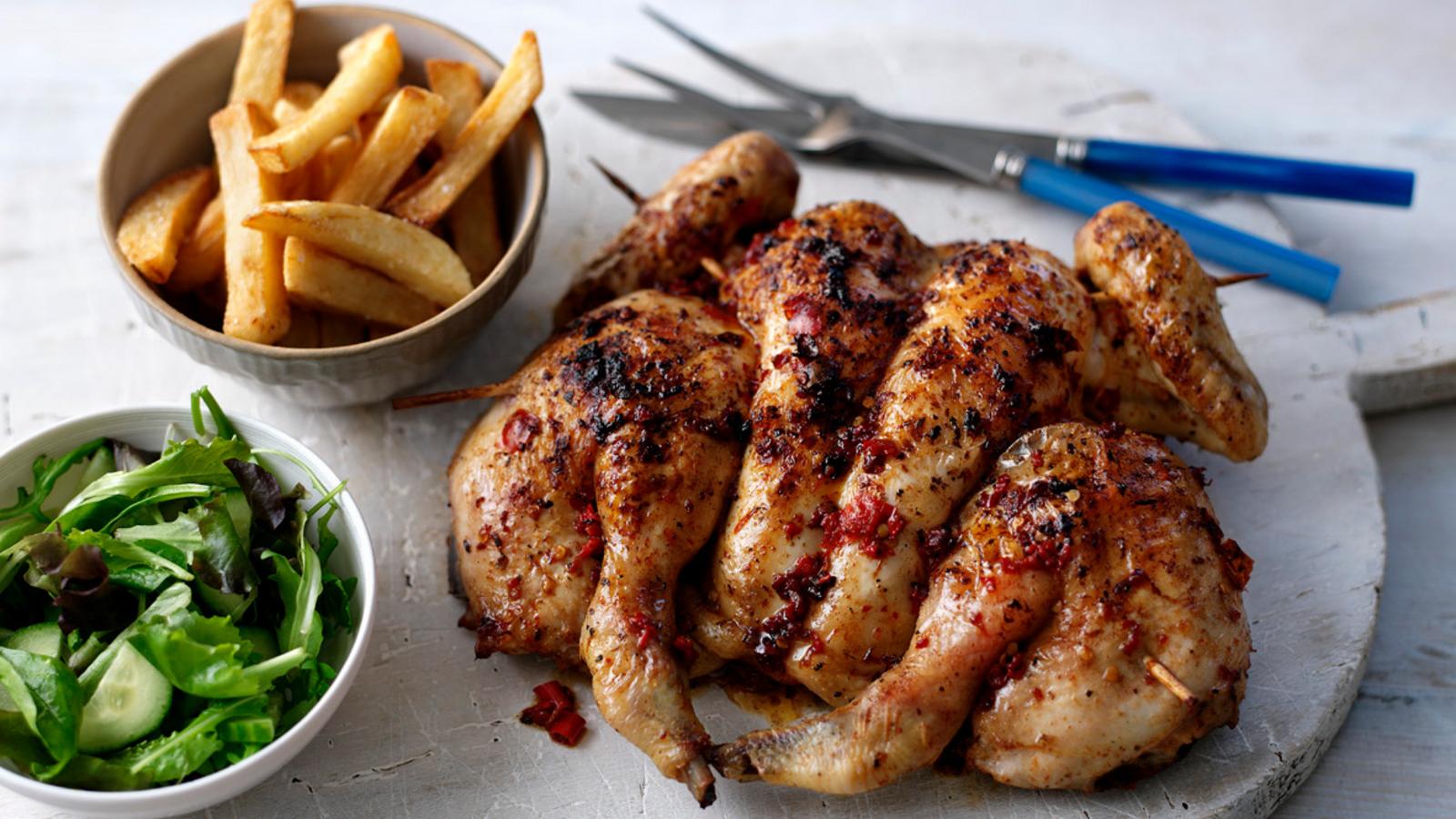
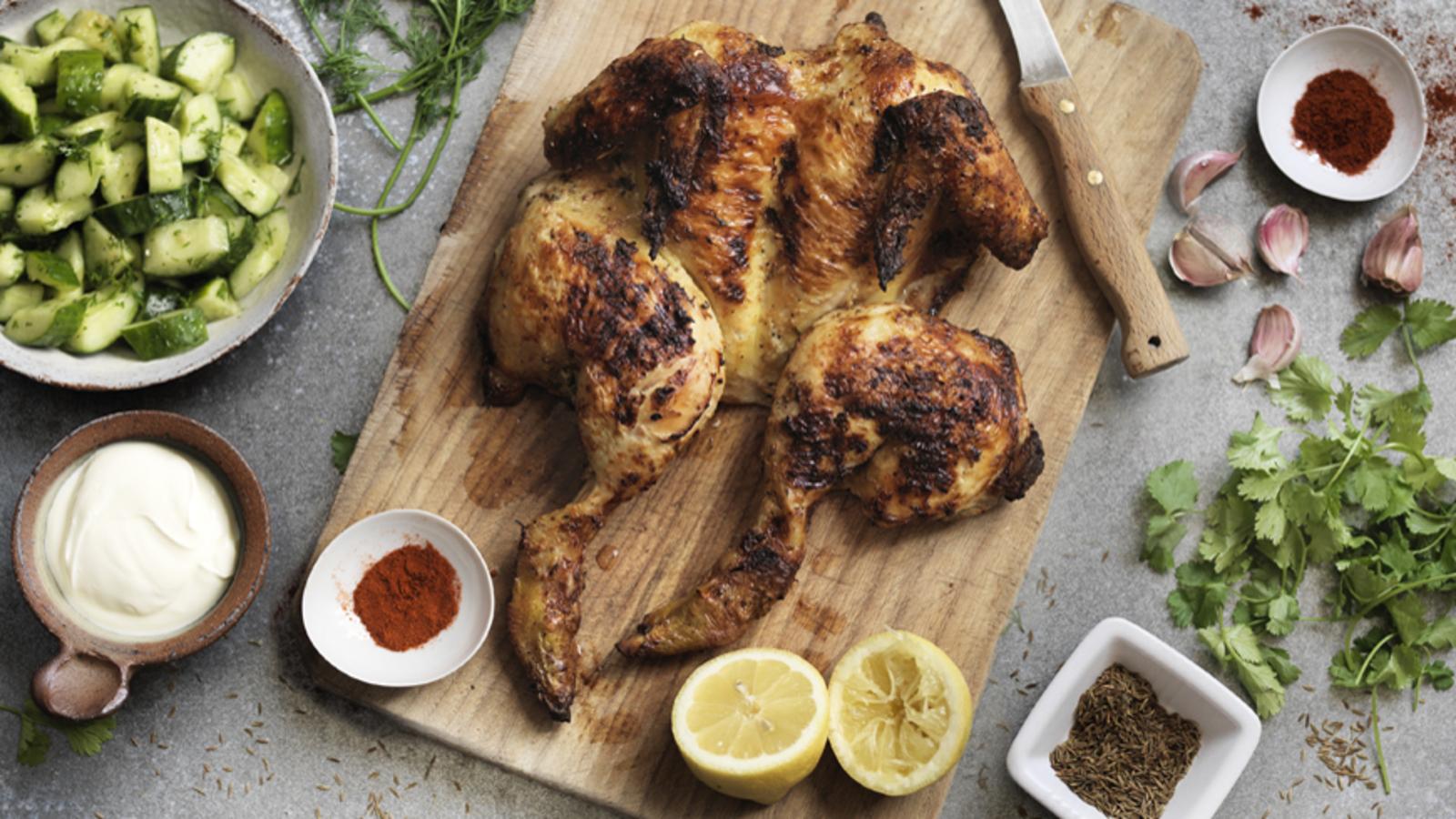
Yardbird chicken with white barbecue sauce and slaw
- Prepare
- overnight
- Cook
- over 2 hours
- Serve
- Serves 4
- Dietary
- Dairy-free
'Yardbird' chicken hails from the American deep South – it's a labour of love to prepare, but is sure to impress a crowd.
Sam and Shauna share their recipe from popular restaurant Hang Fire alongside a Lexington-style red slaw with beets.
Ingredients
For the yardbird
For the bird bath brine
- 50g/1¾oz fine sea salt
- 50g/1¾oz soft light brown sugar
- 2 tbsp coriander seeds
- 2 tbsp coarsely ground black pepper
- 1 tsp garlic granules
- 2 fresh bay leaf
For the white barbecue sauce
- 200g/7oz good-quality mayonnaise
- 50ml/2fl oz good-quality apple juice
- 50ml/2fl oz apple cider vinegar
- 50ml/2fl oz freshly squeezed lemon juice
- 1 tbsp creamed horseradish
- 1 tbsp garlic powder
- 1 tsp onion powder
- 1 tsp English mustard powder
- 1 tsp freshly cracked black pepper
- 1 tsp finely grated lemon zest
- ½ tsp cayenne pepper
- ½ tsp sea salt flakes
- 2 tbsp finely chopped fresh flat leaf parsley
For the almost all-purpose rub
- 2 tbsp fine sea salt
- 2 tbsp paprika
- 1½ tbsp soft light brown sugar
- 1½ tbsp garlic granules
- 1 tbsp onion powder
- 1 tbsp coarsely ground black pepper
- 1 tbsp chipotle chilli powder
- ½ tbsp celery salt
- 1 tbsp ground allspice
- 1 tbsp toasted cumin seeds, ground
- 1 tbsp toasted fennel seeds, ground
For the red slaw with beets
- 1kg/2lb 4oz red cabbage, cored and finely shredded
- 1 medium red onion, finely sliced
- 3 carrots, grated
- 2 cooked beetroot, grated
- 1 lemon, juice only
- 1 tsp almost all-purpose rub (made above)
- 50ml/2fl oz cider vinegar
- 3 tbsp tomato ketchup
- 1 tsp caster sugar
- 50ml/2fl oz olive oil
- ½ tsp freshly cracked black pepper
- 2½ tsp fine sea salt
For the yardbird rub
- 1½ tbsp fine sea salt
- 1½ tbsp garlic granules
- 1½ tbsp paprika
- 1 tbsp white sugar
- 1 tbsp dried rosemary
- 1 tbsp dried oregano
- 1 tbsp English mustard powder
- 1 tbsp coarsely ground black pepper
- 1 tbsp celery salt
- 1 tbsp fennel seeds
- ½ tsp ground turmeric
Method
To make the yardbird chicken, first you need to spatchcock the chicken. Place the chicken on a chopping board and use poultry shears or a sharp knife to cut along either side of the backbone. Using the palm of your hand, push the shoulder blades in opposite directions so the bird lies flat. Set aside.
To make the bird bath brine, put all the ingredients along with 1 litre/1¾ pint water into a large saucepan set over medium heat. Bring almost to the boil to make sure the salt dissolves completely and the aromas of the herbs and spices are released. Take the pan off the heat and allow to cool completely.
Place the chicken in a large bowl or zip lock bag and pour the cooled brine over the bird, making sure it is fully submerged (especially the breast, flip it upside down if you need to). Chill in the fridge for at least 4–6 hours, or overnight.
To make the white barbecue sauce, combine all the ingredients, apart from the parsley, in a bowl, and whisk vigorously until well mixed.
Stir through the parsley and transfer the mixture to a jar. Before using, chill the sauce in the fridge for 1–2 hours to allow the flavours to mingle.
To make the almost all-purpose rub, mix together all the ingredients in a bowl. Set aside.
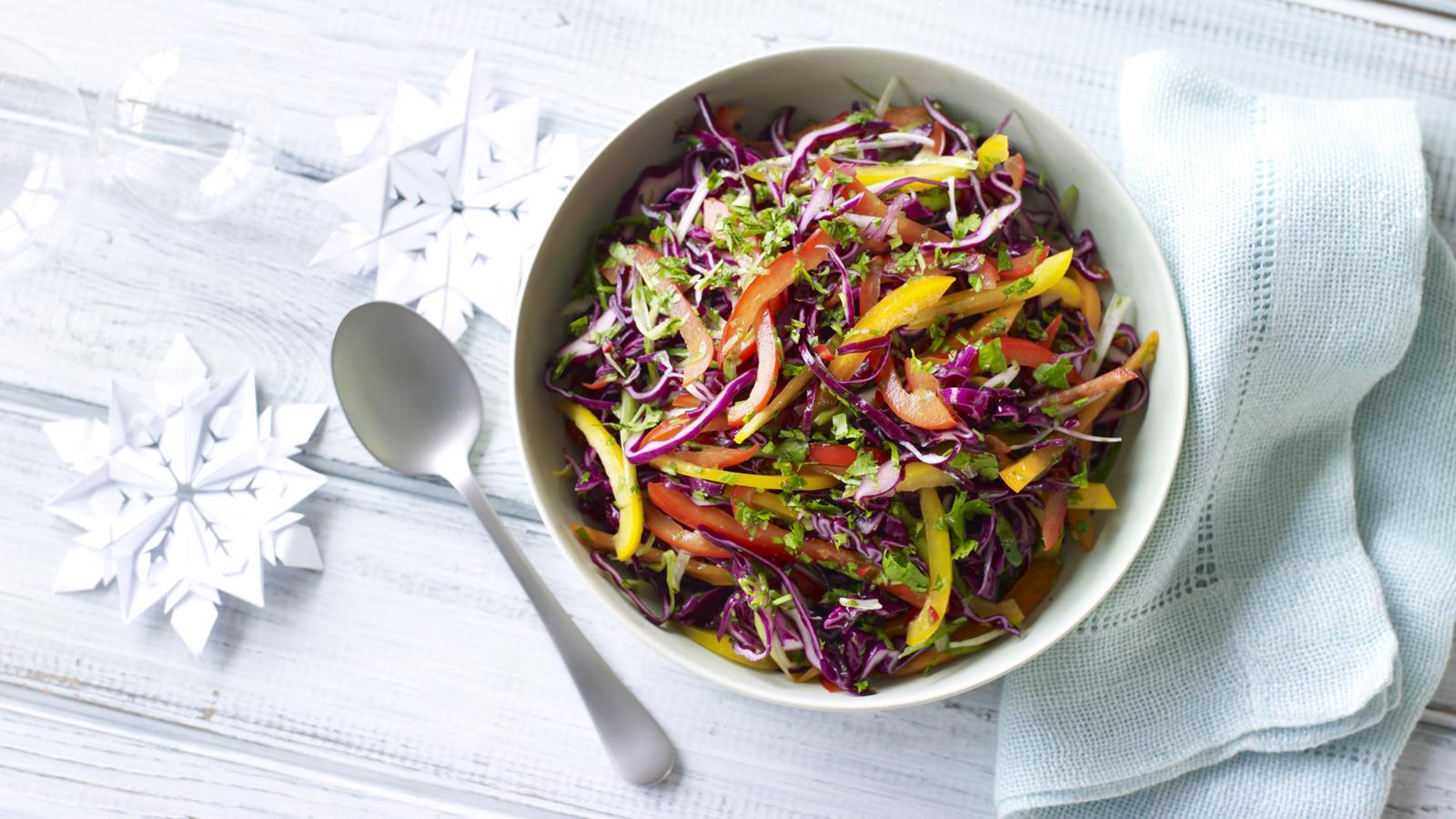
To make the slaw, combine the shredded cabbage and onion in a large bowl. Add the lemon juice and 2 teaspoons of fine sea salt, and mix well. Cover and let osmosis do its thing in your fridge for 2–3 hours.
Pour off any liquid from the onion and cabbage, then stir through the carrot and beetroot. In a food processor or blender, add all remaining ingredients except the oil, and with the blade running at medium speed, add the oil very slowly, drop by drop, until the dressing emulsifies and thickens.
Pour the dressing over the vegetables and toss through, making sure they are all fully coated. Cover the bowl with cling film and allow to sit in the fridge for an hour (to help the flavours come together) before serving.
To make the yardbird rub, in a bowl mix all of the ingredients together well. Alternatively, put through a blender for an extra fine powder. Transfer the rub to a jar, or a shaker if using immediately.
To cook the yardbird in an oven, after the brine time, preheat the oven to 180C/160C Fan/Gas 4.
Remove the chicken and pat it completely dry with kitchen paper. Rub all over with the groundnut oil and sprinkle evenly on both sides with the yardbird rub.
Cook the chicken for around 1 hour in the oven. Check the internal temperature of the thickest part of the breast with an instant-read thermometer. Once it reaches 74°C/165°F, it’s done.
To serve, when the bird is cooked, submerge it in the white barbecue sauce. Serve the chicken with the slaw and a scattering of chopped chives.
Recipe tips
To use a smoker instead of an oven, set up your grill for indirect heat; you’re going start with a relatively low temperature and then after an hour, crank it up. Set the temperature at 108°C/225°F, and add your wood just before you put the bird in.
Smoke for 1 hour, then take the temperature up to 135°C/275°F. Continue to smoke for another 2 hours, adding more wood every hour or as and when it burns out.
Check the internal temperature of the thickest part of the breast with your instant-read thermometer. Once it reaches 74°C/165°F, it’s done.