The "true comfort food" you should only eat once a year
“We love Hanukkah, not just for the food but for the lovely tradition of lighting a daily candle,” says Chef Sarit Packer. Sarit, who grew up in Northern Israel, now runs Honey & Co and its sister restaurants in London with her husband Itamar Srulovich. Sarit and Itamar appear regularly on Saturday Kitchen with their delicious Middle Eastern recipes and seamless teamwork.
“It’s a lovely cosy holiday, but it is lucky it only comes once a year as all the food is traditionally fried, so not really how one should eat on a daily basis,” says Sarit.
Lovely latkes
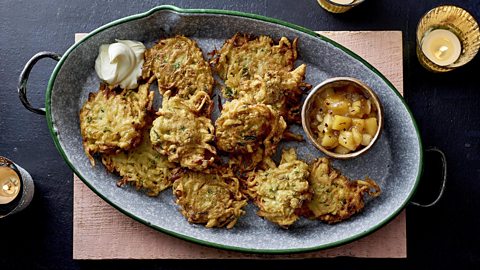
If there's one dish that Sarit would recommend everyone make, at least once a year, whether for Hanukkah or just for pleasure, “it would have to be potato fritters, for the soul," she says. "True comfort food! Itamar will make me some potato fritters when I am in a bad mood; he knows it is one of the only things that makes me happy.”
“When we first opened Honey and Co, we thought it would be nice to serve some fritters. We soon started frying so many we almost couldn’t cope!” says Sarit, but they still make an occasional suprise appearance at their other restaurants as well as their Hanukkah supper club.
“Fritters can be so much more than just dull grey potato sludge, which you sometimes get in horrible places,” she says. "We have them made from any kind of vegetable that can take the frying." Root vegetable latkes using sweet potato work well, or butternut squash, courgettes as well as the classic potatoes and onions.
"To make the perfect latke," says Sarit, "it is really important to salt the veg, drain it and then squeeze it out really well."
"Make sure you only add enough egg and flour to just bring it together. You want to fry it in a shallow frying pan, but don’t skimp on the oil! You need it to be about 3 to 5 centimetres deep, and avoid over crowding the pan at all costs."
The oil needs to be just the right temperature so the latke cooks inside and out to crisp perfection. If the oil is too hot you risk burning the fritters on the outside while they are still raw on the inside. If the oil is too cold, the fritters will absorb the oil and become limp and greasy, "That is the worst crime," says Sarit. The pan will cool down when you add the fritters, so better to start a bit too hot than too cold.
Serve your latkes or fritters with soured cream, apple sauce or compote, lemon juice or even some hot sauce.
Decadent doughnuts
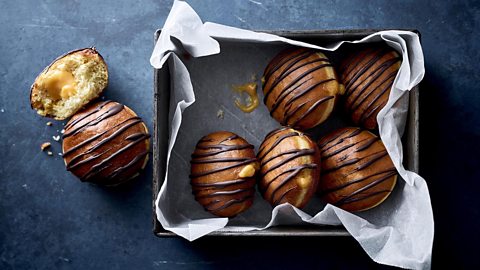
The annual limit also applies to a food emblematic of the holiday season, the freshly-fried doughnut.
“It is rich, over the top, throw away the rulebook food, something to look forward to having once a year, and yearn and pine for it the rest of the time,” says Sarit and Itamar in their introduction to their orange and whisky filled doughnut recipe.
“We like to vary our doughnut game, and everything from drop doughnuts to proper yeasted ones makes us happy,” says Sarit. Drop doughnuts can be made from a cake-style batter, as in Anna Haugh's cinnamon doughnuts recipe, a fairly runny batter as in a funnel cake or even a delicate ricotta batter such as Nigella's sambuca kisses. In Itamar’s household, “they would have zalabiya which is a kind of Yemeni drop doughnut dredged in loads of syrup."
So what’s the secret to making a great doughnut?
Whatever type of doughnut you're making, "they all must be eaten as close to frying as possible," says Sarit. Rule number one, stay near the pan.
For yeasted doughnuts, allow the dough to prove overnight in the fridge. This gives the dual advantage of a deeper flavour and breaking up the prep time. Shape the dough into neat balls and allow it to warm up over two hours for its final prove.
“It’s really important with yeasted doughnuts to let them prove fully before cooking, until they are just about to collapse."
It is also important to heat the oil to the right temperature (around 175C) so the doughnut cooks and crisps without burning or being raw or oily. You can also check the oil is hot enough by popping a tiny amount of dough in, “it should just fizz a little, but not boil like crazy”. It isn't necessary to use gallons of oil. Do use a large pan, with a lid, and fill to a depth of 5cm/2in.
When the doughnut is cooked on both sides, there should be a well-defined white waistline around the middle. "If you don't see the band of white dough around the centre, you need to let the remaining doughnuts prove for a little longer before frying!"
If you don't have a piping bag to fill the doughnuts, you can always slice them in half and spread in the filling "like a doughnut sandwich". "The filling should have a distinct flavour," says Sarit. Jam doughnuts are a classic (“preferably strawberry”) but a smooth custard, a fruity curd or a chocolate spread can also work.
Salt beef
One non-fried food that Sarit associates with Hanukkah is salt beef. Brined over several days, the beef is gently boiled for hours until completely tender. Then it is sliced for sandwiches, or served with potatoes.
“In my household, we would always have salt beef and latkes, a true eastern European treat,” says Sarit. “It’s almost too bad for your heart to believe, but it is oh so good.”
Sarit's mother would start brining the meat in a large tub ten days before it was eaten. “The process was amazing,” says Sarit. "She would flip it over every couple of days in a salt solution, seasoned with bay and allspice, before boiling it for hours. These days she takes the shortcut and gets it prepared from a butcher. It has never been the same."
Sarit and Itamar seek out salt beef via post or deli but also love getting it in a bagel from Brick Lane in London. Making your own salt beef does require space, a very cold room or large fridge to keep the brining beef. After this stage, it is very forgiving and can sit in the fridge for several days making holiday sandwiches. It could become a new holiday tradition.
The Hanukkah supper club Sarit and Itamar are planning will certainly include all of these classic treats from their family traditions. "We'll maybe spin a dreidel or two and play some traditional songs and games revolving around candles. We love Hanukkah!"
What is Hanukkah?
Hanukkah (or Chanukah) is a Jewish festival, commonly referred to as the Jewish festival of lights. It lasts eight days, commemorating the re-dedication of the Temple in 165 BC by the Maccabees. It is marked by lighting a nightly menorah, gifts, prayer and feasting on special Hanukkah recipes with family and friends.