The game changing tactic housemates are using to end kitchen wars

By Izzie Cox
There are loads of great things about house sharing. Like someone always being in to sign for your parcel. The ease of borrowing a pen/charger/tenner. Splitting bills multiple ways to make them (somewhat) more achievable to pay.
But then there’s the issue of the kitchen. That hotbed of gripes, arguments, under-breath muttering and fridge notes dripping with passive aggression.
After a decade of living in shared houses, I’m well acquainted with many of the common frustrations, from dirty dishes piling up in the sink (I will not cave and wash them this time), to vanishing milk, all the hob rings being occupied whenever you want one, and someone else’s chilled goods encroaching on your designated fridge space.
Rosie Kellett, author of cookbook In For Dinner, is also an expert in navigating kitchen-based houseshare etiquette. She gained thousands of Instagram followers as she documented cooking in a warehouse where she lived with six housemates.
Rather than fighting over the oven and kitchen space, they used a system of shared food, cooking and cleaning and were all the better for it – financially and socially. Plus it freed up time.
Makes sense, right?
If you’re over the kitchen being an etiquette crime scene and instead want to cook up some peace and love, Rosie and I suggest you try teaming up with your housemates on dinners.
Here’s how to master communal cooking.
Work out a budget that everyone agrees on
If you’re used to shopping for one, it might surprise you how much more cost-effective it can be to team up on groceries. Rosie and her housemates paid £25 each for their weekly shop, a price that seems almost unbelievably low.
“People are quite skeptical about whether £25 actually works but it did – and it still does. We bought everything in bulk at the supermarket which made it way cheaper,” says Rosie.
To put this into context, I looked at rice in three supermarkets and found you can make an average saving of 93p per kilogram when buying a 10kg pack versus 2kg.
So, talk about budgets together. Decide on the type of food you want to eat, then start looking at prices, remembering to check larger pack sizes. From there you can set a realistic cost that everyone is on board with.
Be clear about routine and responsibilities from the off
More than once I’ve cooked for an entire houseshare, only to be left to tackle all the washing up afterwards too.
When people feel like they’re doing all the heavy lifting, resentments are sure to start simmering.
When it comes to working out your cooking and cleaning system, “You need to make expectations really clear at the beginning,” says Rosie. “Communication is key. Things like who’s in charge of the washing up, it’s just good to get that decided before you jump in.”
Sit down with your housemates and decide how often you want to eat together and who’s going to be in charge of which job each evening.
Rosie’s group had regular house meetings where people could bring up anything they were unhappy about, which helped to avoid big conflicts.
Related stories
Quick curry sauce | Save to My Food
A versatile sauce that can be used with different veg and proteins

Keep it flexible
In all of my house shares, at least one person did shift work, which meant we were like ships in the night.
Currently, two of us are on the same schedule while the other works evenings. So, two of us will cook together and save a portion for our other housemate to have for lunch or dinner the next day.
You need to build in flexibility to your cooking system, agrees Rosie.
“Each day, whoever was cooking would ask on the group chat ‘who’s in for dinner?’. And if you weren’t going to be in but still wanted food, you could ask for a late plate, so some was saved for you.
“Some nights, nobody was in and so no one cooked, and other nights everyone was in but we decided to get a takeaway. It wasn’t rigid because it just couldn’t be. Everyone worked different schedules.”
Plans can change late in the day. So I always plan a meal or two which uses store cupboard or freezer ingredients, meaning it’s no biggie if it needs to be postponed.
Go for customisable dishes
As a veggie, I’ve converted many tofu haters, but I also understand the importance of making sure meals are accessible to everyone.
I’ve lived with and cooked for vegan, veggie, meat-eating and coeliac housemates in my time, so making versatile dishes really helps.
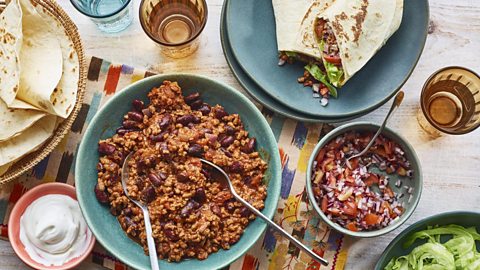
Tacos are always good all-rounders, I’ve found. Corn tortillas, guacamole, salsa and two proteins: one meat, one veggie.
Keep some treats for yourself
I’ve never felt more betrayed than when I returned home from work hungover to find that my housemate had eaten the leftover pizza I’d been looking forward to all day.
Repeat after me: you do not have to share everything.
“I had very strong feelings about olive oil and a specific brand of peanut butter,” says Rosie. “And loads of my housemates were very passionate about ice cream, for instance, which I don’t really care about. So we all bought things that were important to us and labelled them.”
If anything had a label it was out of bounds, otherwise it was fair game. My current house has a similar vibe here: we each buy our own treats and snacks and keep them separate from the communal food.
Slow cooker vegetarian tacos | Save to My Food now
Tacos are easy to adapt and scale up or down
Teaming up with your housemates in the kitchen might be a good idea on lots of levels. But you don’t have to go all in right away.
“Sharing one meal a week is a really good place to start,” says Rosie.
Originally published November 2025
Want more? Visit BBC Food on Instagram, Facebook and Pinterest or watch the latest Food TV programmes on BBC iPlayer.