| Memories of Bessemer | |
| 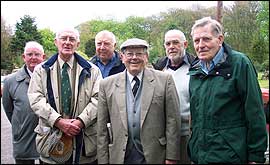 | | Reunion of former Bessemer colleagues on the BBC bus |
| | Some former Bessemer employees came to the BBC Bus to tell us about their memories of working at Bessemer. Dangerous...hot...noisy...
these are some of the initial thoughts that came to mind when stories were related to us. |
| | SEE ALSO | | | | | WEB LINKS | | The Bessemer Project
Find out more about this project Kelham Island Museum
Sheffield Industrial Units Trust website Biography of Henry Bessemer
Find out what made the genius tick Sir Henry Bessemer F.R.S
An autobiography
The BBC is not responsible for the content of external websites. | | | FACTS | | Sir Henry Bessemer patented his new cast steelmaking process on 17th October 1855. By 1885 about a fifth of the steel produced in the UK was manufactured in West Cumbria. In 1917 King George V and Queen Mary paid a visit to the Workington Steel plant. Queen Elizabeth II opened the new Bessemer Memorial Trainig School on 17th October 1956 to celebrate the centenary of Henry Bessemer's invention. Steelmakers worked in very close proximity to molten steel at temperatures of 2000°C The last steel was produced by the Bessemer Steel works and it closed in 1974. The only surviving Bessemer converter is housed at Kelham Island Museum in Sheffield. | | | PRINT THIS PAGE | | | View a printable version of this page. | |  |
| | When you've read their memories, why not add your own? Ron Tinnion
I started in the Bessemer after completing my army service in 1948 as a metallurgical observer. In 1956 I became a shift manager, then later on I transferred to the traffic department. My first memories were that it was very noisy and very energetic. It was a repetitive process - you used to make a cast or a heat as we used to call it every half hour. The molten liquid iron was poured into the Bessemer converter which was an eccentrically shaped vessel. This laid in the belly of the vessel, then compressed air was put into the bottom of the converter.
|
| Ronnie Burrows
It was very noisy, hot, dirty, and in those days there were no showers - you took your muck home with you and we had no baths in them days even at home - you just got yourself as clean as you could. We worked in our old clothes - the final place for a set of clothes was the steelworks, where they either got burns on them or were beyond repair. There were lots of splashes of metal flying all over the place and at times when we were making the ingots, we couldn't close the ladle off when you moved from ingot to ingot - that was what we called a flying stopper - it was all over the place. If there was any water about it used to fly like the devil. In the very early days I got a burn on the left hand side of my face. I went to the health centre and they put some gentian violet on it, so I had a birth mark on my face. The action prevention side of the work was nothing like it today. We worked the whole time in the Bessemer without eye protection or ear protection. In those days we did get steel helmets that were actually miners' helmets. I always wore mine very religiously. There were bits coming off cranes catching my shoulders and arms, and my head got cut with just a very small washer which the tradesmen left upon the cranes. The weather conditions used to control the thing entirely. The tide used to come over the wall and the south westerly wind used to belt in and flood the casting shop, so we had to contend with that. When the converter was put up, the terrific shower of sparks that came flying down the shop normally wouldn't reach us at the casting stage, but when the wind came from the other quarter - what we say "down the shop", you got it from both ends but we used to manage to go behind the girder. | Bill
I started working at the Bessemer steelworks in 1958 until it closed but still worked in the steelworks until 1988. There were a few departments and you started at the bottom then climbed your way up the ladder. I started as an electrician on A1 Arc Furness. Then I was moved to the Bessemer. It was a dangerous and dirty place. A team of good men worked there. There were a few bad accidents - one was when they were pouring the metal out of the converter with the ladle and the ladle somehow came loose from its fittings and tipped the molten metal out onto the men underneath. Some people were killed - one outright and another died in the hospital. There were a lot of sad people who lost their jobs when the Bessemer was closed. There used to be about 5000 people working there when I was there. | | Our own BBC Bus driver Geoff Moore also recounted his memories of working at the steelworks. Geoff Moore
I was an apprentice welder in 1973 at the Bessemer training school. But I only stayed for 2 months as I joined the Navy. One of the things we did was we had a block of metal and had to take an inch off all round with a hammer and chisel, file it flat, then this piece of metal would end up in a small vice. We learned how to wire plugs, weld, pipe fitting, health & safety and had a day in technical college. It was a basic introduction to the industry. It was very noisy and dirty. The rails they made would be red, then they cooled and turned black, but were still extremely hot - we were warned about the black metal still being red hot. The place was massive. The smoke from the converter would light up the sky and fill it. I remember that from being a kid - you could see it for miles. |
Comments The form - Add your comments to our pages... | | | |
|
|