17th and 18th Century alterations
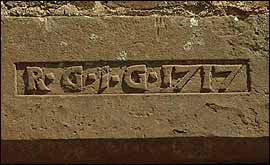
Nothing is known of any physical expansion of Brackenhill Tower in the 17th century. The persecution and transportation of the Grahams to Ireland at the beginning of the century would have weakened and impoverished the family so this probably accounts for this period of apparent peace and quiet. By the 18th century, the fifth Richard Graham (around 1717) constructed brick cottage buildings to the southeast of the tower. These are the earliest signs of the site being consolidated. There is no evidence of the sort of alterations which would have been expected e.g. the enlargement of windows, when what was essentially a medieval tower continued in use as a Georgian house. One alteration is the insertion of the present west doorway of the basement and possibly the superstructure of the tower at attic lever as the two end chimneys look to be of this date (similar to those of a mid 18th century farmhouse). It remains uncertain whether the roof trusses are contemporary with the stacks or were later alterations in 1860. The caphouse and end stack may have been reconstructed in the 18th century, but are probably little different in character from the originals. Towards the end of the 18th century the property was sold to the Stephenson family, who built 'modern' additions of a dining room and kitchen. The Stephenson family name changed to Standish.
19th Century
In 1860 the tower and the Southeast Wing seem to have adjoined corner-to-corner, with a physical internal link. Although by 1860 Whellan's History related simply that the tower was 'kept in good repair by the proprietor' its seem the tower must have remained in used a dwelling until at least the time of the construction of the farmhouse and that the Southeast range performed some subordinate function, perhaps as a kitchen/service wing that probably replaced a medieval of 16th century predecessor. The tower acquired a porch entrance in 1860 which sits at the front of the original 1584 tower. In the 1860's the tower and 18th century cottage were linked together by extensions to make a Hunting Lodge or Shooting box. The ground of Brackenhill contains a planned hunting landscape, which is of major significance. It was specifically designed for recreational hunting with cultivated woodland. This was commissioned by the Standish family in this era. At this time the farm was tenanted and the Standish family used the Lodge for a month, usually September. By the turn of the century a private train was hired for the family and servants as well as their hunting, shooting and fishing equipment, which brought them to Longtown for their late summer holiday. This date appears on one of the rainwater heads. What is extraordinary is how careful the Standish family were in retaining the original 16th century features of the tower. The external entrance porch and the additional chambers they added were done sympathetically to preserve original features wherever possible. Local conservation officer Richard McCoy said they were definitely "early conservationists who were unusually far sighted to save the building for future generations". 20th Century
By the end of WW2 the Carlyle family were the tenants and in 1946, when the Standish Estate was put up for sale, the Carlyle's acquired the Brackenhill Estate. The tower and original group of buildings now sit amidst large prefabricated buildings of the diary farm. |