 | 28 October 2014 |

| |
| BBC Homepage | | |
| |||
| Contact Us | | |
NatureYou are in: Cumbria > Features > Nature > There she blows! 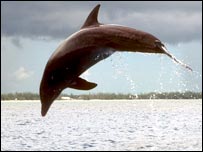 There she blows!St Bees on the West Cumbrian coast is one of the top land-based places to spot dolphins from ... Bottlenose Dolphins - the factsThese widespread dolphins are active and very acrobatic. Life span - unknown. Statistics - Bottlenose dolphins have a body length of 1.9-3.9m and weigh 150-650kg. Physical description - Bottlenose dolphins appear uniform grey, but their colouring can be very variable. They have a prominent dorsal fin, and have a short, well-developed snout which resembles an old style gin bottle (hence its name.) Distribution - They are mainly found in the temperate and tropical waters of Pacific, Indian and Atlantic Oceans. Diet - Bottlenose dolphins feed on squid, shrimp, eels and a wide variety of fish. They often hunt in teams. Behaviour - Like most dolphins, they are extremely social and remain in groups of 1-10 individuals in coastal regions, and groups of 1-25 offshore. Conservation status - Bottlenose dolphins are classified as Data Deficient by the IUCN Red List. Global threats include hunting, human disturbance, habitat loss, prey depletion, pollution, entanglement in nets and collisions with vessels. Dolphins are considered to be one of the most intelligent mammals. About 0.94 per cent of a bottlenose dolphin's weight is made up of its brain. One of the top spots in the country for spotting dolphins is St Bees Head on the West Cumbrian coast - according to BBC Wildlife Magazine. 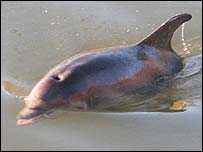 It was off this stretch of coast that Marra the dolphin lived - Cumbria's most famous dolphin - whose story gripped the county in 2006. Marra captured the hearts of the local community in Maryport until the dolphin's sad death. Marra was just one of a number of dolphins that live off the Cumbrian shoreline.
Help playing audio/video From St Bees Head itself you are quite likely to see the Common Porpoise and the Bottlenose Dolphin ... with a little patience that is! Top tips for dolphin spotting
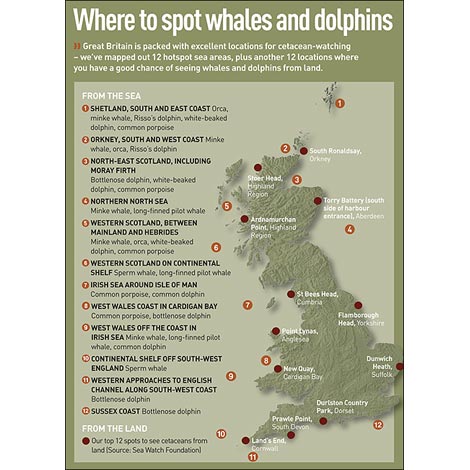 Dolphin & Wale spotting map If you spot a dolphin in Cumbria waters, why not send us a picture at cumbria@bbc.co.uk and we'll add it to our galleries. Watch films from your region from the Nature of Britain series on BBC One.
Help playing audio/video last updated: 15/11/07 [an error occurred while processing this directive] |
| | About the BBC | Help | Terms of Use | Privacy & Cookies Policy |
