 | 24 September 2014 |

| |
| BBC Homepage | | |
| |||
| Contact Us | | |
GeneralYou are in: Cumbria > Features > General > Marra the Dolphin 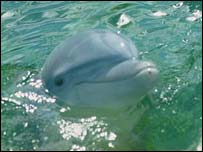 Marra the DolphinRead the full story about Marra, culminating in the dramatic rescue from Maryport Marina ... Bottlenose Dolphins - the factsThese widespread dolphins are active and very acrobatic. Life span - unknown. Statistics - Bottlenose dolphins have a body length of 1.9-3.9m and weigh 150-650kg. Physical description - Bottlenose dolphins appear uniform grey, but their colouring can be very variable. They have a prominent dorsal fin, and have a short, well-developed snout which resembles an old style gin bottle (hence its name.) Distribution - They are mainly found in the temperate and tropical waters of Pacific, Indian and Atlantic Oceans. Diet - Bottlenose dolphins feed on squid, shrimp, eels and a wide variety of fish. They often hunt in teams. Behaviour - Like most dolphins, they are extremely social and remain in groups of 1-10 individuals in coastal regions, and groups of 1-25 offshore. Conservation status - Bottlenose dolphins are classified as Data Deficient by the IUCN Red List. Global threats include hunting, human disturbance, habitat loss, prey depletion, pollution, entanglement in nets and collisions with vessels. Dolphins are considered to be one of the most intelligent mammals. About 0.94 per cent of a bottlenose dolphin's weight is made up of its brain. Marra's storyThe Bottlenose dolphin was first spotted in Maryport marina around Christmas. News of its arrival attracted large crowds, and initial thoughts were of the impact it could have on the town's tourism. Like most dolphins, Bottlenoses are considered social animals, living in groups of up to 25. However experts from the British Divers Marine Life Rescue say it's not uncommon for male Bottlenoses to live alone. Experts from across the UK travelled to the marina to watch the dolphin's behaviour. All night observations were carried out while the marina's lock gates were open, but the dolphin has refused to leave. Specialist underwater speakers were used to try and coax the dolphin back out to sea, and experts at one stage considered building a piece of equipment called a Bubble Curtain, which uses jets of air to stop the dolphins entering the marina. So why did the dolphin refuse to leave?Trevor Weeks, from the British Divers Marine Life Rescue, told us it's difficult to know why the animal wouldn't go back out to sea. "Dolphins are as individual as human beings are. We've had to look at the entire environment, the lock gates, the design of the outer harbour. We feel the the way the gate lies on the bed of the lock may make the dolphin feel unsafe about passing through it." 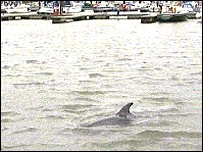 The Dolphin in Maryport Harbour There were fears the dolphin would become sick or even die if it stayed in the marina. Risks like petrol leaking from boats or litter being thrown into the water could have had a serious impact on the animal's health. It's thought there were three other Bottlenose dolphins in the area, out at sea, possibly waiting for their friend, Marra. The rescue of Marra - an eye witness account from BBC Radio Cumbria's Anthony Baxter"Everyone down at the Marina yesterday afternoon will remember what they saw for a very long time - I don't think I'll ever forget it. Such effort to save this creature. The Marina was drained, just enough water to cover the dolphin's dorsal fin. There was a massive crane brought in to hoist the animal off the mud flats. The coast guard was involved, the police, the fire service, the RSPCA, the Whale and Dolphin Society, several lifeguard crews, the list goes on, and although the operation was kept quiet, there were over a hundred people standing in almost silence throughout captivated by what they were seeing. "A team of experts from the British Divers Marine Life Rescue entered the water at about half three and they slowly circled the animal with a net. They eventually captured it, around five men holding the animal still while transferring it to a special dolphin stretcher.
"The dolphin went into what's called captive shock, it started to hold its breath, and I'm told they do this when they're put under a lot of stress. However a vet confirmed that the dolphin didn't need to be medicated, it was revived and returned to sea safely and swam off immediately. "The dolphin's condition began to deteriorate over the weekend. Its skin was breaking down because of low salt levels and it was showing some signs of being distressed, repetitive behaviour. The team of experts observing the animal had tried almost everything they could think of to coax the dolphin back out to sea without capturing it, but it was just too frightened to swim over the Marina gates while they were down in the water. "This is a truly amazing story that has captivated so many people who've visited Maryport Marina over the last few weeks. There will be some people sad to see Marra leave, but I think everyone will agree, it's fantastic that the animal has been returned to sea safe and relatively unharmed after its stay in Maryport." PhotosIf you've taken any photos of Marra you would like to share, send them to cumbria@bbc.co.uk and we'll add them to our dolphin gallery. last updated: 28/09/07 You are in: Cumbria > Features > General > Marra the Dolphin [an error occurred while processing this directive] |
| | About the BBC | Help | Terms of Use | Privacy & Cookies Policy |
