
Last week saw the climax of two of the biggest output ever undertaken by BBC Cymru/Wales Sport, in arguably the busiest year in the history of the department. Both reflected the ecstasy and dark despair of professional sport…. and highlighted the operational challenges we will face as a public service broadcaster in the coming years.
On Tuesday, the Wales football team, led by Chris Coleman and his star names Gareth Bale and Aaron Ramsey, rounded off their Euro 2016 campaign with a 2-0 win against minnows Andorra. With qualification for France already secured, the event at the Cardiff City stadium became a giant public party for Wales to celebrate reaching their first major tournament for 57 years.
Then, on Saturday at Twickenham, Wales' rugby team, led by coach Warren Gatland and captain Sam Warburton, fell just short – agonisingly – in their bid for a place in the World Cup semi-finals. With five minutes left, they were leading two times World Champions South Africa only for a late try by South African Fourie de Preez try to sink Welsh hopes – an all too familiar tale of desperation - so near but yet so far against the Southern Hemisphere giants.
The World Cup lasted five weeks for Wales, while the Euro 2016 campaign started 13 months ago – again with a win against Andorra. The campaigns were very different. But in many ways the challenges in how we deliver the best content for our audiences have been similar.
The broadcast landscape is changing beyond all recognition. BBC Cymru Wales did not have the TV broadcast rights for the World Cup, or for the Euro 2016 campaign, and the way we adapted to serve our audiences has been a fabulous example of how we’ve evolved into a truly Digital First provider, putting our online and social media services at the heart of our commissioning model.
Our journalists, regardless of what platform they routinely work for, are always prioritising Digital platforms – often spontaneously - like when one of our Television AP’s was at the Cardiff World Cup fanzone for Japan’s historic win against South Africa, and decided to grab the crowd reaction for our Facebook account – the video was viewed nearly 700,000 times.
Irish fans celebrate in Cardiff's "Fanzone"
Then that same day, when Shane Williams was seen by a fanatical Japanese fan before a Scrum V interview, the producer thought it was a reaction that had to be captured, and shared on Facebook. That was seen 620,000 times.
We know that short form video on Facebook is a great way to target younger audiences and a successful way of serving people our output wouldn’t normally reach. Our Facebook page is going from strength to strength; only launched this year, it is one of the top ten pages across the BBC, ahead of the likes of BBC One, Radio 1, Eastenders and Strictly Come Dancing. BBC Wales Sport content, via Facebook, had a reach of 5.1 million (that’s how many times our content appeared in people’s news feeds).
And it’s not just Facebook where we’re excelling. Our Twitter accounts are growing rapidly. Scrum V has now passed 80,000 followers, and BBC Wales Sport has 56,000.
We may not have been the primary rights holders for Euro 2016 or the World Cup, but the content we shrewdly gathered pre and post-match around the games paid dividends. It’s about understanding the audience and identifying the content that captures the public imagination. Live TV sport remains king but consumption is all about spontaneity and mobile devices. The Scrum V daily podcast was a big success, and a model worth considering for future major events. With the Euro qualifiers - no TV rights - we’ve focussed on offering our audience something different – so when we gather emotional and sobering mixed zone interviews after matches and published them immediately on our online and social media platforms – reaching the widest and fastest growing audiences. The tweet of Gareth Bale’s reaction to qualifying for Euro 2016, after their defeat in Bosnia, gained more than 300,000 impressions.
Of course, there is a digital audience away from Social Media, and last week we also enjoyed our most successful week ever on our website - 3.2 million unique browsers in a week. Not surprisingly our two top stories were from Euro 2016 and the World Cup.
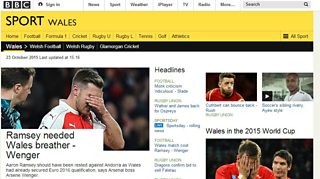
The latest sport coverage from the BBC Cymru Wales Sport Website
On some assignments, mobile phones have replaced traditional PSC craft cameras. But we’re not moving completely away from our traditional methods; far from it. Scrum V Rugby World Cup specials have been a huge success, delivering audiences of more than 200,000, and a reach of up to 17%, consistently and comfortably ahead of network. Our radio coverage of the Euro 2016 qualifiers and World Cup has offered people a real and credible alternative to Sky and ITV’s coverage.
We’re concentrating on the platforms where our audiences consume content. Lee Selby's recent World Featherweight Title defence in Arizona was a great example. Traditionally, we'd prioritise radio and TV. This time, we identified a huge potential audience on social media and other digital services, and sent a team to particularly focus on this, while still offering content to TV and Radio. The fight was in the early hours of the morning, but our engagement on social media was impressive. One tweet, pre-fight, gained more than 200,000 impressions, greater than any potential linear audience we could hope for.
We've made huge strides in the last 12 months. This year has been an historic one for Sport in Wales, but it's one that may have given BBC Wales/Cymru Sport something of a blueprint for the future of covering the biggest Sporting events and delivering content to the widest possible audience.
We've made a start. We can't afford to stand still.
