
All nations have their own folk traditions, particularly at important times of the year. Wales is no different. From the ancient custom of Plygain on Christmas morning to the appearance of the Mari Lwyd each New Year, our country has a rich and fascinating range of folk customs, and nowhere is that more apparent or more interesting than in the traditions relating to food and drink at this festive time of the year.
Wassailing has always been thought of as an English custom, based mainly in the cider producing regions; a toast and a drink from the wassailing bowl was meant to bring good health to people, crops and animals. In the late Saxon period and the Middle Ages the wassail cup would be filled with cider, which most householders then fermented, and carried from house to house and from street to street as everyone took their share of the offering. The original name for wassailing - ‘waes hael’, was an Anglo-Saxon term meaning “be healthy” and the whole purpose of the activity was to wish good fortune to the community.
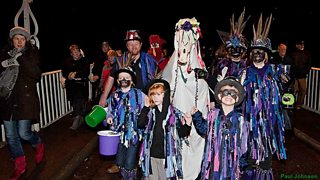
Wassailers by Paul Johnson
Yet wassailing was also common in parts of Wales, particularly in the border areas to the west of Offa’s Dyke. There, presumably, cross cultural traditions were both fertile and common, despite the restrictive nature of the dyke. Both sections of society learned from each other and, even now, in Chepstow a new tradition or a coming together of both English wassailers and the Welsh Mari Llwyd has recently been set into motion.
Wassailing has also been practiced on the Gower peninsula which - after the coming of the Normans, like Pembrokeshire to the west - always had strong English connections.
The Gower wassailing bowls were usually made from elderberry boughs and the contents consisted of a mixture of wine, sherry, cider and beer, all topped off with a layer of bread or apples that were coated with beaten eggs. In days of short rations the toppings were just as popular as the alcoholic content of the wassailing bowl.
The Gower wassailers sometimes painted their faces black or wore masks and, occasionally, even dressed as women. The tradition has definite shades of the later Rebecca Riots - except that the Gower cross-dressers were called Bessy and carried nothing more lethal than a broom.
The strength of the old Welsh traditions can be judged by the fact that many of them survived the rigours of Oliver Cromwell’s Commonwealth despite the Puritans steadfastly refusing to make merry at Christmas time. One of the traditions to be maintained was that of making Caroller's Broth - Cawl y Carolwyr in Welsh.
Caroller's Broth was a tradition that originated in north Wales, possibly from the Treweryn area. The broth was made from either lamb or beef, depending on what was available, and was given as a gift to people singing Christmas carols around the houses – in itself a derivation of the old wassailing custom. Potatoes, onions, carrots, honey and celery were included in the mixture – as well as a large helping of cider.
Making Welsh White Christmas Cake was another old tradition, the cake having none of the ingredients like demerara or treacle that make the usual Christmas cake so dark. It is easy to see the reasoning behind the creation of the recipe, as sugar was very expensive and beyond the means of many ordinary people although they usually did manage to top the cake with a layer of glacé fruits and nuts.
The making of Taffy was once a common practice. It was usually done on Christmas Eve when women were waiting for their menfolk to come back from the traditional Christmas Plygain in the church or chapel – a service with unaccompanied singing in three, or four-part harmony that sometimes lasted for three or four hours. Toffee would be boiled up in an open pan on the fire and then dropped into ice-cold water. It immediately curled into various shapes - some of them were like letters which the unwed girls would interpret as the names of the men they were going to marry.

Christmas pudding by iStock/esp imaging
One of the more unusual Welsh Christmas customs concerning food comes from Monmouthshire. A Christmas pudding would be impaled on the horn of a cow which would then be frightened into running around the field until she threw off the pudding. If it went forwards it spelled a good harvest and if it fell backwards the outlook was decidedly poor.
A recipe from Penarth, dating from the end of the nineteenth century implored people to make Christmas pudding sandwiches! Thin slices of the pudding were to be layered between two slices of bread and then eaten cold. The recipe was not a success and died with its creator.
Food and drink have always been important at Christmas time, particularly in rural regions like pre-industrial Wales. They signified fun and enjoyment at the darkest time of the year and, after the four week fast of Advent, were a welcome diversion to what was really a very difficult and bleak existence. That is something worth remembering when we sit down to this year’s Christmas lunch.
