
The service files of several million WWI soldiers were destroyed during the Blitz in WWII. This is one of the many problems faced by historians researching the stories of soldiers who fought during WWI. Here, genealogist Cat Whiteaway explains how she overcame this issue when uncovering the story of one Welsh soldier.
It began with an email from John Roach from Swansea, who provided the autobiographical details surrounding the military service of his father, Sapper David James Roach, 92519 of Royal Engineers:
"My father signed up for the duration of the war. He served in the Somme, Ypres, Mametz Wood, and Cambrai, my research is ongoing. I hold several photographs taken in this country and in France and other objects."
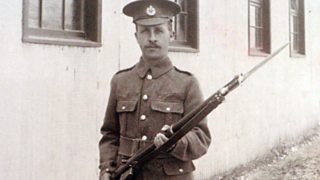
Sapper David James Roach, 92519, RE. Image courtesy of John Roach
John has vivid memories of his father and of the WWI stories he had been told. Apparently his father had signed up in 1914 and completed his training at Abergavenny and also Shrewsbury.
He served with the Royal Engineers right through the war, seeing front-line action. That he survived major battles including Ypres and Mametz Wood is in itself not much short of a miracle. He suffered shrapnel wounds but John did not know where or when or how.
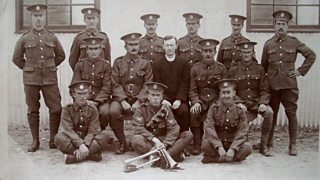
Sapper D J Roach, seated front row bottom right. Image courtesy of John Roach.
Sadly, Sapper Roach's service file was destroyed during the Blitz in WWII and there is not enough left of his file to even form part of the burned series, which meant that John had two unanswered questions:
- Where and when did his father enlist?
- Where and when did his father get injured?
However, he did have his service number, his three campaign medals, several photographs and some unique trench art, which included some hand-carved bibles made from the pews of the bombed-out Cathedral at Ypres. Quite incredible.
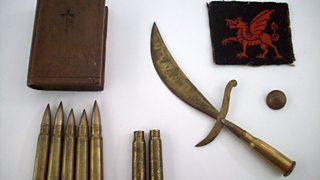
World War One artefacts. Image courtesy of John Roach
WWI trench art, including spent (not live) cartridges carved with the name Ypres and a "sabre" created from artillery shells as shown above, was usually made simply to relieve the boredom during long hours waiting in the trenches.
John also has several very poignant stories about the time his father served during WWI and I quickly decided he would be a very special guest to invite into the BBC Radio Wales studio on 7 August.
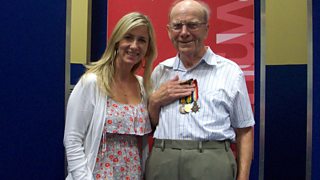
Eleri Siôn with John Roach, proudly displaying his father's medals
Sapper David Roach was an explosives specialist, a skill he acquired during his time as a stone mason before the war. This meant that he was much in demand and frequently moved from one battalion to another depending on their specific needs. However, this fact also meant that it was difficult to identify any one particular war diary or company to investigate in order to try and find the answers to John's questions.
Even if a war diary could be found all too often they are full of military abbreviations, map references and statistics, which although vital at the time does not give us the personal names and the ensuing stories so much desired by their descendants.
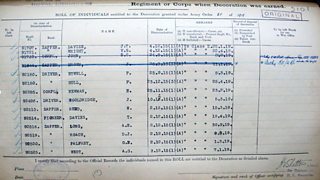
1914-15 Star Medal Roll confirms Roach's entitlement to the 15 Star Medal. Courtesy of The National Archives (Ref: WO95/2579)
This image confirms that Sapper Roach landed in France on 2 December 1915. Just three and a half weeks later and he would only have been entitled to the British War and Victory medals.
It also confirms that Sapper Roach served for the duration of the war and on 8 February 1919 he was transferred to Class Z. This was a contingent consisting of discharged soldiers held in "Reserve" just in case of further problems. Class Z reserve was abolished on 31 March 1920.
There was just one possible angle that could be explored in order to try to answer John's question about his father's enlistment details.
If Sapper D J Roach was number 92519 then surely it is possible that the service records of the men standing either side of him in the line might have survived and if they served alongside each other that would enable us to trace their WWI footsteps.
So I enlisted the help of my brilliant and pedantic brother Tim who set about creating a list of all the Royal Engineers with service numbers close to Sapper D J Roach's number of 92519:
92516 Long, Albert E
92517 Beavan, Albert — enlisted 8 April 1915
92520 Palfrey, George C
92536 Tresize, Fred G — who was a Cornish lead miner
But none of their service records survived. All had been burned during the Blitz, presumably tied up in one safe bundle.
And then a small glimmer of hope.
92538 was Sapper David Sidney Williams. Crucially, Sapper Williams (who was a clerk from Port Talbot in civvy life) was plucked out of the ranks and sent for officer training in December 1917. This meant that his service record was stored in a different place and had survived.
If Sapper D S Williams 92538 enlisted on April 14 1915 in Abergavenny and Albert Beavan had enlisted on 8 April then there was a very good chance that Sapper D J Roach 92519 enlisted between those dates.
Which just left one unanswered question… how and when did Sapper David James Roach get injured?
To find out more join me and Eleri Siôn on BBC Radio Wales on Wednesday 24 September between 2-3pm.
