
Having decided early in life that all things slithery, scaly and feathered were what floated his veterinary boat, Lance has specialised in those species which many people consider unusual as pets.
From 15-foot pythons to 53-year-old terrapins, and parrots to coatimundis (a South American member of the raccoon family) there's nothing much which fazes Lance when it appears in the consulting room.
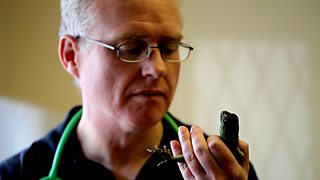
Lance Jepson
So if Flopsy, Mopsy, Cottontail or Peter is feeling a bit under the weather, it's worth going to see someone who's got the specialist knowledge your pet needs.
This can include filing a bunny's teeth down - a common procedure as some don't wear them away evenly when they chew, which can cause all sorts of nasty problems - to removing a sperm stick from a guinea pig, which looks as painful as it sounds, but Lance assures me the poor animal feels very relieved afterwards.
During our week of filming with Lance, we expected some weird and wonderful experiences. A highlight for me was being allowed to film inside the monkey enclosure at Swansea's Plantasia tropical pyramid.
The cotton-top tamarin monkey is a critically-endangered species, with only a few thousand surviving, so it's important that the colony at Plantasia receives the right veterinary care. Lance had been called to do an on-site health check on one of the monkeys, which appeared to have a leg injury.
To have captured the animal to bring into Lance's clinic would have put stress on the monkey, and it may have been rejected by the others when returned to the enclosure.
Being able to see it in its own environment meant that Lance was able to observe whether the injury was likely to be infected, or cause long term problems, and there was no risk of the colony attacking the weaker member.
The trip went well, there didn't seem to be a serious problem with the monkey's leg, and none of the tamarins tried to poo on the crew, which I'd been told was a potential risk when entering the enclosure. They are apparently very territorial creatures, I like to think they knew Lance was there to help them!
We also wanted to film some of Lance's patients in their homes before they came to see him in clinic. One lovely lady, Kirsten, introduced us to her herd of African pygmy hedgehogs.
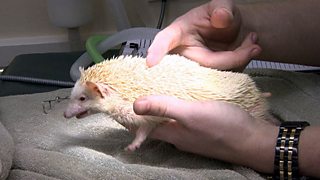
Treating a hedgehog
Each of them has a name and a personalised hutch, and Kirsten's allocated a whole room in her home to their care and comfort. She brought one of her favourite hogs, Theia, a champagne-coloured hog with bags of personality, to see Lance because she was concerned about a lump she'd spotted on Theia's mouth.
Lance operated to remove the lump, which was a stressful time for Kirsten who'd feared the worst. The mass was tested though, and Kirsten was delighted to find out it wasn't cancer, which hedgehogs can be prone to.
What was truly inspiring working on Vets 24/7 was the love and devotion all the owners showed their pets. Kirsten was typical of that. Theia may not be as cuddly as a kitten or able to go on long walks like a dog, but to Kirsten all her hogs are special and unique and deserve the best possible care and attention. And that's what being a responsible pet owner is about.
Rachel MacManus is the shooting director of Vets 24/7, which returns to BBC One Wales on Monday 2 September at 7.30pm.
