
Exciting news this week revealed archaeologists think Offa's Dyke may be 200 years older than previously thought.
Until the discovery it was thought to have been built by King Offa during his reign between 757 and 796. But, crucially, there is no firm archaeological evidence to support this.
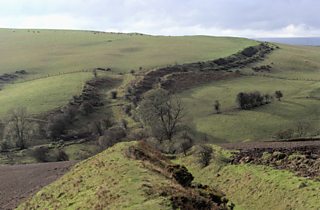
Offa's Dyke. Photo: Homer Sykes
It is the longest linear earthwork in the UK, and one of the longest in Europe, stretching for 177 miles (285km). The modern boundary between Wales and England closely follows much of the route of the dyke.
The discovery by Clwyd-Powys Archaeological Trust now dates the earthwork to the second half of the 6th century.
Despite this new revelation, the Trust says, “Further work is needed on other parts of this enigmatic monument before we can really say who built it and why" - which leaves the door (and ground) wide open to more expansive theories behind the dyke’s creation.
In places the dyke is 88ft (27m) wide and 8ft (2.4m) high. It is scarcely believable that such a huge earthwork could have been created by human hand without the aid of mechanical earth-moving equipment.
So, what if it’s not a monument at all? And the question is not who built it, but what (and how)?
Siôn Griffiths obviously had the same thought and got in touch with an intriguing new avenue to research;
@evilshemp
“it's clearly made in prehistoric time by a 'Graboid' that lived in Wales
#Tremors”
Clearly it is, but prehistoric? This didn’t seem likely, as the earliest
known film of the terrifying subterranean creatures only dates back to 1990.
However, some initial research revealed a graboid (Caederus, C.americana) fossil was thought to date from the Precambrian Eon (source: Tremors 2).
Until it was realised no life existed on land then.
The date of the fossil was subsequently revised to the Devonian period, during which time prey large enough to sustain the gigantic terror worms would have existed.
This geologic period ended some 360 million years ago, long before the new earlier date of 430 for the creation of Offa’s Dyke.
So, the timeline still fits. Graboids could have created the dyke in prehistoric times.
But Griffiths then appeared to cast doubt on his own theory; @evilshemp: “Would the soil in Wales facilitate their movement? As most of their sightings have been in dry landscapes”
This could be the deciding factor. Graboids are a sandworm, so could they thrive in wet Welsh soil?

Could graboids thrive in Welsh soil?
The British Society of Soil Science seemed to think not;
@Soil_Science "#soil of Wales might put your Graboids off, certainly would stunt their growth and limit movement!"
It’s true that graboids need loose soil to ‘swim’ through.
But this wouldn’t be the first time a non-native subterranean beast has been found on the western side of the dyke.
Which leads onto an even more chilling possibility – what if graboids have mated with the alien flesh-eating ghost slug (Selenochlamys ysbryd), creating an almost invisible hybrid?
That would certainly explain the current lack of sightings of graboids in Wales.
Spotted evidence of graboid activity in Wales? Could any other famous landmarks have been created by the creatures? Let me know in the comments below or via #WelshCryptozoology and I'll do my best to research any sightings. Possibly.
