Tryweryn: 50 Years On
Dr. Wyn Thomas is the presenter and writer of a special new documentary, Tryweryn: 50 Years On, which marks half a century since the official opening of the Tryweryn Reservoir. Here he gives a personal view of how a defining moment in modern Welsh history came about, and how the events should be remembered.
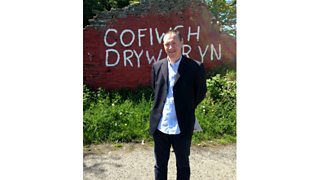
Historian Wyn Thomas with the graffiti reading Cofiwch Dryweryn (Remember Tryweryn), on the main road from Aberystwyth to Llanrhystud
I have spent over ten years researching the flooding of Cwm Tryweryn. The drowning of the valley led in the early 1960s to the obliteration of Capel Celyn, which was home to a Welsh-speaking community. The story has fascinated me and made me angry. But it has also made me question what is truly remembered. I am sure that most of us are aware of Tryweryn and its importance to Wales as a lingering symbol of our subjugation at the hands of England. But is this view too steeped in romanticism? Has the truth been lost in the fog of history?
In preparing Tryweryn: 50 Years On, I believed three key questions needed to be tackled. Why did ‘Tryweryn’ happen? Did it need to happen? And was it worth it - in the sense that, who benefitted from it?
In answer to the first question, we accept that Liverpool, in the post-war period, had a real and genuine need to increase its water supply. The city had some of the worst slum areas in Britain. As Liverpool City Council formulated a slum clearance policy, it was established that Liverpool would soon require 65 million gallons of water every day. Its existing supply was 48 million gallons.
But the Liverpool authorities were not being entirely truthful about their motives. Liverpool also intended to sell large amounts of the water to neighbouring authorities; and much of it would be used for industry.
It is important to remember that not everyone in Wales opposed the measure. For instance, Bala Town Council supported the proposal to flood Cwm Tryweryn, believing it would provide a much needed source of employment in the area.
However the contrary view, as especially espoused by Welsh nationalists, was that this was an imperial act of aggression. Whatever the truth, on 31 July 1957, the Tryweryn Reservoir Bill was passed in Parliament. It soon became clear that, politically speaking, Wales was extremely vulnerable and unable to protect its own assets and resources.

Wyn Thomas interviews one of the Liverpool Welsh, D Ben Rees
Out of this anger emerged two groups as well as more mainstream movements such as Cymdeithas yr Iaith Gymraeg: the publicity orientated Free Wales Army and the militant and audacious, Mudiad Amddiffyn Cymru, or MAC, the ‘Movement to Defend Wales’. And so, as a result of the failure of the constitutional attempt to prevent the drowning of Cwm Tryweryn, Wales witnessed a bombing campaign throughout the 1960s, which is unparalleled in its history.
But could all of this have been avoided? I believe it could have been. For one thing, Liverpool should have been more truthful about why it needed so much water. Furthermore, the situation might have been greatly improved if Liverpool officials had adopted, from the outset, a sympathetic approach, announcing that the drowning of the valley would create jobs and be done ‘for the greater good’. Efforts to help the city meet its increased water needs were made by Welsh parties, both before and after the Tryweryn Reservoir Bill was passed, when feasible alternatives were suggested. But Liverpool rejected every proposal.
And this is perhaps another feature of this painful episode in our nation’s history, which should be considered. Liverpool officials undertook their task with a ruthless detachment; adopting a rather contemptuous and indeed almost imperious attitude towards the local Tryweryn community - if not to say Wales itself.
Yet, if Liverpool regarded the reservoir as a proud symbol of the city’s status, the disparaging attitude of its officials was exemplified by the decision to hold an inappropriate opening ceremony on 21 October 1965. As a public relations exercise, the opening ceremony was a disaster for the Liverpool authorities.

A view of the Tryweryn Reservoir
With the passing of fifty years, yes we should remember the flooding of Capel Celyn, but for the right reasons. Wales did benefit from the flooding of Cwm Tryweryn, both politically and culturally. But for a nation to be progressive and forward-looking, it must not define its identity on grievances and perceived injustices - however real or imagined.
Tryweryn: 50 Years On
Monday, October 19, BBC One Wales, 10.35pm
