
Ghost stories are, in themselves, a fascinating phenomenon. In countries like Wales and Ireland they proliferated in the pre-industrial days of the seventeenth and eighteenth centuries when travel between one place and the next was difficult and dangerous and when the wind and rain seemed to have lives of their own.
Some ghost stories did manage to survive into the more worldly-wise nineteenth and twentieth centuries. In Wales, as industrialisation changed the face of the country for ever, such stories were a way of keeping in touch with a more reassuring and accepting past.
Many of us will remember being gathered around the fire at Christmas time as some aged aunt or grandmother held everyone spellbound with her tales of headless horsemen and shrieking demons. Being sent up to bed after that, the way lit only by a flickering stub of candle, was just one more aspect to the success of the ghost story, be they about murderers or children lost on the marsh, men killed in battle or women heartbroken by the death of a loved one.
Such stories catch the mood of the time, playing on people’s fears and making use of things like flickering candle light and ancient, derelict buildings. From castles and lonely manor houses to the country inns of rural Wales, you will find ghost stories that are based around all manner of buildings.
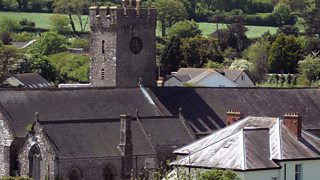
Monkton Priory
In Pembroke, for example, there are – strangely – no ghost tales about the castle but several about nearby houses. For many years in the nineteenth century the Rev Tudor Evans lived in the Old Hall next to Monkton Priory, literally a stone’s throw from the castle. The Priory had been dissolved by Henry V111 in the 1530s but continued to function as a parish church.
The Rev was regularly disturbed by knocking on his bedroom door, almost always at 4.00am. Each time the gentleman got out of bed to see who was there the knocking immediately stopped and he was met only by an empty corridor. Was it a mischievous servant playing a trick on her master or something much more sinister? We will never know.
There was certainly something untoward about the Old Hall. The building had another room which Tudor Evans’s dog steadfastly refused to enter. His daughter also claimed to have seen the head and shoulders of a cowled figure at the window of the same room.
In the nearby church the remains of a kneeling woman were found, bricked up behind one of the walls of the Priest’s Room - a nun, perhaps, from the days of the Priory, someone who had committed a cardinal sin? It makes for interesting speculation.
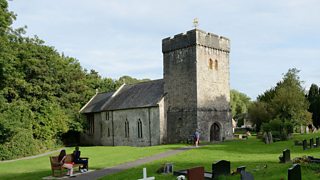
Llancarfan Church
The mutilated body of the fugitive lay, undisturbed, for many years before being discovered during renovations to the old building in the early twentieth century. Interestingly, it is not the ghost of this man who is said to haunt the gardens and grounds but that of his wife, searching relentlessly for her missing husband.
It was not just the Rev Tudor Evans who was disturbed at a specific time of night. The ghost of John Crichton-Stuart, the second Marquess of Bute, is said to haunt Cardiff Castle, a building that he loved dearly and spent thousands on renovating. His apparition is said to pass through walls six feet thick while at precisely 3.45am, heavy doors have been known to slam shut of their own accord.
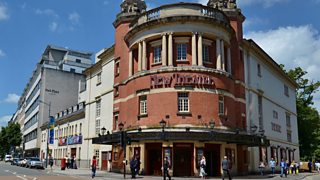
New Theatre
It is easy to scoff at or dismiss these stories as the product of men and women with over-fertile imaginations. Dark passageways, echoing bedrooms and dimly lit theatres lend themselves to such tales. If they are then told with skill and aplomb, particularly as the light fades and night begins to steal across the landscape, then so much the better.
We all like to feel a flutter of fear along our backbones occasionally, particularly as we know such emotions can be dismissed with the coming of daylight.
But in the long gone days before radio and television, the art of the story teller – and, in particular, the scary story teller – was to keep that fear alive and see it passed on from person to person down the ages.
