
These days Dyffryn House and Gardens fall under the remit of the National Trust and thousands of visitors flock to the site every year. Being close to Cardiff but still nestling in the depths of quiet countryside, it is the ideal location for a day out. Yet it was not so long ago that the place was a private residence – albeit one with a long and fascinating history.
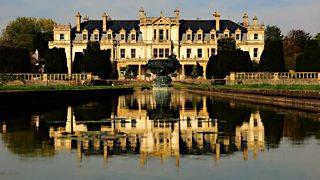
Dyffryn House. Photo: Gale Jolly in the BBC Wales Nature Flickr Group
Situated just outside St Nicholas in the Vale of Glamorgan, the Dyffryn Estate dates back to the seventh century when the Manor of Worleton, which then included St Nicholas, was granted to the Bishop of Llandaff. By the 16th century the manor lands were being rented by the Button family, a house of some sort possibly situated on the spot which the gardens now occupy.
The Buttons were well known in the Vale of Glamorgan, with several different residences in the area at different times. Their principal residency is now the site of Cottrell Park Golf Club. One of the family, Admiral Thomas Button, later became famous as a sailor and explorer, perhaps creating a fascination with distant lands that was to reverberate down through the years and influence the lives of several future owners of Dyffryn House.
The Manor of Worleton changed its name to the Manor of Dyffryn in the 18th century, at about the time that the land was sold to Thomas Pryce. He built the first Dyffryn House in 1749, a typical Georgian building but, despite creating a walled garden and a 'dipping' pool, he did little work on the grounds or gardens.
In due course Dyffryn passed into the hands of Henry Ellis Collins, a man who had made his fortune out of baking. In 1891 the estate was sold to John Cory, the shipping magnate and coal mine owner who had his base in Cardiff Docks. Cory was a self-made man, the family having originally come from the Bideford area of Devon to make their fortune in the booming industrial port of Cardiff and in the coal fields of the hinterland.
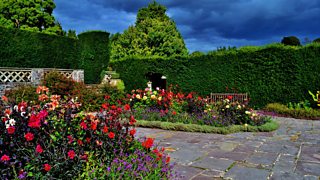
Dyffryn Gardens. Photo by Paula J James in the BBC Wales Nature Flickr Group
Cory began to build the present Dyffryn House in 1893, two years after his purchase. Designed by the architect EA Lansdowne of Newport, the house was largely completed by 1894 – one of the last traditional mansions to be erected in Wales.
It was – and still is – a long, rather narrow building with the main entrance on the north wall. The rooms are high and airy and the ornamental glass windows in the main hall show Queen Elizabeth addressing her troops at Tilbury during the Armada Campaign of 1588.
It was John Cory who laid down the original plans for the gardens. Work began under Thomas Hayton Mawson, first President of the Institute of Landscape Architecture, in 1894. The basic design and layout were largely completed by 1909, the year before Cory's death.
When John Cory died in 1910 the estate was inherited by Reginald, his third son. Reginald was a leading figure in the Royal Horticultural Society, a man who sponsored several plant hunting expeditions to various parts of the world to help develop his gardens at Dyffryn. The famous plant hunter Ernest Wilson brought many specimens to Dyffryn, including the Paper Bark Maple which he had found in China.
By 1912 the enthusiastic Reginald had managed to assemble the largest private bonsai collection in the country. Despite their origins in the Victorian period and development rooted in the first decade of the 20th century, the gardens had become one of the last truly Edwardian gardens in Wales. All manner of exotic plants and trees flourished in the gardens.
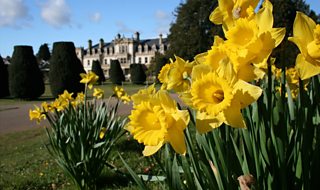
Daffodils at Dyffryn. Photo by welshlady in the BBC Wales Nature Flickr Group
Reginald Cory died in 1934 and the estate came briefly to his sister Florence. After her death in 1937, Dyffryn House and Gardens were bought by Cennydd Treharne but by the beginning of World War Two the place was on loan to Glamorgan County Council as a botanical garden.
In 1973 Dyffryn hosted a party to commemorate the dissolution of the old Glamorgan Council and after the death of Sir Cenydd in 1995 the estate was sold to the Vale of Glamorgan for £300,000.
Over the years the gardens fell into disrepair but the house was used, variously, as a conference centre and as a police training centre. By the beginning of the 21st century, however, it was clear that major refurbishment was required if both house and gardens were to survive.
The gardens were awarded a Grade 1 status by CADW and with the aid of an £8 million grant they were restored to the original design and conception of John Cory. In 2006 work also began on restoration of the house, listed as Grade 2, and in 2013 the whole property passed into the stewardship of the National Trust.
These days Dyffryn House and Gardens are one of the top tourist attractions in south-east Wales. It is a fitting tribute to the men and women who created the estate and proof of what can be achieved if the desire is great enough.
Browse a photo gallery of Dyffryn House and Gardens images on the BBC Cymru Wales Facebook page.
