Rhys Jones's Wildlife Patrol - Just when you thought it was safe to go back in the water....

Ian Durham
TV Producer
Tagged with:
As the series producer of ‘Rhys to the Rescue’ and now ‘Rhys Jones’s Wildlife Patrol', I’ve been working with Dr Rhys Jones for over six years now; and in that time he’s led me into some scary animal scrapes – a close encounter with Africa’s most venomous snake, a deadly spider in a Cardiff garden centre, and any number of heart-pounding animal-related police raids.
So I guess it should have come as no surprise when he came to me during filming for the brand new series of ‘Wildlife Patrol’ and said: ‘I think we should do something on the killer shrimp in Cardiff Bay.’
‘The killer what? In Cardiff where?’ was my alarmed reply – my head filled with visions of vicious blood-thirsty crustaceans taking people along Mermaid Quay.
Rhys explained to me that whilst us humans were currently safe, the bay’s waters were in danger of being overrun by a voracious and aggressive shrimp that had made its way to Wales from Russia and was now munching through our native shrimp, fish and plant life – causing general carnage to the local ecosystem, and worrying the be-gee-bees out of ecologists, environmentalists, and scientists across Wales fearful that the shrimp – currently contained within the bay - would soon break out and infest other waterways. So far, so bad. And it’s worse…

Dr Rhys Jones & Prof Peter Kille, Cardiff Bay
Killer shrimp are classified as ‘alien invaders’; non-native animals and plants that have somehow found their way to Wales and are now happily breeding and in some cases - like these natural prawn killlers – having a negative impact on our native wildlife and ecosystems.
According to latest estimates, we currently have over 2,000 alien invaders in Wales: everything from Aescypalian snakes in North Wales (don’t worry, they’re non-venomous) to the most recent invading incomers – wild boar in South Wales (see episode four of the new series for an astonishing behind the scenes and as-it-happened insight into this latest invasion.)
The bottom line is that in every instance it is us humans who are responsible for these plagues of unwanted pests. Killer shrimp have come here on the hulls of boats; the snakes in North Wales were the result of a single pregnant female escaping from a zoo; and the wild boar were the result of a burglary on a farm. Add to that people dumping unwanted non-native pets (terrapins, guinea pigs, prairie dogs); and the phenomena that scientists such as Rhys now call ‘global weirding’ – warmer waters leading to sharks and parrot fish appearing in Welsh waters – and the threat to what we see as the indigenous Welsh landscape is at its greatest since the last ice-age.
Apparently this isn’t just happening in Wales, but on a global scale too. The worst-case scenario seems to be that every countryside in the world will end up going the way of every high street – in other words, local home-grown species will be out-competed and killed off by bigger, better, more aggressive and adaptable incoming species and eventually the Earth will end up if not a monoculture (humans and nothing else), then a world where millions of distinct species of plant and animal life are reduced to nothing more than a few thousands or even hundreds surviving species.
But that doomsday scenario is not here yet, and science is already fighting back against alien invaders – and Dr Jones is one of those on the frontline.
The reason Rhys wanted to feature the killer shrimp was because colleagues at the Cardiff University School of Bioscience have been developing an eDNA kit to help thwart the killer shrimp, and had invited Rhys to participate in the first trials of this new piece of space-age science.
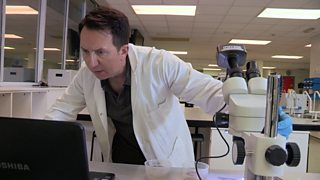
Dr Rhys Jones in the lab
So of course, once Rhys had explained all of this to me, I readily agreed with him that it would make a very interesting story for Wildlife Patrol. Therefore, I gallantly volunteered the programme’s producer, Huw Crowley, to don his prawn repellent wellies and wade into Cardiff Bay with Dr Jones, Professor Pete Kille, and the killer shrimp.
Did they all make it out alive? All I can tell you is that there were some casualties – and if you tune into the new series of Rhys Jones’s Wildlife Patrol, you’ll find out exactly who I mean!
The new series of Rhys Jones's Wildlife Patrol starts Friday 14th August at 7.30pm on BBC One Wales.
