
The paddle steamers of the White Funnel Fleet – in reality the firm of P and A Campbell Ltd – ran excursions up and down the Bristol Channel for over 70 years.
From 1887 until the demise of the last vessel in 1981 they reigned supreme, gaining and holding a position of reverence, even of love, in the minds of many people from south Wales.
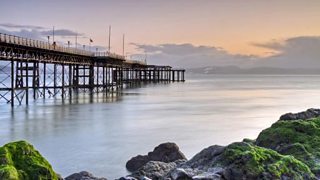
Mumbles Pier image from BBC Wales Flickr copyright Paul Dennis minar5
In that 70 year period, no visit to Mumbles or Barry Island was complete without at least one short trip on the Waverley, the Ravenswood or the Glen Gower.
Pleasure steamers had operated in the Bristol Channel for several years before the Campbell brothers arrived on the scene.
The Scottish-built paddler Bonnie Doon was the first vessel to offer excursions on the waterway, and was chartered by the Bristol Steam Yachting Excursion Company in 1896. The experiment was so successful that the following year she sailed again.
This time, however, the Bonnie Doon had competition. It came from the formidable Captain Alex Campbell and his paddle steamer Waverley.
They had been hired by a rival company. Alex Campbell did not skipper her himself; at that stage he did not have a licence to operate in the Bristol Channel.
The Waverley cruises were so popular that Alex and his brother Peter decided to move their sphere of operations from the River Clyde in Scotland and make their base at Bristol on the Severn Estuary.
Campbell's pleasure cruises
In 1888 the Campbell's, now working for themselves rather than under charter, now began a series of pleasure cruises that would see them rise to a position of dominance on the waterway.
In these early days there was much competition, mainly from the firm of Edwards Robertson, a Cardiff based company that had acquired the Bonnie Doon as well as several other paddlers.
The Campbell brothers responded to the challenge by ordering brand new vessels like the Ravenswood and the Westward Ho. Other companies running excursions to rival the White Funnel Fleet were Pockets of Swansea and the Barry Railway Company.
Strong competition
The Bristol Channel has one of the greatest tidal ranges in the world and in order to embark passengers safely and efficiently long piers were built, reaching out into the estuary, at places such as Weston-super-Mare and Penarth.
From the beginning there was competition between all the steamers and excursion companies to reach the pier head first and so be in a position to take on the greatest number of passengers.
In the scramble for primacy there were many instances of small boats being upset, their passengers tossed unceremoniously into the water.
Overcrowding was another common occurrence. On 11 July 1900 Captain Ashford of the Glen Rosa was found guilty of carrying 797 passengers when his ship was licensed for only 541.
Captain MacCloud of the paddler Scotia was once charged with overloading his vessel by 357 extra bodies. As a consequence, accidents and incidents carried on for many years.
During World War One most of the White Funnel Fleet was requisitioned by the Admiralty for use as mine sweepers. They returned to a country beset with financial burdens and all the problems of the Depression years.
Nevertheless, the Campbell fleet continued to offer cruises up and down the channel, steadily ploughing their way between places such as Cardiff, Penarth, Ilfracombe and Tenby.
Trips to France
It was a rigorous schedule but one that never faltered and they even operated cruises along the south coast of England. From there the paddlers made regular trips across the English Channel to French ports including Boulogne and Calais.
With the outbreak of World War Two, the White Funnel steamers were again requisitioned as mine sweepers. This time the paddlers were more unlucky than their World War One counterparts.
Eleven White Funnel ships were “called up” in the months after war broke out in 1939. Three were lost during the Dunkirk evacuation, the Waverley was bombed and sunk in 1941, and the Glen Avon went down in a gale off the Normandy coast in 1944.
The Cambria and the Westward Ho were so badly knocked about that, at the end of hostilities, they were unfit for further service and were duly scrapped. Only four paddlers returned to cruise the Bristol Channel in the post war years.
The bubble bursts
To begin with there was huge delight from the people of south Wales, with passenger figures even matching pre-war levels. Campbell's introduced two new paddlers, the Bristol Queen and the Cardiff Queen in 1946 and 1947 respectively. But by the early 1950s the bubble had burst.
The accessibility of the motor car, available now to more and more people, and rising fuel costs made the paddle steamer excursion a luxury that many felt unable to risk. More and more ships were withdrawn from service and by the end of the decade only the two 'Queens' remained in service.
The rise of the package holiday
There were several false dawns, the 1960s seeing the motor vessels Westward Ho, the Vecta and the Balmoral entering service. But with the coming of the package holiday and the easy availability of foreign holidays, the writing was soon on the wall.
Passenger figures dropped and continued to drop, not helped by a series of bad summers. The company battled gamely on, continuing to offer cruises until the end of the 1980 season. And then retired gracefully from the scene.
The White Funnel Fleet had been a constant presence on the Severn Estuary and in the Bristol Channel for over 70 years. They were a part of summer holidays and their passing was met with more than a little regret in most quarters. Many young boys had their first taste of the sea on one of their pitching decks. Now they were gone forever.
The Paddle Steamer Preservation Society did manage to step into the breach, running the Waverley (a newer ship than the one lost during the war) and the Balmoral for regular summer seasons. Now even that appears to be in jeopardy as passenger take-up has continued to fall away in the face of easier and cheaper holiday options.
Cruising on the Bristol Channel was once a way of life. It is now little more than a piece of fascinating but distant history.
