
When you think about prisoner of war camps your mind invariably turns to the internment of British servicemen in German camps like Colditz during World War Two. However, there were also many British prisoner of war camps – and not just during World War Two either. One site used as a camp during World War One was Dyffryn Aled, high up on the moors of Denbighshire in north Wales.
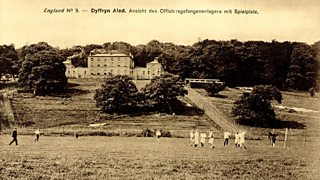
Dyffryn Aled. View of the grounds of the officers' camp (ICRC, UK, no.9)
Requisitioned by the army on the outbreak of war in 1914, the camp was located just outside Llansannan in a house that belonged to Lady Dundonald and her family. The old mansion house was in a reasonably good condition although, as one German prisoner later commented, the roof did leak and his room got rather wet.
That comment alone says an awful lot about conditions in the house and of the regime that was run there. No regimented barrack blocks for these prisoners; they all had individual rooms where two or three men could share the facilities. Food might have been basic but it was filling and as one prisoner commented to the Daily Mail:-
"I cannot say I am exactly happy; I am a prisoner in the enemy's country. But I am as comfortable and well cared for as any man in my position has reason to expect."
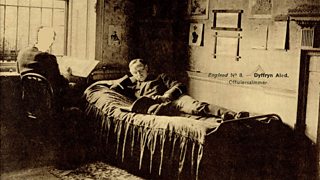
An officer's bedroom at Dyffryn Aled (ICRC, UK, no.8)
Security was relatively low key. Being situated 600 feet up on the Denbigh Moors in a very bleak and isolated position – and in an area where the main language, sometimes the only language, was Welsh – there was little reason to festoon the grounds with barbed wire and guard towers. The environment provided nearly all the security the place required.
Dyffryn Aled held over a hundred German officers, plus a few civilians who had been caught up and interned when war was declared. Most of the prisoners were navy men, many of them submariners, young men who were intrepid and courageous. The local populace viewed them with interest – they were exotic just by being what they were.
The place even had a sports field, on a flat piece of land on the other side of the river from the mansion. The men could use it – guarded, of course – at almost any time during the day, either to play football or just to walk and think.
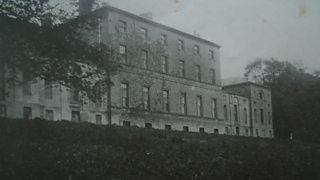
Dyffryn Aled House
One of the most celebrated inmates of Dyffryn Aled was Lt Wolf von Tirpitz, the son of Grand Admiral Tirpitz, Secretary of State for the German Navy and the man who had masterminded the growth of the Kaiser's Dreadnought fleet. Wolf von Tirpitz had been captured at the Battle of Heligoland Bight when his ship, the Mainz, was sunk by Admiral Beatty's battlecruiser squadron.
He had been lucky to survive when the mast on which his spotting position was located was blown into the sea. Adrift in the water for half an hour, Tirpitz was eventually pulled on board a British ship and taken back to England.
Obviously well connected, before war began Tirpitz had moved in fairly exalted company. After his capture, Winston Churchill – then First Lord of the Admiralty – sent a message to Admiral Tirpitz, informing him that his son was safe. The young Tirpitz, who had spent time in Oxford before the war and spoke excellent English, was interviewed by a reporter from the Daily Mail and explained that:-
"I know Mr and Mrs Churchill quite well. I played tennis with Mrs Churchill at the Queen’s Club last summer and lunched with them both."
Wolf von Tirpitz might have been content at Dyffryn Aled but others were not. There are several recorded instances of prisoners making desperate dashes for freedom.
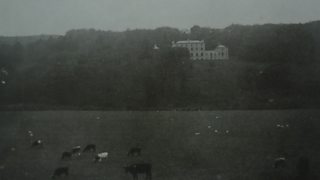
Dyffryn Aled house and slope towards river
On 4 April 1915 two officers managed to escape from the camp. They were loose for seven days before being captured close to Llanbedr in Merionethshire on 11th of the month. Interestingly, both men were then convicted of trying to escape – clearly not considered part of an officers' duty in those days – and sentenced to 28 days imprisonment in Chester Jail.
It did not put off other would-be escapees. Lt Commander Hermann Tholens and Captains Heinrich von Henning and Hans von Heldorf managed to get out of the camp in early August 1915. They walked 20 miles across the moors towards Llandudno – in itself no easy task – and in the early hours of 14th found themselves in the Welsh seaside resort.
Despite knowing little English – and certainly no Welsh – they managed to order breakfast for themselves in a local café before heading up onto the Great Orme. Through ingeniously coded letters home they had already arranged to be picked up by a German U-Boat but although the U-38 was actually lying off the Orme, the escapees could not get down to sea level and after two nights up on the headland they gave up the attempt. They were then picked up by police officers trying to board trains for London.
Like the previous escapees, Tholens, Henning and Heldorf were also charged with and convicted of trying to escape from custody. This time each man was sentenced to three months in Chelmsford Prison before being returned to the prisoner of war camp.
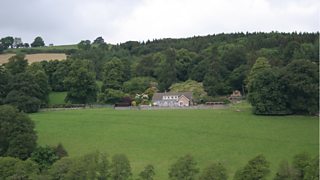
Dyffryn Aled site today
When peace returned in 1918 the camp at Dyffryn Aled was slowly run down and was finally returned to private ownership in 1919.
Although the old house was bulldozed to the ground in the 1960s, a single storey house was built in its place. And the present owner can, at least, be content in the knowledge that the place was once part of a very special piece of Welsh history.
Listen to the Dyffryn Aled camp story with BBC Radio Wales and World War One At Home.
