
D-Day, 6 June 1944. Shortly before dawn, the greatest sea-borne armada in the history of the world anchored off northern France preparing to disembark thousands of American, British and Commonwealth troops onto five pre-ordained invasion beaches.
What followed, in what has since been termed 'the longest day', determined the course of the whole campaign against Hitler and Nazi Germany. It was perhaps the most pivotal moment of the war and thousands of soldiers and civilians lost their lives in one of the bloodiest and most gruesome episodes of the conflict.
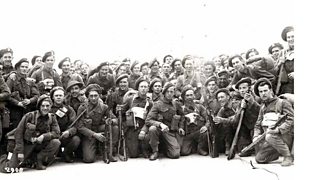
2nd Battalion at Southampton, 5 June 1944. Regimental Museum of The Royal Welsh, Brecon
Among the soldiers packed into the assault ships wallowing in the waves off Normandy, all waiting for Operation Overlord to begin, were undoubtedly many Welshmen - hundreds of them, in fact. They were infantrymen, tank drivers, artillery gunners and the like, all spread over a dozen different units. However, only one specific Welsh regiment had been detailed to take part in the invasion, the redoubtable South Wales Borderers.
The Borderers had come into existence in 1689, originally known as the 24th Regiment of Foot. A renowned and distinguished unit, their most famous moment had been during the Zulu War of the 1870s when, during the defence of Rorke's Drift, 11 Victoria Crosses were won in a single day. Most of them were won by members of the 24th Foot, but despite popular belief, it was only in 1881, after the Zulu War, that the regiment adopted the name South Wales Borderers.
The 2nd Battalion of the Borderers already had the distinction of being the first Welsh regiment to see action during World War Two. In 1940 they had been part of the ill-fated Norway campaign. This time, everyone hoped, there would be a better result.
Now, in 1944, the Borderers were part of the 50th Infantry Division. They had been allotted their role as recently as March and had spent two months in feverish and hectic training, in preparation for the operation. In May, along with thousands of other Allied troops, they moved into the assembly area ready for the assault.
The South Wales Borderers' task on D-Day was to wait until the first waves had gone ashore on Gold, Juno and Sword beaches, the British and Commonwealth invasion areas. Then they would land near Arromanches and push inland from the beachhead to high ground north of Bayeaux.
On their way inland the Borderers were expected to capture a radar station as well as the guns and bridge at Vaux-sur-Aure. Finally, they were to link up with American troops coming from their right. It was an ambitious plan.
During the long morning of 6 June the South Wales Borderers sat waiting in their assault craft as the smoke from the battle rose into the air and the sound of explosions echoed across the water. Then, just before midday, came the order to land.
Two men were drowned in the landing – the same fate nearly befell the CO, so eager was he to get ashore. Glad to be out of the rocking landing craft, the Borderers met little resistance at the beachhead and pushed quickly forward. D Company drove the defending Germans out of the radar station and by nightfall on that first day the bridge at Vaux-sur-Aure was in their hands.
At the end of D-Day itself the South Wales Borderers had captured more ground than any other unit involved in the invasion. Their job was not over, however, and 11 months of hard fighting were to follow, with the South Wales Borderers in the van of the Allied drive through France into Germany.
Their war ended only in May 1945 when Germany surrendered. By then the Borderers had reached Hamburg in northern Germany, a long way from those invasion beaches in Normandy. They were to stay on in Germany as part of the Allied occupying force until 1948.
The South Wales Borderers were absorbed into the Royal Regiment of Wales in 1969 but their history is a proud and distinguished one. The American Revolutionary War, the Zulu War, the Boer War and World War One – the regiment took part in them all.
Their proudest boast, however, has to come from the second great conflict of the 20th century when they were the only Welsh regiment to see action on D-Day and to take part in the mighty Overlord landings.
Learn more about D-Day at 70 on the BBC: download a free interactive book, listen to first-hand accounts and find out about coverage of the 70th anniversary commemorations.
