
The 1920s and 30s were an exciting time in aviation history. Following on from the huge advances that flying had taken during the World War One, post war aviators quickly and easily took on new challenges.
With barely a pause for breath they were soon extending the boundaries of what was possible – and sometimes, given the basic and elementary nature of their aircraft, even trying to do things that were not even remotely within their capabilities.
The Atlantic was first flown by Alcock and Brown in the summer of 1919, Charles Lindberg did it solo in 1927 – and those were just the successful attempts. War aces like Charles Nungesser simply disappeared into the vastness of the Atlantic on his attempt to fly between Europe and America.
It did not stop people striving to achieve and long distance flights were clearly all the rage as flyers strove to claim world records.
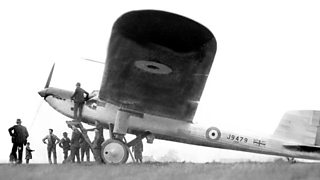
Jones-Williams and Jenkins, 4 December 1929 (Planet News Archive/SSPL/Getty Images)
The names of pilots like Amelia Earhart, Amy Johnson, Alan Cobham and Jim Mollison have gone down in history but two intrepid Welsh flyers have been largely forgotten. And yet, in 1929 they set one of the great world 'firsts' by flying non-stop between London and India.
The two men in question were Squadron Leader Arthur Jones-Williams and his co-pilot Flight Lieutenant Norman Jenkins. Flying a Fairey Long-Range Monoplane – one of two built specifically for the RAF Long Range Development Unit - they set off from the RAF base at Cranwell on 24 April 1929. 50 hours (and 38 minutes) later they arrived at Karachi in the sub-continent.
High winds had delayed their departure from Cranwell and because of the circumstances it was decided to restrict the weight on the plane to 16,000 lbs.
The aeroplane had been built at a cost of £15,000 and was specifically designed for long-distance work. It was meant to be flown by two pilots and there was even a bed for members of the crew to relax and gain a few hours sleep.
Jones-Williams was a Welshman who had transferred from the Welsh Regiment to the Royal Flying Corps in January 1917 and achieved 11 combat victories before the war ended. He had been awarded the MC and in 1927 became an OBE.
Not much seems to be known about Norman Jenkins but he appears to have been a much-decorated war hero, holding the DFC, the DSM and also an OBE. Like Jones-Williams he was fascinated by the prospects and potential of long-distance flying.
With the full backing of the RAF, the two men were making an attempt on the world long distance record which was then held by two Italian flyers. Their intention was to fly to Bangalore, a destination that would have given them the record – had they been able to complete the journey.
The flight went well and the two Welshmen were 100 miles past Karachi when they realised that they had only six hours fuel left, not nearly enough to reach Bangalore. Consequently, they decided to turn around and head back to Karachi which they reached on 27 April. They had covered a distance of 4,130 miles.
The world record may have eluded them but this was the first-ever non-stop flight between Britain and India, in itself a major achievement in what was still the infancy of aviation.
The lure of the world long distance record had not receded, however, and the following year Jones-Williams and Jenkins decided to have another crack at claiming the record for Britain. Their target this time was South Africa.
Sadly, the intrepid flyers ran into difficulties soon after crossing the north African coast. On 17 December their monoplane crashed into the Atlas Mountains in Tunisia and both men were killed outright, proof positive of the dangerous nature of early flying in those days.
Arthur Jones-Williams and Norman Jenkins may well have been overlooked in the pantheon of air history but they deserved to be remembered, as two intrepid Welshmen who took their skill and their daring to new heights.
