BBC BLOGS - Today: Tom Feilden

Archives for December 2008

Taking stock of animal experiments

Tom Feilden|07:46 UK time, Thursday, 18 December 2008

Scientists tell us they're working hard to reduce the number of animals they use in laboratory experiments, replace them with alternatives wherever possible, and refine those experiments to minimise suffering.

This is the doctrine of the 3R's, and it forms the basis of the public's ongoing - qualified - support for medical research involving animals.

Lab mouseAnd yet the overall number of experiments continues to rise. The latest Home Office figures show the number of procedures carried out on laboratory animals rose 6% last year to 3.2 million.

Scientists explain this apparent contradiction by pointing to the enormous increase in the amount of research being done. Recent advances in genetics have allowed scientists to model human diseases in animals much more precisely - inserting the individual genes they suspect are responsible for conditions into rats and mice.

As a result researchers claim they're doing more, and better, work on wider variety of diseases. And if money's the crtieria, they might have a case. By 2010 the Medical Research Council's budget will top £682 million, while the National Institute for Health Research will spend a whopping £992 million.

But what about the other side of the coin? The commitment to reduce, replace and refine?

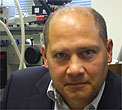
I talked to Professor Mike Emerson from Imperial College London, who's experimenting with imaging techniques in his work on Pulmonary Embolism. In the past he's used mice to study the progress of the disease, inducing clots to form in the lungs, and dissecting the animals to assess the performance of drugs designed to cure the condition. But by purchasing a simple probe that can be suspended over the mouse's chest he estimates he's reduced the number of animals he uses by 70-80 percent.

Along the corridor Professor Sian Harding is using human embryonic stem cells to replace animals in her work on heart disease. By stimulating a cluster of stem cells to develop into heart cells - cardiac myocytes - Professor Harding can study the progress of disease in a petri dish. And because these are living human tissues the results are even better than those provided by animal models - typically in rats.

But perhaps the most contentious issue surrounding the use of animals in medical experiments relates to their welfare. The conditions they're kept in and the level of pain and suffering they endure.

In order to see this content you need to have both Javascript enabled and Flash installed. Visit BBC Webwise for full instructions. If you're reading via RSS, you'll need to visit the blog to access this content.

At Oxford, where the University's new Biomedical Sciences Building opened last month, a great deal of effort has gone into the design of the animal facilities. When the primates finally move in next year they will be housed in social groups, and in cages that feature climbing frames, tyres, ropes and perches.

The head of veterinary services at Oxford, Sarah Wolfensohn, argues that's both better for the animals and better for scientists since stressed or unhealthy subjects tend to produce less valuable results.
Where are all the miracle cures?

Tom Feilden|11:47 UK time, Tuesday, 16 December 2008

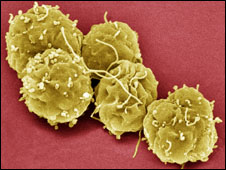
Stem cellsFor all the hype (and we've been promised revolutionary new treatments for everything from Alzheimer's and Parkinson's to cures for spinal chord injury) stem cells have - as yet - delivered remarkably little.

OK, so we had the world's first trachea transplant last month, but that involved a unique effort involving teams from six universities in four countries, and it will be years before anything like it is routinely available.

Perhaps you think I'm being a little unfair? Certainly it can take years - decades even - to develop a promising breakthrough into a fully fledged treatment. Regenerative medicine is still in its infancy, but even so, a sizeable number of exciting stem cell projects are now reaching the stage where they should be moving on from the research lab and into clinical trials.

So why the slow progress? Why the log-jam of promising potential treatments?

Well it turns out that the big drug companies are just as much in the dark about where to go with these new ideas as the rest of us. Stem cells are not like conventional chemical pharmaceuticals. It's harder to predict outcomes - forcing a drug company out of the comfort zone of its established business model. And, because they're living tissues, if something does go wrong you can't simply stop the treatment.

Well all that could be about to change. The world's largest drug company, Pfizer, is taking the plunge. Earlier this month it announced plans to invest a $100 million in two new centres - in Cambridge UK and Cambridge Massachusetts - to develop exciting lab-based stem cell projects drive them towards clinical trials.

It's early days (the company has yet to announce which projects it will be picking up), but the hope is this marriage of basic research and Pfizer's know-how in drug development will break the deadlock.

Regenerative medicine may finally be moving out of the lab and into the clinic.

Searching for Einsteins

Tom Feilden|09:57 UK time, Thursday, 11 December 2008

Is science stagnating?

That's the claim from scientists at University College London, who are so concerned about the diminishing returns from more and more funding, that they're stumping up the cash to support scientists engaged in truly original "paradigm shifting" research.

The Venture Research Prize is the brainchild of professor Don Braben, who will lead the selection panel. The benefits of science, he argues, are inherently unpredictable. Lasers, nuclear power, the transistor, computers and even antibiotics were all either discovered accidentally or the value of their applications was not appreciated in advance.

In order to see this content you need to have both Javascript enabled and Flash installed. Visit BBC Webwise for full instructions. If you're reading via RSS, you'll need to visit the blog to access this content.

"Almost everything we value today came unexpectedly from the work of a few pioneering researchers. Scientists like Einstein and Rutherford, Crick and Watson. Their work transformed our lives and underpins modern civilisation. We call them the Planck club after the German physicist who founded quantum theory".

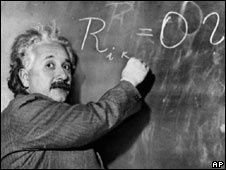
Albert EinsteinIt's a claim that seems hard to square with the massive increase in funding. By 2011 the UK science budget will have reached more than £4 billion. That's a huge amount of money doled out by research councils to support a vast array of projects and individual scientists.

But with all this largesse has come new rules to ensure the taxpayer is getting value for money. Scientists applying for grants now routinely have to justify their research in terms of the results they expect or the uses it can be put to.

And while peer review works well for the majority of projects, Don Braben argues, it fails at the margins where the really important discoveries are made. There's less and less scope for scientists to challenge the conventional wisdom.

"Where are the Einsteins and Plancks of the 21st century going to come from?"

Science minister conducts his own research

Tom Feilden|08:46 UK time, Friday, 5 December 2008

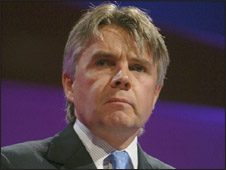
While it was the £250m to be invested in training the scientists of tomorrow that grabbed the headlines, it was the Science Minister's comments on standards in education that generated the most heat at a press briefing in London yesterday.

Lord DraysonLord Drayson was on hand to unveil plans for 44 new post-graduate training centres across the UK, and funding for more than 2,000 PHD students.

The new centres will focus on some of the most pressing problems facing the country - from climate change and energy, to medical science and crime and security. Students at the new Security Science Centre at University College London for instance, will concentrate on developing the technologies to combat terrorism and explore how companies can protect themselves from hackers and fraud.

There's a heavy emphasis on commerce underpinning the scheme, and students will spend the first year of their courses improving their practical research skills and building links with industry.

"Even though we're going into a downturn" Lord Drayson said, "it's vital that we maintain our investment in science and innovation. It's going to be the application of science that gets us out of this downturn more quickly".

But it was the Minister's response to a question about 'dumbing down' in schools that had journalists scribbling furiously in their shorthand notebooks.

Asked whether the new centres were needed because higher education wasn't producing students good enough for entry level jobs in engineering or science-based companies, Lord Drayson claimed one of the first things he'd done after his appointment was to demand to see last year's GCSE and A-Level papers. He'd "dusted down" the exams he sat in the 1970's and had been engaged in a little comparative research project of his own.

Lord Drayson - who has a PHD in Robotics, and made a fortune running his own medical research company - was careful not to condemn current standards, but he said it was vital to make sure that the education system stretched the brightest and the best pupils.

His concerns echo those of the Royal Society of Chemistry. Last week it launched an e-petition on the Downing Street website condemning a catastrophic fall in the standard of science teaching, and claiming that record breaking exam results were "illusory".

Can you teach robots right from wrong?

Tom Feilden|09:31 UK time, Wednesday, 3 December 2008

robot.jpg"Look, I'm not stupid you know. They can't make things like that yet."

"Not yet. Not for about 40 years."

When I first saw the film The Terminator in 1984 this exchange between the heroine Sarah Connor and the time travelling soldier Kyle Reese, elicited something of a knowing laugh from the audience. Clearly the film makers were having some fun with the concept of time travel.

Thankfully the star of the film, a fully autonomous (and relentlessly homicidal) cyborg, is still the stuff of science fiction, but would anyone now argue with the timescale?

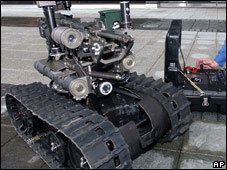
It sounds incredible, but the US military currently has more than 5,000 robots deployed in Iraq, many of them armed. While Predator and Reaper drones patrol the skies over Afghanistan equipped with Hellfire missiles, mine clearance and bomb disposal is already routinely performed using semi-autonomous robots.

It won't be long before supplies are delivered to the front line by robotic vehicles, and more ominously, the US military recently took delivery of a ground-based robotic system that can fire everything from pepper spray to grenades and a heavy calibre machine gun.

Although these are sophisticated machines they are still only semi-autonomous. Even though a Predator or Reaper drone can fly itself for long periods during a mission and identify potential targets, the order to fire its missiles still comes from mission control in a bunker in Nevada.

But a huge amount of money is being invested in reducing even this level of human involvement. By 2010 it's estimated the US defence research agency, DARPA, will have invested more than $4bn in "autonomous systems". Robots that can decide for themselves who is an enemy combatant, and whether to kill.

Given that aim, attention is now turning to questions of ethics: Is it possible to design a robot that can tell right from wrong? A moral machine that would observe the laws of war?

In a recent report written for the US Army one of the leading figures in the field, the computer scientist at Georgia Tech Ronald Arkin, concludes it may be possible. While not "perfectly ethical on the battlefield" robots could "perform more ethically than human soldiers". That's because robots don't need to worry about protecting themselves, and their judgement isn't clouded by anger, frustration or a desire for vengence.

It's a prospect the British robotics expert Professor Noel Sharkey finds, frankly, terrifying. Leaving aside the (massive) information processing problems associated with the confusing and rapidly changing conditions of combat, he says, do we really want cold calculating machines taking life or death decisions?

Emotion, he argues, (and particularly compassion) is a crucial component in the decision to fire. Otherwise, he says, what we're left with is a glorified parking attendant fastidiously and ruthlessly implementing "the rules".

As Kyle Reese says of the Terminator: "It's what it does. It's all it does. And it absolutely will not stop."

BBC © 2014The BBC is not responsible for the content of external sites. Read more.

This page is best viewed in an up-to-date web browser with style sheets (CSS) enabled. While you will be able to view the content of this page in your current browser, you will not be able to get the full visual experience. Please consider upgrading your browser software or enabling style sheets (CSS) if you are able to do so.