

Stem cells help you breathe
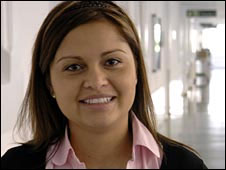 As Claudia Castillo skips up the front steps of the Barcelona Hospital Clinic, or laughs and plays with her four-year-old daughter in the park, she looks just like any other happy, healthy young mum.
Only the thin scar at the base of her neck hints at how remarkable these everyday activities really are. As recently as last June, the trip to the park might have earned her a couple of nights on a ventilator and even a flight of stairs represented a major challenge.
But at a press conference in London yesterday her surgeon Paolo Macchiarini was able to roll his eyes as he recounted how Claudia had recently called him at home at five in the morning to complain about feeling breathless....she was ringing from a disco and had been dancing all night.
This miraculous transformation did not come easily. Teams of scientists from Spain, Italy and Britain have collaborated in a pioneering project to achieve a double first. The first transplant of a trachea (the windpipe) from an organ donor, and the first time a bio-engineered organ has been successfully grafted into a living patient.
First the donated trachea was removed and chemically treated to strip away the living cellular tissue, so that just the collagen framework of the original organ remained. Then in a separate procedure adult stem cells were taken from Claudia's bone marrow and stimulated to develop into chrondrocytes, or cartilage cells.
Using a technique originally developed to treat osteoarthritis, scientists at the University of Bristol stimulated these chrondrocytes to seed, or re-populate, the collagen framework creating a 'bio-engineered' trachea that's a perfect match to the patient.
And finally this new organ was cut and shaped to replace the damaged section of Claudia's windpipe and transplanted into place allowing her to breathe normally for the first time in years.
And because Claudia's new windpipe has been tailor-made from her own cells none of the usual problems associated with transplantation apply. There's no risk of rejection and Claudia will not have to spend the rest of her life on immunosuppressive drugs.
Professor Anthony Hollander whose team in Bristol developed the revolutionary stem cell techniques used to bio-engineer the new organ described the achievement as a significant step forward.
"At last," he said, "we can stop talking about the potential this technology offers...this is stem cell medicine in practice."
 I'm Tom Feilden and I'm the science correspondent on the Today programme. This is where we can talk about the scientific issues we're covering on the programme.

Comments Post your comment