
In Our Time newsletter: The Moon
Post categories: In Our Time, newsletter
 16:00, Monday, 7 November 2011
Editor's note: This week Melvyn Bragg and his guests discussed the Moon. As always the programme is available to listen to online or to download and keep - PM.
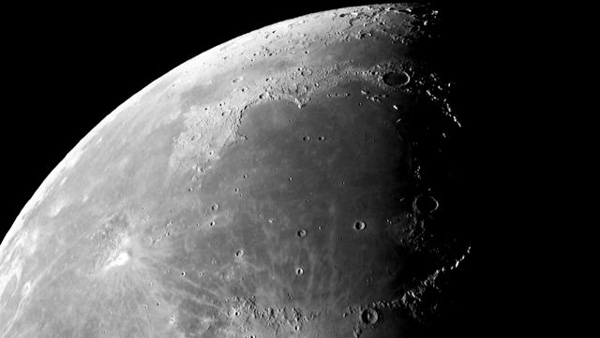
Immediately after the programme Carolin produced a piece of the Moon. It was a sliver of a lunar meteorite which had landed in the Sahara. It was strange to hold something of the Moon. Immediately they went into a discussion about the future of space travel and space exploration. One of the contributors spoke of the Treasury's reluctance to fund it; apparently in space the Treasury is interested only in what we can learn about the weather, or... well, that seems to be about it.
Meanwhile, the Chinese, twenty years ago, set up a plan for space which they are steadily achieving. They have hit every target so far, Paul Murdin said, though not precisely on time. Their next big goal is to colonise the Moon and he's quite sure that they will.
This scares the USA, he says, because it is still interested in global competition, even though it is not feeding its own space programme at the moment. But space programmes can be recreated, as Kennedy did when he created NASA to put men on the Moon.
There is a tendency to compare the Moon with the Antarctic and say that it will belong to everybody and nobody. This was dismissed by those around the table. Paul Murdin didn't even think it would really apply to the Antarctic much longer. He'd been in Australia when there was a row about Australian scientists putting up a statue of a famous Australian explorer in the Antarctic. The committee demanded to know why waste so much money. It was explained that they were staking a claim. The committee demanded to know why the statue wasn't much, much bigger.
The idea of war for and on another planet (starting with the Moon) has ceased to be H G Wells and is coming into view, it seems.
Afterwards I went across the road with Tom Morris, the producer, and we worked out the programmes until Christmas and sketched in a few for January. Then a discussion with a former producer of In Our Time, James Cook, who is working on another project.
And so down Regent Street in the drizzle.
Still very warm in London, but this lovely, refreshing drizzle. I walked along the Mall, slushing my feet through the dead leaves, and was instantly taken back to childhood autumns when this was a big thing to do. Trailing your feet in these piles of leaves. The sound and the sensation came back in a flash. It's curious how tiny moments can electrify you.
The other night I was in the Parks in Oxford. I'd gone back to my old college and I was walking around the Parks in the dusk, enjoying the dusk thickening, the river darkening and still as glass, the paths disappearing between high bushes.
Suddenly, behind me, a voice - it must have been that of a five- or six-year-old girl (I didn't want to look round in case I spoiled it all) - began to sing "Twinkle, twinkle little bat, how I wonder what you're at". And she kept on singing it! Then she laughed and it really was peals of crystal. Her mother (or was it her mother? I didn't want to look round) then joined in. And suddenly I was - on another planet? It felt like that and it's stayed with me already for over a week and I suspect it will linger around, or I want it to, for a long time to come.
And speaking of the Moon, we forgot to make any real reference to poetry. Paul Murdin's favourite Moon lines are from Keats in Endymion:
"What is there in thee, Moon! that thou shouldst move / My heart so potently?"
And found among Shelley's papers was this poetic fragment:
"Art thou pale for weariness / Of climbing heaven and gazing on the earth, / Wandering companionless / Among the stars that have a different birth, / And ever changing, like a joyless eye / That finds no object worth its constancy?"
Melvyn Bragg presents In Our Time
- Listen to this episode of In Our Time: The Moon online
- Download this episode to keep from the In Our Time podcast page
- More about the In Our Time archive of podcasts to download and keep
- Sign up to receive the newsletter by email

Comment number 1.
At 16:58 7th Nov 2011, Forget It wrote:Nice blog Melvyn - especially the walk in the drizzle and the voices.
A full moon
to fill a mind
to empty a sea.
A full moon
to free a man
of the day's gravity...
Complain about this comment (Comment number 1)
Comment number 2.
At 23:59 7th Nov 2011, John Thompson wrote:As in poetry the moon proves symbolical.It sublimates man's aggression to compete in its virtual field.No tides,little water,a dusty satellite of the earth.The moon inspires wishful thinking: a launching pad for future exploration of space? strip mining for helium 3?No atmosphere,no weather,no plate techtonics,a palimpsest of the sun's evolution and the early earth,in its bombardment history.A museum.In cold light of day
uneconomical.These lines from Sir Philip Sidney:-
" With how sad steps ,O Moon,thou climbst the skies!
How silently,and with how wan a face!...
Sure,if that long-with-love-acquainted eyes
Can judge of love,thou feel'st a lover's case:
I read it in thy looks:thy languished grace,
To me that feel the like,thy state decries."
Complain about this comment (Comment number 2)
Comment number 3.
At 07:23 8th Nov 2011, Rip wrote:Good to see the penny dropping that Antarctica does NOT yet 'belong to everyone'. The Treaty was only a provisional political bandaid, not permanent 'internationalization'. See Polar Record, January 2010 I think, for discussion of its problematic future. Dunno about Oz, but Russian policy for near-term possessive exploitation was formally established in law some years ago.
As for the moon, it may be cheese but it's also toast.
Complain about this comment (Comment number 3)
Comment number 4.
At 08:18 10th Nov 2011, Oxborrow wrote:Although mythology was mentioned in the trailer for this discussion about the moon, I was disappointed in the lack of any mythological perspective. I am relieved therefore to find that Jules Cashford's book, The Moon Myth and Image (2002), is on the booklist. The speakers showed little understanding of this area of knowledge. Keats said "What is there in thee, Moon! that though shouldst move my heart so potently? Surely the poetry, mystery and awe that we all feel in relation to the moon, and which is and has been so deep within the collective psyche for all time, was sidestepped by the panel, in favour of such a narrow, literal, scientistic bias. What seemed to have been unconsciously banished from the discussion, was the imagination. I consoled myself with the feeling that all the talk of future landing and colonising the moon was pure imagination anyway. Surely gazing at the moon and dreaming, rather than literally planning to go there, is what will feed our souls in our day-to-day present life?
Complain about this comment (Comment number 4)