
Dr Geoff Bunn introduces A History of the Brain
Post categories: A History of the Brain, Brain season
 13:15, Monday, 7 November 2011
Ed's note: A History of the Brain, presented by Dr Geoff Bunn, starts today on Radio 4 at 1.45pm and is on every weekday for the next two weeks. See the links at the end of this post for more info - PM.
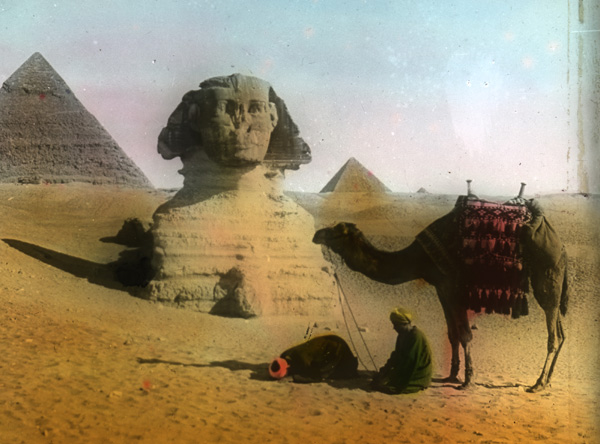
Egypt: Gizeh, Sphinx and Pyramid, Brooklyn Museum Archives
In researching A History of the Brain, what struck me was how different historical eras have understood the brain in their own different ways.
For example, today we find the "brain-as-computer" metaphor plausible because computers have permeated every aspect of our lives.
But sometimes it might be more appropriate to view the brain as more like a compost heap than as an information processor. After all, unlike the information stored in a computer, human memories gradually degrade and change over time.
The ancient Egyptians discarded the brain during mummification, pulling it out through the nose bit by bit with a hook. Even though they had a basic knowledge of brain function, the Egyptians thought the heart was the most important organ, vital for a person's passage into the afterlife.
Curiously, the Egyptians were one of the few ancient peoples who didn't practice trepanation, the drilling of holes through the skull of the living person, in order to drain blood clots or to release evil spirits.
There is no doubt that our knowledge of the brain has steadily improved since ancient Greek philosophers first agreed that the brain was the controlling organ of the body. But progress was agonisingly slow at first. From the Dark Ages up to the Renaissance, the brain's three fluid-filled ventricles were thought to house the psychological functions of sensation, cognition and memory. The "common sense" was the first ventricle, the place where the senses were combined into a whole.
Thomas Willis' Anatomy of the Brain and Nerves of 1664 was a groundbreaking attempt to correlate mind and brain. According to Willis (who was Charles the First's personal physician), the brain was a "kingdom", the "chapel of the deity" and the sovereign organ of the body. Nerves were "companies of soldiers", acting on orders to move muscles "like the explosion of gunpowder". At a time when the world was turned upside down, Willis saw the brain as an analogy of the divine right of kings to govern.
Willis has been called the father of neuroscience. Yet at the time it was far from universally accepted that the study of the brain would lead to great discoveries. The Cambridge philosopher Henry More ridiculed what he considered to be a complete waste of time:
"Verily if we take a right view of this lax pith or marrow in Man's Head, neither our Sense nor Understanding can discover anything more in this Substance that can pretend to such noble Operations, as free Imagination and the sagacious Collections of Reason, than we can discern in a Cake of Sewet or a Bowl of Curds."
Many important innovations in the brain sciences had unusual origins.
Camillo Golgi stumbled on his spectacular "black reaction" brain tissue stain in 1872. This, together with the development of better quality microscopes, led to the discovery of the synaptic gap between nerve cells. The experiment that eventually proved that nerve transmission was a chemical process came to Otto Loewi in a dream in 1920. In 1925, Hans Berger invented the EEG brain scanning machine by accident whilst trying to prove the existence of psychic energy.
A variety of new neuro disciplines such as Neuroesthetics, Neuroeducation and Social Neuroscience have emerged since President Bush announced funding for the "Decade of the Brain" in 1990. The recent shift toward a brain-based understanding of almost every aspect of human personality is truly remarkable.
But is it the whole story?
According to popular understandings, we think and act as we do because our brains are "hard wired" like a computer. But perhaps the metaphor of plasticity is a more appropriate way of explaining the brain's enormous potential for flexibility. Indeed, the history of the brain itself has been one in which chance events, accidents, and creativity have all played a vital part.
Dr Geoff Bunn is the writer and presenter of A History of the Brain
- A History of the Brain starts today at 1.45pm with the episode A Hole in the Head. You'll be able to listen online shortly after transmission and also download the podcast to keep and listen later.
- Visit the Radio 4 Science Explorer for more about Dr Geoff Bunn and the Radio 4 science archive.
- Find out more about other programme's in the Brain Season
- The image is from the Brooklyn Museum's lantern slide collection.
- Follow Radio 4 on Twitter and Facebook.

Comment number 1.
At 15:07 7th Nov 2011, Forget It wrote:This is a great initiative - thanks BBC
Complain about this comment (Comment number 1)
Comment number 2.
At 16:00 10th Nov 2011, Joanna wrote:Doctor Burn, for my own research I'd love to know the name of the manuscript you describe (toward Minute 8 of Episode 3) in which brain function is drawn in four quadrants "like a Celtic cross." In the manuscript the brain was described as cold/moist, the heart hot/dry. I would imagine the liver was described as moist/warm and the testes cold/dry? But I would like to know. Is the manuscript published? Thanks for the series!
Complain about this comment (Comment number 2)
Comment number 3.
At 13:00 15th Nov 2011, 0poponax wrote:MIND - BRAIN, & 'THE' Definite Article.
*********************************
Trapped in 'THE' Brain I cannot call my own,
I serve a life sentence only 'THE' Experts
know how to punctuate..........
[but I can always go out of my mind]
Complain about this comment (Comment number 3)
Comment number 4.
At 14:40 15th Nov 2011, WoodLooker wrote:A History of the Brain, episode 7 'Mind the Gap'
Dr Geoff Bunn on the synapse and how the microscope allowed neurologists to detail the structure of brain cells. speaks of the histology staining techniques of "Cajal". In the 1950s (when Polio was of considerable significance) at the Cytology Lab of the National Institute for Medical Research, London, I carried out many of such techniques for the microscopic examination of nerve cells and took an interest in the history of the subject for which a book by John R. Baker was invaluable. Baker advised that "Ramon is often called by his mother's name, Cajal, but no spaniard would do this. He should properly be called Ramon y Cajal or simply Ramon". John R.Baker, Cytological Technique, Methuen: London, Second edition 1945, footnote on p. 101.
Complain about this comment (Comment number 4)
Comment number 5.
At 12:33 16th Nov 2011, Paul Murphy wrote:#2 Hi Joanna
I mailed your query to Geoff and this what he replied:
The image is here:
https://www.flickr.com/photos/catfunt/6349645839/in/pool-976328@N25/
Best wishes
Paul
Complain about this comment (Comment number 5)
Comment number 6.
At 14:03 18th Nov 2011, Valentinus wrote:It is a great shame that this informative and absorbing (if sometimes quirky) series could find no place for the several, searching critiques of neuromania and biologism. In my view we are no more on the cusp of a revolution in the understanding of the self than were the phrenologists of the 19th century. So much of this material is simply philosophically illiterate, confusing minds with brains, reducing consciousness to chemistry (even in its deceptively 'plugged-in' version) and entirely devoid of a coherent understanding of intentionality or first-person ontology. Where in the inventory of cited thinkers are Peter Hacker, Mary Midgely, Raymond Tallis (whose recent book blows much of this out of the water) or Stephen R. L. Clarke? Unacceptably one-sided for public service broadcasting and part of the ongoing BBC love affair with neuromania.
Complain about this comment (Comment number 6)
Comment number 7.
At 17:38 18th Nov 2011, philthehombre wrote:When politicians and corporations lavish money on neuroscience with particular eye on decision making at a very fundamental-and involuntary- level, folk better watch their votes and an even stealthier picking of their pockets.
Complain about this comment (Comment number 7)
Comment number 8.
At 18:14 18th Nov 2011, Paul Murphy wrote:# 4 Hello WoodLooker,
I mentioned this to Geoff in an email and he said to thank you for that. Very much appreciated,
Paul
Complain about this comment (Comment number 8)
Comment number 9.
At 07:55 19th Nov 2011, Tony wrote:Hi Geoff
Great final episode. Could you give me the reference to the 2007 Chinese research into cultural identity recognition and the name of the US philosopher who you quoted.
Many thanks
Tony
Complain about this comment (Comment number 9)
Comment number 10.
At 18:22 19th Nov 2011, Marcath wrote:It's heartening for once to find a modern psychologist willing to admit on the BBC that dreams and psychical research can play a pivotal role in scientific discovery. Academics should always consider human testimony first and foremost when positing theories about consciousness, rather than become mired in fruitless linguistical skirmishes that lead nowhere. At the same time neuroscience and biological research may shed light on genetic disorders that affect human behaviour. We need a multi-pronged approach to tackle such vast questions.
Complain about this comment (Comment number 10)
Comment number 11.
At 22:19 19th Nov 2011, Darrell Miller wrote:A complex topic delivered in an interesting and entertaining format with word-perfect narration. Well done BBC. Well done Geoff Bunn. Really enjoyed it!
Complain about this comment (Comment number 11)