
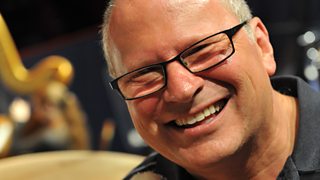
John Chimes
PH Tell us a little about your background; did you play any other instruments before learning the timpani?
JC I played the piano up to Grade 7 but I also played the guitar and the bass guitar. Then I started to play the drums with my father who was a semi-professional saxophone player. We played in bands in the '60s for weddings and social functions. That was where I received my first performing experience. I played in other bands too but basically it was he who started me off. Playing the drums in a band was a wonderful foundation course for playing timpani in an orchestra because you have to think for yourself, lay down the "feel" as it were, and in retrospect it was a great way to start.
We couldn't really afford any timps so I had to practice on pillows! I would set them up in my bedroom, one pillow per timp and I learnt the whole repertoire on them.
At the time of course I thought it a pity I didn't have timps to practice on when my potential rivals probably had them. But, given that life can only really be understood backwards ('tho you have to live it forwards), not having any timps was actually the very best thing that could have happened to me. In fact I would recommend all budding timpanists initially to leave the timpani alone and practice on pillows because one learns to hear the notes in one's head and not on some mediocre, out-of-tune instrument played by an as yet inexperienced player. So I grew up having a very clear picture in my mind of the sound, feel, texture and pitch that I wanted to hear. That is a prerequisite of good timpani playing - without that the timpani play you; only when you have a clear idea of the note in your head before you play it are you in control.
PH Your brother Terry played drums in punk rock band 'The Clash', was there any sibling rivalry?
JC No. I had decided to play the timpani by the time he did that and I had left the drum kit behind.
PH Were you influenced by any players around at that time?
JC I studied with Alan Cumberland (then at the LPO) - a wonderful musician. In the mid '60s the LSO's timpanist Kurt Hans Goedicke introduced us to his flamboyant style which greatly impressed us all at the time. But I've found my own way since.
PH You joined the BBCSO 1975, how different was the orchestra in those days?
JC Times were different back then. It was an orchestra full of characters, very strong personalities, and so the orchestra had something about it because of that. But I'd say that now the orchestra is technically in better shape. There's always a big turnover of personnel, particularly in London orchestras, so inevitably things are affected by that and it's difficult to compare. We are still in the same studio - THAT hasn't changed!
PH Over the years you have renovated quite a few German ‘Ringer’ timpani (which the orchestra now own). Tell us why you chose those particular timps.
JC Back in the '70s in the UK it was the era of plastic-skinned timpani and I was never happy with it, I never found it satisfying. There are often false overtones to the fundamental note and it wasn't a sound that I ever found fulfilling. I owned some and played on them here in the orchestra and at the time players thought that they brought a comparative ease of intonation because they weren't subject to the dramatic changes in pitch due to heat and humidity that real skins are. However I don't think that they produce a "true" note, there's always that overtone and they can sound horrifically sharp from a distance, even if you think they are in-tune when standing over them. That began to get to me and I had always rather admired the sound obtained by some of the German orchestras; it is a softer sound in terms of not being aggressive, more organic. As soon as I started playing these timps I knew it was the sound I was looking for so I made it my business to purchase lots of (very expensive) German timpani. It was difficult at the beginning, the real skins are terribly affected by atmospheric conditions, the air-conditioned studio etc. In extreme situations a timp can drop or rise in pitch in a movement by as much as a fourth without you even touching it, so it can be scary.
But given what I said earlier about trying to achieve the sound you want, with natural skins it is easier to focus in on that, that's why I use them.
When I started using them in the BBC, conductors and members of the orchestra were very enthusiastic about them so I pursued the activity to the usual extreme that I tend to do everything!
PH You have worked a lot with John Eliot Gardiner's orchestra and have been a member of the Chamber Orchestra of Europe since 2012. Do you have to change the way you play with these differing ensembles?
JC I don't believe there is only one way to play. I don't have a style as such, I play the way I taught my students to play and that is to do what is necessary - to react to the musical style and the conditions around you: the conductor, the size of the hall and the size of the orchestra. I use my experience and I do what I think is right at the time.
PH Which conductors have you enjoyed working with most over your 39 years at the BBCSO?
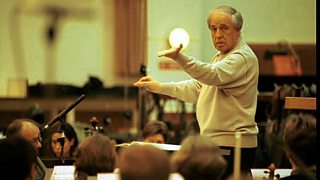
Pierre Boulez at Maida Vale
At the same time we were working with Sir Adrian Boult, an inspiring link to the greatest 20th century English composers and it was very special to play the works of those composers with him. Sir Adrian's Brahms was also wonderful and I cherish the memory of those concerts with him.
I also really enjoyed working with Sir John Pritchard. For me he did some of the best Strauß and Mozart that I've ever heard and I'm a bit of a record collector! There was an expansiveness about his interpretations that worked very well with the big Strauss pieces and his Mozart was special
Thanks to Pritchard, we worked with Günter Wand, my all-time hero for sure. For me he had everything. You can look at it like this: there are boxes to tick when considering the merits of a conductor - experience, knowledge of the score, knowledge of the capabilities of the instruments, diplomacy, how to get the best out of people, stylistic implications etc. - the list is practically endless. Some conductors are diplomats, very nice but they might not be so good on stick technique. Some are great at stick technique but could almost be considered tyrants by players! Günter Wand was the only conductor I ever came across who pretty much ticked every box in the repertoire he conducted with us – Schubert and Bruckner. Although of course he could be difficult to work with - he would insist on turning off all the air conditioning (in the summer!) and he'd still complain of a draught! But despite that I'd say the concerts we did with him were the pinnacle of my time here for me.
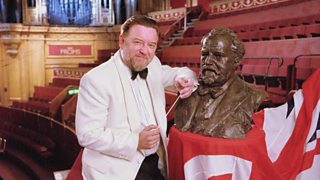
Sir Andrew Davis with Sir Henry Wood
PH Your wife Polly is a percussionist. Have any of the children followed suit and entered the music profession?
JC No. They've seen what it does to people - what it's done to me!
PH I recall a Boulez tour in '97 where we were chartered all over Europe and the morning after the crew had watched us play the Rite of Spring, the flight attendant announced that she really enjoyed the guy playing the bongos! Do you have any anecdotes from your career?
JC I remember many years ago the orchestra played a concert in Tolworth Leisure Centre (that well-known centre of musical excellence!). Behind the orchestra there was a large clock which made a loud rhythmic grunting noise. We were playing Tchaik 5 and as the first movement progressed more and more people became aware of the ridiculous grunting clock noise and gradually the suppressed laughter started to spread like wild fire. Of course in an orchestra you CANNOT laugh in concerts which only serves to make matters worse. Poor Derek Taylor, a wonderful horn-player (and a bit of a giggler himself) had to play the sublime solo with half of the orchestra around him snorting! Somehow he managed it brilliantly - as he always did.
PH Are you aware that you always get the biggest cheer after concerts?
JC Do I? (Laughs) I've never noticed that!
PH What future plans do you have?
JC Playing with the COE and getting my golf handicap down. I'm just short of single figures and I'd like to get into low single figures but you need time and effort. Every time I turn up at my golf club the morning after a concert hoping for a quiet relaxing game they tell me it's a competition day! I'm usually shattered from the night before because concerts take a lot out of you, so it'll be nice to turn up fresh and not emotionally drained!
