
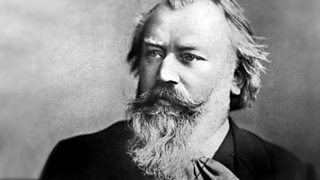
Poor old Brahms...It's weird to feel sorry for a composer as celebrated and performed as any of the greats, whose works - and whose preternaturally effulgent beard - are as familiar as anything in classical music.
But I do. That familiarity is precisely the problem. What do we hear when we hear Brahms' music? The acme of solid - even rather stolid - 19th century classicism? The comforting, perfected endpoint of a German tradition that goes back to Johann Sebastian Bach Henirich and Schütz? Or a “leviathan maunderer” (George Bernard Shaw's phrase) whose earnestness and self-conscious historicism mean that his music is essentially limited in what it's trying to say?
This week's performances and broadcasts will, I hope, reveal another Brahms: a visionary pusher of expressive boundaries in his chamber music, a symbolist dreamer in his late piano music and choral works, a multi-dimensional virtuoso of time and space in his orchestral works. And above all: we're going behind the beard to the seething passions of the man it so expertly disguised. That intensity of feeling, that pain and joy is all there in the music - we just have to hear it.
And in the hands of performers from the incendiary Skampa Quartet to the inspirational pianist Stephen Kovacevich, from violinist Daniel Hope’s passionate advocacy to the choral and orchestral resplendence of the BBC Singers and BBC National Orchestra of Wales, that’s exactly what the Brahms Experience will offer listeners in St George’s and Colston Hall and on BBC Radio 3. There’s a powerful, distilled alchemy at work in every note of Brahms that we’ll hear, from the aching melancholy of the Clarinet Quintet on Monday night to the intimate power of the solo piano pieces that Kovacevich will play on Friday. It’s to do with the way Brahms is thinking on so many musical levels at the same time. He dealt with a unique historical situation: coming to maturity in the mid-19th century in Germany and Austria, he felt in a way that no other composer had done before that every piece he produced ought to be able to stand beside the great music he knew and loved so well, from Schubert to Schumann, from Couperin to Bach, from Mozart to Beethoven. That was the tradition that Brahms understood that he belonged to, and which he had to honour and continue with every new work he composed. Everything had to be a masterpiece, in other words, to satisfy Brahms’s astonishingly high personal standards. That’s some pressure to put yourself under!
But honouring that tradition meant the opposite of repeating what had gone before. In fact, Brahms is one of the most innovative composers in classical music because he is simultaneously reflecting and transcending centuries of music history, as well as creating something genuinely new. And paradoxically, all of that intellectual and technical labour, and all of that devastatingly severe self-criticism, produces music that speaks with a unique emotional power. When you hear the opening of the German Requiem, which the BBC Singers perform on Thursday, you’re confronted with a breathtaking simplicity and directness. The choir sings music you feel must always have been there.
It hadn’t been, of course, but that’s the epiphany of Brahms’s best music. You feel you’re hearing not just some of his most inspirational music, but a distillation of the repertoires of classical music as a whole. Brahms is, literally, essential, because his music is a concentrated essence of so many of the repertoires of what we call “classical music”. And that goes backwards and forwards in time, by the way, since Brahms is such a crucial influence on 20th century composers, as well as refining everything that mattered to him in his musical predecessors. So we’ve ended up with Brahms the time-traveller as well as Brahms’s the bearded classicist… Told you this was rich stuff. But that’s just one part of the world of Brahms’s music and his life: join us during the week of the Brahms Experience to hear and find out more!
