Notes from a composer, Part 11 - Bohortha
Blog comments are currently unavailable. Find out more.
Post categories: BBC Symphony Orchestra, behind the scenes
 |16:38 UK time, Tuesday, 31 January 2012
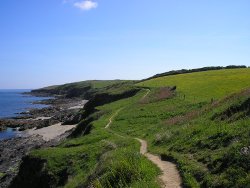
Bohortha, Cornwall
Composer Michael Zev Gordon is writing a new piece for the BBC Symphony Orchestra. Here's his eleventh post explaining the process
I’ve reached the final part of my work – and once again I’m facing its recurring subject: time. 6 months ago I wasn’t sure if I would really call this last movement, and the whole piece, after a tiny cul-de-sac of a hamlet in rural Cornwall. But my visit there last May has remained deeply etched inside me: a perfect image of tranquillity and stillness, of time stretching out towards infinity. And this is where this last movement – and the whole piece – is headed.
At the same time, early on in writing the piece, I had the idea that the last movement would try something new for me in terms of the evocation of time, and that was to attempt to layer different kinds of time. A kind of experiment I suppose, but with a deep poetic impulse behind it. I felt – and as I’m now in the midst of writing the music, I feel even more – that infinite ‘slow’ time or ‘timeless’ time, would appear all the more so if I could superimpose upon it different kinds of ‘faster’ time. Certain questions have arisen in doing this. Does one kind of time subsume, or win over, the other? Am I really dealing with speed rather than time? Can I really have any control over how a listener perceives the passing of time?
But I am of course the first listener of my music – as all composers are. And as all composers do, I write as I hear. And it seems to me that there is at least a possibility of evoking simultaneous time layers; and that there is also a relationship, however difficult to define, between the way music moves and how (much) time appears to have passed.
There are precedents for what I’m trying to do – though perhaps not so very many. One in particular figures strongly for me – and that is Charles Ives’ The Unanswered Question. In his piece, the orchestral strings inhabit a world of sustained long notes, changing little and unpredictably – the infinite universe; against it a trumpet is layered with its question, and scampering woodwind respond. And I’ve certainly taken the idea of using orchestral texture and colour to differentiate the time layers. The strings at the start of my movement are also the timeless layer. But as I’ve worked into the piece, I’ve realised too that I want to try to evoke stillness not only as something static from the start, but also in terms of slowing down – to reach an even deeper calm.