
Notes from a composer, Part 10 - Of Pain and Angels
Post categories: BBC Symphony Orchestra
 |10:28 UK Time, Monday, 16 January 2012
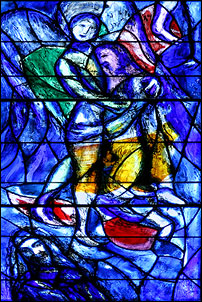
Chagall - stained glass: Jacob wrestling with the angel
Composer Michael Zev Gordon is writing a new piece for the BBC Symphony Orchestra. Here's his tenth post explaining the process
I've had the most terrible tooth problems of late. The extraction of a wisdom tooth has led to all kinds of complications you don't want to know about. But it has led me to dwell all the more on the relationship between creative expression and suffering, which movement 6 of my set, 'Terrifying Angel', explicitly focuses on - even if I had originally intended it to be of a purely spiritual sort!
The pathos of, say, the Adagietto from Mahler's 5th Symphony, or Billie Holiday singing the blues touches in an extraordinary way. Some may see our desire to listen to such things as a need for catharsis: as we witness the outpourings of others, our own pain, at least temporarily, is eased. But for me, instead, hearing Mahler 5 or Tchaikovsky's Pathétique Symphony has more to do with empathy, with sharing something we hold in common.
Even before my tooth episode, I saw the sixth movement, as needing to be especially intense and soaring, so that the final movement will appear all the more timeless and tranquil - beyond human passions. And in this work of short movements, I have particularly seen No.6 as not taking its time to unfold. It has to burst in and shatter, and be gone. There is a danger in this of course. Things do need a certain length of time to speak. But this work has in part been about taking risks, of pushing things towards the edge - and here of trusting that a fragment may actually be more powerful than a whole, the pathos in part coming precisely because it is broken off.
So what kind of expressive world have I tried to create? It's not been an ode to tooth decay! Nor did I want thee to be too much personalised expression. Not because I'm against such a Romantic idea - what more poignant music is there than, say, the intimacy of Schumann piano pieces? But still, I wanted here for the music to sound more like a collective cry of anguish. It has felt to me that in such a short time-frame this might make more a mark.
How to be collective? This seems to me to have to do with tapping into shared material: folk or religious music are two possible routes that many have taken. And just the other day, I heard a piece I sang as a child - Britten's A Ceremony if Carols - and was taken by the strength a simply a short piece of 'common' plainsong can bring in the opening and closing processionals. Stravinsky's example is so powerful in this too: gaining distance and universality by using Russian chant or folksong.
And so my idea here has been to draw on my own heritage: the sound of Jewish chant. By engaging with that melos, it has immediately felt that I am inhabiting the music of others, not simply making my own. The tension I've felt, though, is that one can be overly-subsumed into it, and so the music loses individuality. Never a danger of that for Stravinsky. Whatever he borrowed, he imprinted himself upon it. But have I done this? Have I transcended the shared elements. For others of course to decide. But - as my teeth continue to throb - right now, as I'm just completing this movement, it's felt an oddly moving place for me to go: to embrace so openly my heritage.
Oh - and who is the terrifying angel? Old testament maybe? But the image in fact comes from Rilke: his wrestling in his Duino Elegies with all-perfect angels - trying to come to terms with human frailty along the path to enlightenment - is one of the most profound things I know.

Comments Post your comment