Eroica Uncovered
Blog comments are currently unavailable. Find out more.
Post categories: Beethoven, National Orchestra of Wales, Radio 3, behind the scenes
 |16:59 UK time, Monday, 22 February 2010
'Dum! Dum! Dah-dee-dah-duh-dah-dee-dee-dah ...' The opening bars of Beethoven's Third Symphony, the Eroica, have been ringing out rather a lot in the office of the Radio 3 Interactive team recently.
In the last few months we've been working on new ways to develop in-depth understanding of classical music and we selected the Eroica Symphony for 'special measures' because it is a well known, widely accessible and in its own way, ground-breaking work.
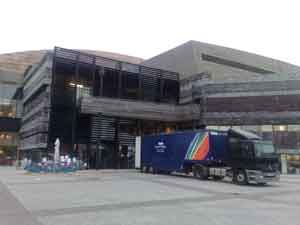 I've been working closely with producer Gregory Stevens on the video recording of the Discovering Music programme on the Eroica which Radio 3 broadcast on Sunday (still available on the iPlayer for another six days). Last December, we travelled to the Hoddinott Hall in Cardiff's Millennium Centre to film Stephen Johnson's splendidly informative and entertaining analysis, and the performance by the BBC National Orchestra of Wales, conducted by Christophe Mangou. My job was to write the camera script and direct the video: this means that, unlike a full-scale TV outside broadcast, you do your own vision mixing.
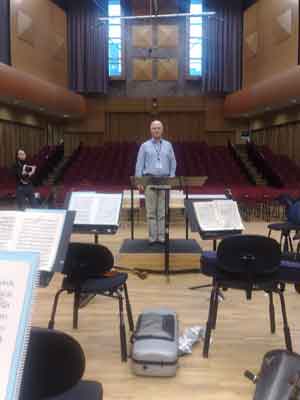 As well as scripted cuts to the conductor, the 'conductor shot' is also the fail-safe or default shot should anything go wrong - however Christophe Mangou had an extremely expressive face and it was tempting to cut to him more often than not because most of his shots were winners, as you'll see if you watch the performance. In post-production, Gregory and I also prepared extracts for the visual glossary of musical terms which we are developing as part of our support for the Discovering Music archive. You can watch Stephen Johnson's introduction and the complete performance by following this link.
Meanwhile, as a 'homework' project, producer Roger Philbrick has been putting in a lot of hours developing a visual guide to the Eroica's opening movement. Roger had been studying audio waveforms of the music and it occurred to him that these could be used to provide visual representations of musical structures and patterns.
He used colour coding to show the broadly sonata-form format of the movement - and how its scale, dynamics and section lengths compare with a late Mozart symphony. A second set of colours were used to show themes, texture and instrumentation. The next step was to use Flash animation to combine the waveform graphics with music clips, dynamic descriptions and simple controls so you can both see and hear what is going on at important points in the music.
Roger and coder Anthony Ali have compiled these elements on a rather colourful webpage, with links to the relevant sections of Stephen Johnson's analysis. They hope you enjoy the results.
We'd always like to do more, of course: to this end, we'd welcome your comments on the Eroica work - just post them here!
- The pictures (©Graeme Kay/BBC) show the Hoddinott Hall scene dock at the Wales Millennium Centre, and Gregory Stevens lining up the ConductorCam in the hall.