Discovering Music: Exploring 'Eroica' - 1st Movement
What made Beethoven's 3rd Symphony such a revolutionary work?
This analysis focuses on the first movement of the symphony, using waveform graphics from audio recordings to illustrate length, structure, dynamics etc.
1. Length and Structure - The first movement is colossal, constructed on an 'heroic' scale. Beethoven adapts the conventional 'sonata form' by extending the Development and Coda sections.
Compare the first movement of a late Mozart Symphony - KV 550 in G minor... 
...with the first movement of Eroica (shown to scale):
2. Dynamics and Texture - Beethoven exploits the full dynamic range of the orchestra, juxtaposing contrasting sections for dramatic effect.
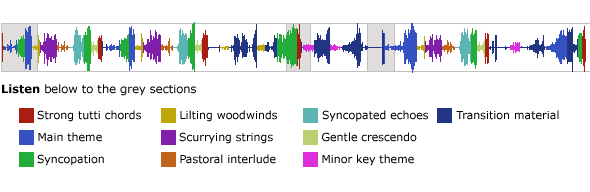
3. Thematic development - Rather than a traditional sequence of clearly defined themes, Beethoven takes a very simple fanfare (possibly borrowed from Mozart*) and lets the music evolve organically (paving the way for his fifth symphony). Yet he introduces an apparently fresh theme in the middle of the Development section - the last place his audience would have expected to hear a new tune.
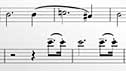
4. Tonality - The unexpected C# at the start of bar 7 has been called 'possibly the most famous single note in the entire symphonic literature'**. The movement has hardly started before Beethoven steers the cellos off course, causing the first violins to shudder (off the beat) in shock.
Listen to the opening bars: (press to play the clip)

Throughout the movement, Beethoven plays games with the conventions of modulations (key changes), ending up in the remote key of E minor for the unexpected tune in the Development and deliberately crunching the gears to get back to the home key at the end.
5. Power and Dissonance - Breaking with the genteel traditions of the 18th century, the sforzandos, fortissimo sections and harsh, dissonant harmonies sound shocking even today.
6. Triple Time and Syncopation - The time signature of 3/4 (normally associated with dance) is a strange choice for an opening movement, especially such a ferocious one. Beethoven also uses off beats and syncopation to disrupt the rhythm and disorientate the listener.
Listen to the syncopation, dissonant chords and minor key theme in the Development:
7. The 'premature' horn - The result of stretching sonata form and extending the Development section is that the wait for the main theme to return at the start of the Recapitulation is almost unbearable. Beethoven emphasises the frustration - and blurs the boundary - by getting the 2nd horn player to play the theme (quietly) 4 bars early, despite the fact that the strings are still playing the previous chord. At the first rehearsal, Beethoven's student, Ferdinand Ries, was convinced the horn player had made a mistake.
His comment: "Can't that damned player count?" did not please Beethoven!
Listen to this section:
Read more about this project on the Radio 3 blog.

 Watch Stephen Johnson's full analysis of the 'Eroica' Symphony.
* The Overture to 'Bastien et Bastienne', written by the young Mozart, contains a very similar fanfare theme.
** Richard Taruskin: The Oxford History of Western Music, Vol. 2
Beethoven Symphony No.3 'Eroica': 1st movement - Dynamics and Texture
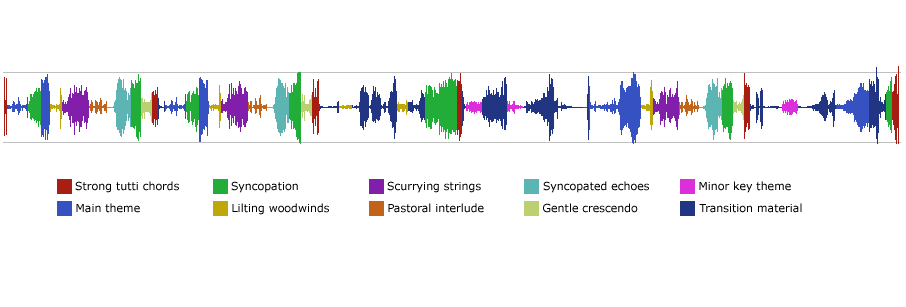
Beethoven exploits the full dynamic range of the orchestra, juxtaposing contrasting sections for dramatic effect.