Poor
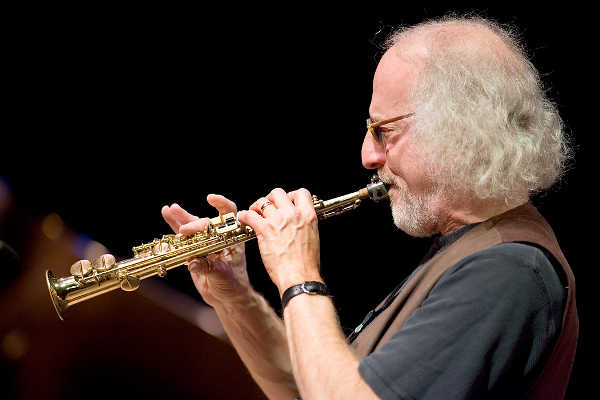
Larry Ochs. There he was playing a set at the
Sigüenza Jazz Festival with his band Drumming Core, when (according to a report this week in the
Guardian)
a posse of armed Spanish police arrived en masse to investigate claims from a disgruntled customer that he was not playing jazz at all but some other form of 'contemporary music'.
The irony is that Larry, a versatile saxophonist from California who specialises on the sopranino sax as well as the tenor, has spent most of his playing career investigating the interstices between contemporary composition, jazz and free improvisation. For 32 years, he's been a member of the Rova Saxophone Quartet, a group dedicated to mixing jazz and the experimental end of composition.
When I heard the group at a Bath Festival appearance a few years ago, their set ranged from free improv to a complex score by
Barry Guy that involved playing sequences of composed material in a random order. There was not a great difference aurally between one genre and the other, and the boundaries have been further blurred in Larry's other work: the acoustic-meets-computers band Room in the 1980s, his International Creative Orchestra (with pianist
Wayne Horvitz) in the 90s, and his concerts with trombonist George Lewis and the AACM. When I made a BBC World Service documentary about Larry and the Rova Quartet in 2002, we got plenty of letters asking what their kind of music was doing on a jazz programme. But in my interview with him, Larry eloquently made the case for a jazz connection in almost everything he does.
The question 'What is jazz?' has been vexing listeners since the origins of the music.
Paul Whiteman's 'symphonic jazz' was reviled by purist critics in the 1920s, but gave birth to
Gershwin's
Rhapsody in Blue.
Cab Calloway dismissed
Dizzy Gillespie and
Charlie Parker 's 1940s experiments as 'Chinese music', and
Ornette Coleman was heavily criticised for his free jazz of the late 1950s and early 60s by listeners who wanted at least the semblance of a recognisable harmonic sequence.
When
Rashied Ali replaced
Elvin Jones's rhythmic backdrop to
John Coltrane with an impressionistic wash of sound, the old definitions of jazz as music with 'syncopation' and 'swing' went out of the window. So how can we define it? I tend to side with
Dr. Johnson. When he was compiling his dictionary, he did not feel it was his job to be prescriptive about what words ought to mean, rather he attempted to reflect what a word has come to mean over time. And so his view about the changing definition of the word 'jazz' might well be summed up by this paragraph from his preface: '
In every word of extensive use, it was requisite to mark the progress of its meaning, and show by what gradations of intermediate sense it has passed from its primitive to its remote and accidental signification; so that every foregoing explanation should tend to that which follows, and the series be regularly concatenated from the first notion to the last.'
Those of us who write or broadcast on the history of jazz would do well to remember the sage doctor. If enough people agree that a particular type of music is 'jazz' and call it by that name, then in due course, that type of music becomes part of the concatenated sequence of definitions of jazz. On the other hand, maybe the best advice to the Spanish police would be from the old adage about
Fats Waller. When he was asked 'What is jazz? he apparently replied, 'Lady, if you gotta ask, you ain't got it!

 |15:41 UK time, Wednesday, 23 December 2009
 We've a Christmas Cracker for you: it's a short film of a 'composite' performance of Handel's Hallelujah Chorus using recordings made by some of the 450 choirs who signed up for Sing Hallelujah!