
Latest global satellite temperatures for September
The latest global temperature anomaly for September has been released and according to the UAH measure is +0.289C above the running 30 year mean, shown on the graph below.
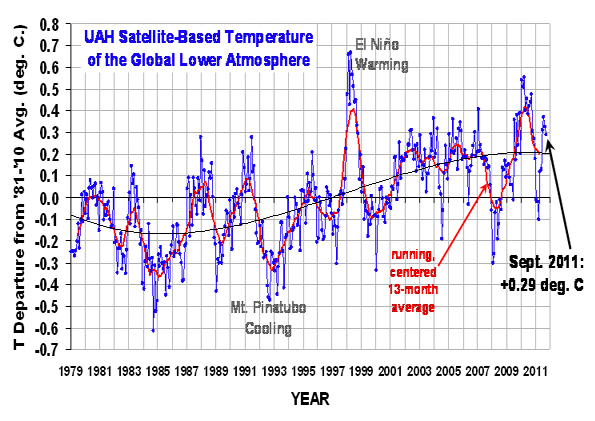
Adjusted to the more standard time period, the anomaly is approximately +0.542C above the 1961-1990 time period used by the Met Office and WMO.
With the onset of La Nina widely expected, global temperatures are likely fall in the coming months.
 Hello, I’m Paul Hudson, weather presenter and climate correspondent for BBC Look North in Yorkshire and Lincolnshire. I've been interested in the weather and climate for as long as I can remember, and worked as a forecaster with the Met Office for more than ten years locally and at the international unit before joining the BBC in October 2007. Here I divide my time between forecasting and reporting on stories about climate change and its implications for people's everyday lives.
Page 1 of 2
Comment number 1.
At 01:21 6th Oct 2011, Lazarus wrote:"global temperatures are likely fall in the coming months."
Great, just in time for our winter so I assume we can expect another fairly cold one?
Complain about this comment (Comment number 1)
Comment number 2.
At 07:48 6th Oct 2011, QuaesoVeritas wrote:Based on AQUA CH5, temperatures are already falling, but the question is, how long will that continue.
What puzzles me slightly is whether this is a genuine fall in global temperature or if it is a problem with how the temperature is measured.
If it is falling, what is causing that to happen on such a short time-scale?
Complain about this comment (Comment number 2)
Comment number 3.
At 08:20 6th Oct 2011, ukpahonta wrote:How long does it take for energy to stabalize in the system?
Is the current plateau the stabalized effect from past warming?
What are the indications for where the new direction of energy is going to take us?
I am sure that we will soon find out.
Complain about this comment (Comment number 3)
Comment number 4.
At 09:27 6th Oct 2011, quake wrote:the big puzzle for me is why RSS anomalies are more than 0.1C lower for the last few months
Complain about this comment (Comment number 4)
Comment number 5.
At 11:33 6th Oct 2011, newdwr54 wrote:2. QuaesoVeritas wrote:
"....what is causing that to happen on such a short time-scale?"
If you look back to the 2007 La Nina episode which also began around August that year, and compare August-September 2007 with 2010 there isn't that much difference. The trend lines are almost identical. October has started off colder than 2007 admittedly.
But this cooling may just be typical of the effects a La Nina episode has on temperatures at that altitude at this time of year?
Complain about this comment (Comment number 5)
Comment number 6.
At 12:18 6th Oct 2011, QuaesoVeritas wrote:quake,
After adjustment to the same base period you mean?
Actually I think it's UAH which has been higher, rather than RSS lower.
RSS has been pretty close to HadCRUT3, GISS and NCDC, so it looks to me as
if UAH has been the "odd man out", although I suppose with UAH and RSS both
being satellite based, you would expect them to be the same.
As I have mentioned elsewhere, UAH has also been about 0.1c higher than would be expected from AQUA CH5, based on the normal relationship for each month, based on 2002-2010. Until September that is.
Complain about this comment (Comment number 6)
Comment number 7.
At 13:20 6th Oct 2011, quake wrote:yes i think UAH is too high as well
Complain about this comment (Comment number 7)
Comment number 8.
At 17:33 6th Oct 2011, QuaesoVeritas wrote:As a result of the August HadCRUT3 anomaly figure of 0.458c, the 10 year rolling linear trend increased from -0.075c/decade to -0.070c/decade. This is the second month in which the 10 year linear trend has increased, since reaching a low of -0.0776c/decade in June. However, the latest figure remains the 4th fastest negative trend since April 1977.
The 20 year linear trend rose slightly from +0.1679c/decade to +0.1681c/decade which still leaves it below the peak at +0.237c/decade in April 2004. While the decline in the 10 and 20 year rolling linear trends does appear to have stalled for the time being, I believe that this is a temporary situation and that the decline in the trends will resume over the next 12 months.
The 50 year linear trend rose from +0.1408c/decade to +0.1413c/decade. While the 50 year linear trend does not yet appear to have peaked, it does seem to be approaching a peak and we could see some declines in the trend over the next 1-2 years.
As a result of the respective September figures, the UAH 10 year linear trend increased from +0.0490c/decade to +0.0495c/decade and the RSS 10 yer linear trend fell from
-0.0551c/decade to -0.0567c/decade.
Complain about this comment (Comment number 8)
Comment number 9.
At 22:27 6th Oct 2011, Lazarus wrote:According to Scientific American, Accuweather is predicting another 'Brutal ' winter for the US because of La Nina. I expect weather in the UK will also follow a similar trend to what we had last winter.
https://www.scientificamerican.com/article.cfm?id=brutal-winter-predicted-for-us
Complain about this comment (Comment number 9)
Comment number 10.
At 23:39 6th Oct 2011, newdwr54 wrote:8. QuaesoVeritas:
Is there any particular reason why you avoid using the 30-year linear trend? It is recommended by the WMO and UNEP as the 'classic period' for determining climate trends from temperature data as it filters out much of the 'noise'. It is also the period that most of the main data sets use to establish their baseline anomaly value.
For the record, the latest HadCRUT3 30-year trend peaked in Jan 2004 at +0.195C/decade and is currently fairly steady around +0.163C/decade. The 30-year trends for all the other main global data sets, including satellite, agree with HadCRUT3 to within 2/100ths of a degree C.
Complain about this comment (Comment number 10)
Comment number 11.
At 23:59 6th Oct 2011, newdwr54 wrote:9. Lazarus:
This NOAA chart suggests that the La Nina that occurred in 1988/89 started earlier, lasted longer, and had more severe temperatures than did the La Nina that occurred 2010/11: https://www.cpc.ncep.noaa.gov/products/analysis_monitoring/ensostuff/ensoyears.shtml
The 1988/89 La Nina did not result in severe winter weather in the UK. There must be more at play than La Nina conditions. If we have another severe winter this year again then it may have as much, if not more, to do with conditions prevailing in the Arctic rather than the tropical Pacific.
Complain about this comment (Comment number 11)
Comment number 12.
At 07:40 7th Oct 2011, QuaesoVeritas wrote:#10. - newdwr54 wrote:
"Is there any particular reason why you avoid using the 30-year linear trend? It is recommended by the WMO and UNEP as the 'classic period' for determining climate trends from temperature data as it filters out much of the 'noise'. It is also the period that most of the main data sets use to establish their baseline anomaly value."
I'm not deliberately avoiding using the 30 year trend, it just wasn't one of the ones I set up on my spreadsheet and I haven't got around to adding it yet.
I think that the 50 year trend compensates, but from what you say, the 30 year trend sounds interesting, so I will have to add that one as well.
I don't think there is anything special about a 30 year trend, compared to a 20 year or a 40 year trend. It's use is entirely arbitrary.
Complain about this comment (Comment number 12)
Comment number 13.
At 07:48 7th Oct 2011, QuaesoVeritas wrote:#9. - Lazarus wrote:
"According to Scientific American, Accuweather is predicting another 'Brutal ' winter for the US because of La Nina. I expect weather in the UK will also follow a similar trend to what we had last winter."
That forecast looks pretty much what I would expect in a US winter to me.
When Accuweather correctly predicts snow in Florida, I will be interested.
Complain about this comment (Comment number 13)
Comment number 14.
At 08:04 7th Oct 2011, millennia wrote:It's a little worrying that discussions are starting on the validity of the UAH figures. I hope this isn't an indication of more dataset tampering as UAH is commonly used to show global anomalies now. If it is an instrument problem then you have to wonder if there is any raw data we CAN rely on as everything used to reinforce AGW theory seems to be modified in some way before we see it.
I do not see much of a correlation between US and UK winters, they have often had bad winters that haven't materialised over here simply because cold in the US is generally caused by incursion from Canada whereas our most penetrating cold requires continental polar air coming in from the east. The Atlantic makes a huge difference to the results of similar weather patterns either side of it.
Notably Piers Corbyn has remained very tight lipped about this winter. Nearly everybody has nailed themselves to the cold winter mast now but he continues to say nothing - although everybody has inferred every single type of outcome from this silence. My take is that he simply doesn't know; something is happening this year which is causing enough doubt that a long range forecast can't be nailed.
Therefore I don't expect much of an indication until about 15 days before a month begins - October is shaping up pretty much how he told it in mid September, despite all the pee taking about the warm start to the month. His forecasts are all about general trends, not what it will do in Leeds on the 14th, and the trend is for blocking to the south with occasional extension north and some big storms to the north of the UK possibly with one diving into the North Sea.
Complain about this comment (Comment number 14)
Comment number 15.
At 07:22 8th Oct 2011, Sheffield_city wrote:I remember some Primeminister bragging that he had broken the boom bust cycle. It reminds me of the people who believe in man made Global warming. I have just noticed a forecast for - 20 degrees and heavy snow for November, December and January. This will be the trend for the next 30/40 years. Temperatures in Britain reflect the rest of the world. People are going to die because of being unable to afford to heat their homes.
Complain about this comment (Comment number 15)
Comment number 16.
At 07:54 8th Oct 2011, QuaesoVeritas wrote:Sheffield_city
That forecast was mentioned on the radio this morning but without identifying the source.
Do you have a link to the forecast you saw?
Complain about this comment (Comment number 16)
Comment number 17.
At 08:45 8th Oct 2011, PingoSan wrote:"Temperatures in Britain reflect the rest of the world."
They do seem to do this very well, especially with the cooling we've seen in both the world climate and the UK climate over last 5 or so years. We seem to be affected much more here by the quiet sun as a result of a quiet sun causing blocking highs over Greenland in winter. This then drives our winds to originate from the north or the east
Complain about this comment (Comment number 17)
Comment number 18.
At 10:02 8th Oct 2011, ukpahonta wrote:QV
James Madden, long-range forecaster for Exacta Weather, said: “I expect the most frequent and heavy snowfalls to occur across many parts of the UK during November, December, and January.
There could also be frequent and significant snow across northern regions and Scotland throughout this winter.
“I also expect November, December, January, and February to feature largely below average temperatures across many parts of the UK. It is likely that temperature and snowfall records will be broken,” he said.
https://www.express.co.uk/posts/view/276202
Complain about this comment (Comment number 18)
Comment number 19.
At 10:55 8th Oct 2011, QuaesoVeritas wrote:ukpahonta,
Thanks for the additional info.
Here is a link to the Exacta website and forecasts:
https://www.exactaweather.com/Home_Page.html
Who exactly are Exacta Weather and have they any track record?
I don't like the apparent obsession with quoting newspaper headlines, based on forecasts they have made. That isn't proof of anything. Newspapers will publish any forecast if it is unusual enough.
I see that their summer forecast included a warning about "torrential downpours and severe flooding". Don't recall when they happened.
It also irritates me when the newspaper articles use the term "forecasters", when they mean a single forecaster with an unproven track record.
Complain about this comment (Comment number 19)
Comment number 20.
At 11:05 8th Oct 2011, jkiller56 wrote:to lazarus# 9 Sheffield city & others
This wouldn't this be the same Accuweather who predicted a "scorching August" would it?
There is always a rash of doomsayers expounding fearful visions of winter terrors to come at this season. It almost goes with the territory - I suppose no one would pay them any attention if they predicted a mild or mediocre winter.
The press lap it up of course. And even if by some fluke the are proved to be right - it does not neccessarily mean they actually know what they are talking about.
PS. don't anyone dare mention berries!
Complain about this comment (Comment number 20)
Comment number 21.
At 11:10 8th Oct 2011, ukpahonta wrote:QV
I know what you are saying but in fairness further in the article:
Jonathan Powell, senior forecaster at Positive Weather Solutions, said councils had taken a “wise precaution”.
But still:
https://www.positiveweathersolutions.co.uk/
Complain about this comment (Comment number 21)
Comment number 22.
At 11:24 8th Oct 2011, Paul Briscoe wrote:Some posters on this thread ought to watch the following informative video from Potholer. As you will see, the scientific literature has never supported the suggestion that Britain would not endure cold winters with climate change:
https://www.youtube.com/watch?v=5nJuAslQPaY&feature=channel_video_title
Paul
Complain about this comment (Comment number 22)
Comment number 23.
At 11:53 8th Oct 2011, PingoSan wrote:"As you will see, the scientific literature has never supported the suggestion that Britain would not endure cold winters with climate change:"
You may wish to tell senior scientists at the Climatic Research Unit then!
---"According to Dr David Viner, a senior research scientist at the climatic research unit (CRU) of the University of East Anglia,within a few years winter snowfall will become "a very rare and exciting event".
"Children just aren't going to know what snow is," he said"---
https://www.independent.co.uk/environment/snowfalls-are-now-just-a-thing-of-the-past-724017.html
And that is why the scientists aren't trusted, when they make claims that can not be supported but want us to take their authority on things they claim.
Complain about this comment (Comment number 23)
Comment number 24.
At 11:57 8th Oct 2011, PingoSan wrote:And then there's the other climate alarmist, Dr Stephen Schneider, who said, "we need to get some broad based support, to capture the public’s imagination. That, of course, means getting loads of media coverage. So we have to offer up scary scenarios, make simplified, dramatic statements, and make little mention of any doubts we might have. Each of us has to decide what the right balance is between being effective and being honest."
That sort of thing has now been exposed thanks to Climategate.
Complain about this comment (Comment number 24)
Comment number 25.
At 12:09 8th Oct 2011, Paul Briscoe wrote:Pingosan @ #23
It's clear from your post that you haven't actually watched the video, as it deals in some detail with Dr Viner's comments. If you had bothered to watch it, you would have found that it confirms what I said.
The scientific community as a whole cannot be held responsible for what one individual says to a newspaper in an unguarded moment. That is why you should be spending your time reading what the scientific literature tells us rather than the newspapers or blogs!
Paul
Complain about this comment (Comment number 25)
Comment number 26.
At 12:21 8th Oct 2011, Paul Briscoe wrote:Pingosan @ #24
Your quote from Schneider has been edited somewhat, removing much of the context and totally changing the emphasis. Sadly, some elements of the press are very adept at doing such things.
The complete quote was:
"On the one hand, as scientists we are ethically bound to the scientific method, in effect promising to tell the truth, the whole truth, and nothing but – which means that we must include all doubts, the caveats, the ifs, ands and buts. On the other hand, we are not just scientists but human beings as well. And like most people we’d like to see the world a better place, which in this context translates into our working to reduce the risk of potentially disastrous climate change. To do that we need to get some broad based support, to capture the public’s imagination. That, of course, means getting loads of media coverage. So we have to offer up scary scenarios, make simplified, dramatic statements, and make little mention of any doubts we might have. This “double ethical bind” we frequently find ourselves in cannot be solved by any formula. Each of us has to decide what the right balance is between being effective and being honest. I hope that means being both."
https://climatesight.org/2009/04/12/the-schneider-quote/
Another example of this was the disgraceful misquote of Sir John Houghton used by Monckton and others to suggest that Sir John was advocating exaggerating the science.
Paul
Complain about this comment (Comment number 26)
Comment number 27.
At 12:29 8th Oct 2011, PingoSan wrote:The complete quote is just as bad.
Complain about this comment (Comment number 27)
Comment number 28.
At 12:51 8th Oct 2011, Paul Briscoe wrote:Pingosan @ #27
"The complete quote is just as bad."
Well, no! Your view is based on the assumption that the science must be false and that the scientists are dishonest. Neither of these assumptions are supported by the facts.
The scientific community has to find a way to communicate the facts to a public that has a very poor understanding of science and for the most part is not willing to do the reading necessary to understand it better. There is also a need to counter the huge amount of misinformation in the media and on the internet. Dr Schneider's full comment is an honest assessment of this problem.
For me, the most troubling aspect of this is that some people would choose to present such a statement without the contextual element, thereby changing its meaning - why would they do this if not to mislead?
Paul
Complain about this comment (Comment number 28)
Comment number 29.
At 13:07 8th Oct 2011, PingoSan wrote:It shows that climate scientists (not all of science) have indulged in being less than honest in order to be more effective.
The Climategate files also support this, with the revealing talk of "hiding the decline" in temperatures; "re-defining the peer review process" to prevent sceptical papers getting airtime; and discussion about the travesty of missing heat whereas in public they were claiming global warming was still going on.
Complain about this comment (Comment number 29)
Comment number 30.
At 13:39 8th Oct 2011, Paul Briscoe wrote:Pingosan @ #29
"It shows that climate scientists (not all of science) have indulged in being less than honest in order to be more effective."
No it does not! What were the closing sentences of Schneider's comments?:
"Each of us has to decide what the right balance is between being effective and being honest. I HOPE THAT MEANS BEING BOTH." (my emphasis).
If you were being at all objective about this and recognised that scientists are human beings like the rest of us, you would KNOW that this has nothing to do with dishonesty. I refer you back to the article I linked to in post #26 above. It pointed out what this statement was REALLY about:
"Dr Schneider was explaining how the media does not give climatologists a lot of time to explain anything thoroughly. As a scientist, he has an obligation to include all error and uncertainty measurements in statements, like any legitimate scientific report would. But as a human being, he needs to convey his message to the public in the couple of sentences journalists allow him."
In other words, a piece in a newspaper can never do justice to something so complex.......... which is why you need to read the original scientific literature if you want to understand all of the details, the caveats and the uncertainties. Only if the original papers failed to include these caveats could you accuse the scientists of dishonesty.
Your final sentence shows how easily you have been taken in by the propaganda on the internet. The various Climategate reviews looked into these emails and found that when placed in their proper context there was nothing sinister about them at all. We've been through them all before, so let's not go there again. If you disagree with the findings of the inquiries that's up to you.
However, I must just pick you up on one point:
"..with the revealing talk of "hiding the decline" in temperatures;"
This has NOTHING to do with declining temperatures. The divergence issue (to give it its correct term) has been discussed extensively in the scientific literature - it has NOT been hidden.
Paul
Complain about this comment (Comment number 30)
Comment number 31.
At 14:32 8th Oct 2011, PingoSan wrote:I read the released Climategate emails, that's all I needed to do and I suggest others do the same. Rather than looking at interpretations like yours that take them out of context, or government whitewashes of government scientists.
The divergence issue is exactly what they hid in their famous hockey stick graph, in order to give a false and misleading visual impact. Including the tree proxy data from post-1960 would have shown they were useless proxies, so they deleted them and spliced graphs together, in order to devise an "effective" icon.
And Briffa acknowledges this in the released emails.
It's that being effective or being honest again isn't it!
Shall we move onto the breaking of Freedom of Information rules?
PS Where is Briffa these days..
Complain about this comment (Comment number 31)
Comment number 32.
At 18:51 8th Oct 2011, Paul Briscoe wrote:Pingosan @ #31
"I read the released Climategate emails, that's all I needed to do and I suggest others do the same."
Yes, everyone with your views says this, Pingosan, but you clearly haven't considered the full context, which you HAVE to in order to understand what they were really talking about. For instance, your assertion regarding Kevin Trenberth's email simply displays your own ignorance, as he had already made exactly the same point in a scientific paper:
https://www.youtube.com/watch?v=P70SlEqX7oY&feature=channel_video_title
The above video also deals with "hide the decline" and the "trick".
"....government whitewashes of government scientists."
With respect, you HAVE to claim this, as the review findings make a mockery of everything you assert! Let's see what the reviews actually found:
https://www.skepticalscience.com/Climategate-CRU-emails-hacked.htm
Briffa and his co-workers discussed the divergence issue in great detail in their papers. They justified the use of the tree-ring data prior to the divergence in the 1960's - they did so to the satisfaction of those who reviewed the papers and to the satisfaction of the scientific community. Subsequent work by others indicates that the judgement of Briffa et al was almost certainly correct:
https://www.skepticalscience.com/Tree-ring-proxies-divergence-problem.htm
"And Briffa acknowledges this in the released emails."
.... yet Briffa et al had ALREADY made it absolutely clear what they had done in the original papers!!
It is only those attacking the science who are still trying to make an issue out of this - I wonder why?!
"It's that being effective or being honest again isn't it!"
No! It's about making false allegations of scientific malpractice!
"Shall we move onto the breaking of Freedom of Information rules?"
We've done that to death as well. It is the ONLY aspect of the emails which reflects badly on UEA and CRU:
https://www.skepticalscience.com/Climategate-freedom-of-information.html
However, there is one point which people such as yourself ALWAYS ignore. I quote from the Skeptical Science article:
"As Phil Jones has admitted, CRU did the wrong thing with regard to Freedom of Information requests. However, they clearly perceived that the requests were not being made in good faith. The Review apparently made no attempt to investigate the motivations of the requesters."
It is the last 2 sentences which are most telling - the lack of a proper investigation into the motives and
Complain about this comment (Comment number 32)
Comment number 33.
At 18:55 8th Oct 2011, Paul Briscoe wrote:It seems I lost track of my word count again - easy to do in such a smal window!
The final sentences should have read:
"It is the last 2 sentences which are most telling - the lack of a proper investigation into the motives and activities of the people attacking the scientists. It is also no coincidence at all that "Climategate" broke just before the Copenhagen summit."
Paul
Complain about this comment (Comment number 33)
Comment number 34.
At 08:33 9th Oct 2011, ukpahonta wrote:"It is the last 2 sentences which are most telling - the lack of a proper investigation into the motives and activities of the people attacking the scientists. It is also no coincidence at all that "Climategate" broke just before the Copenhagen summit."
My how times have changed, from the science is settled argument from authority to it's a conspiracy against science. Wow.
Must be time to bring in the panic press with the coming Ice Age:
https://washingtonexaminer.com/opinion/op-eds/2011/07/ice-age-threat-should-freeze-epa-global-warming-regs
Just so we don't miss the opportunity of scare tacticts.
Complain about this comment (Comment number 34)
Comment number 35.
At 10:05 9th Oct 2011, Sheffield_city wrote:Pingosan. I would ignore Paul Briscoe, he could do with a decent holiday in a warm climate, then he may come to his senses. We haven't had a half decent summer since 2006 and that stopped early. Talking to Paul Briscoe, is like trying to explain to Gordon Brown, that there is going to be a recession, when he believes he has broken the Boom bust cycle. Gordon was the man who tried to tell the world, he had saved it from economic meltdown.
Complain about this comment (Comment number 35)
Comment number 36.
At 11:55 9th Oct 2011, PingoSan wrote:Re: 35
I find it interesting how warmistas always have the same canned arguments wherever you find one hanging out on the web somewhere. It's the same language as well - I'm surprised Paul hasn't mentioned their favourite phrase "grubbing through emails", or called them "stolen". Clearly he needs to join Mike Mann on improving his "climate communication" skills!
Complain about this comment (Comment number 36)
Comment number 37.
At 12:35 9th Oct 2011, mjmwhite wrote:From the Sunday times
https://thegwpf.org/the-climate-record/4062-met-office-u-turn-europe-may-be-facing-return-of-little-ice-age.html
Met Office U-Turn: Europe May be Facing Return Of 'Little Ice Age'
Complain about this comment (Comment number 37)
Comment number 38.
At 13:34 9th Oct 2011, PingoSan wrote:An Ice Age is a possibility if the protracted solar slumber continues for another cycle or two. By then of course the global warming protagonists will have long since disappeared over the horizon with their gold-plated pensions like the bankers.
Complain about this comment (Comment number 38)
Comment number 39.
At 17:10 9th Oct 2011, Paul Briscoe wrote:Sheffield_city @ #35
Did you actually watch the video I linked to in post #22?
If you had done so, you might have realised how foolish you make yourself look by continuing to use the argument that cooler weather (or poor summers) here in the UK somehow disprove anthropogenic global warming. In the same way, a few warm summers do not prove that it's happening.
I am a former research scientist. Consequently, I know, like Potholer, whose video I linked to, that the ONLY reliable source of information on any complex scientific subject is the scientific literature. Anyone with an agenda can pass off nonsense as "science" on a blog and most people will not know the difference. Indeed, Potholer has examined in detail how scientific myths prosper on the internet and has exposed dozens of them regarding AGW science (yours being one of them).
I obviously cannot make you read the scientific literature if you don't want to (and even if you did it's unlikely that your preconceptions would allow you to believe it). However, if you continue to make nonsensical claims which do not stand up to close scientific scrutiny, don't be surprised if myself and others correct you.
Paul
Complain about this comment (Comment number 39)
Comment number 40.
At 17:20 9th Oct 2011, PingoSan wrote:"is the scientific literature. Anyone with an agenda can pass off nonsense as "science" on a blog and most people will not know the difference."
Whereas the peer reviewed literature is redefined as and when climate scientists aren't happy with a paper, with journal editors hounded to resign when they publish "inconvenient" papers.
Blogs, with citizen science, no paywall, and an open review process have proved far more diligent in climate science.
Complain about this comment (Comment number 40)
Comment number 41.
At 18:35 9th Oct 2011, Paul Briscoe wrote:Pingosan @ #40
Perhaps you'd like to provide some evidence in support of this assertion?!
Let's consider your comment at the end of post #29 which started this exchange. You stated:
"The Climategate files also support this, with the revealing talk of "hiding the decline" in temperatures;"
Although the denialist blogs stated this, it is demonstrably untrue to suggest that the email was discussing a decline in temperatures.
You also stated:
"......and discussion about the travesty of missing heat whereas in public they were claiming global warming was still going on."
The implication of your statement, that Trenberth was admitting in private that global warming had stopped, is demonstrably false. If you had read the entire email (rather than the extract cherry-picked by the blogs), you would have known that Trenberth was simply discussing a paper already in the public domain.
Yet, in post #31 you stated:
"I read the released Climategate emails, that's all I needed to do and I suggest others do the same."
This implies that the meaning of the emails was obvious. If it was so obvious, how did you get the two points above so spectacularly wrong? The answer to this question is obvious - you DIDN'T read the full text of the emails properly, let alone check up on their context. Instead you uncritically accepted the interpretation fed to you by blogs that told you what you wanted to hear.
This illustrates perfectly the danger in believing things you read on the internet simply because they happen to confirm your preconceived ideas.
Peer-review is not perfect and I'm not aware of any working scientist who believes that it is. However, it is a necessary first step and certainly prevents pseudo-science, misinformation and distortion from getting into print. Beyond the peer-review process, papers only gain acceptance if they can stand the test of time and withstand scrutiny by the wider scientific community. Ultimately, it is the "most cited" papers which are considered most credible.
"Blogs, with citizen science, no paywall, and an open review process have proved far more diligent in climate science."
An "open review process" only works if the reviewers really understand the subject and do not have a preconceived agenda. The problem is that most internet reviewers THINK they understand the subject....... just as you THOUGHT you understood the emails. The truth is that you believe in the open review process because it tells you what you want to hear rather than de
Complain about this comment (Comment number 41)
Comment number 42.
At 18:40 9th Oct 2011, Paul Briscoe wrote:Onc again, I've lost just the last few words of my post. The last paragraph should have read:
An "open review process" only works if the reviewers really understand the subject and do not have a preconceived agenda. The problem is that most internet reviewers THINK they understand the subject....... just as you THOUGHT you understood the emails. The truth is that you believe in the open review process because it tells you what you want to hear rather than delivering sound science that contradicts your preconceptions!
Paul
Complain about this comment (Comment number 42)
Comment number 43.
At 19:04 9th Oct 2011, Paul Briscoe wrote:Pingosan (continued)
I would like to address this assertion a little further:
"Whereas the peer reviewed literature is redefined as and when climate scientists aren't happy with a paper, with journal editors hounded to resign when they publish "inconvenient" papers."
As you may be aware, the various reviews found no evidence to support your claim. I know you are unlikely to accept this, but other readers might be prepared to consider what the reviewers actually found:
https://www.skepticalscience.com/Climategate-peer-review.html
Of course sceptics claim that peer-review is corrupt - they HAVE to. After all, the only other potential reason why their papers don't get accepted by the major journals is that they are not sound.
Here is another video which touches on a number of relevant points:
https://www.youtube.com/watch?v=eJFZ88EH6i4&feature=channel_video_title
Paul
Complain about this comment (Comment number 43)
Comment number 44.
At 19:48 9th Oct 2011, Paul Briscoe wrote:Just to address the remarks about the return to "ice-age" conditions...........
It is my understanding that the next true ice-age is not due for at least another 16,000 years. Indeed, I recently read something (which I can't now locate) which suggested that it was much further off than that. These projections are based on changes in the Earth's orbit around the sun and are predictable.
However, it is possible that a new grand minimum COULD occur. The following Potholer video discusses many of the issues, their handling by the press and how a new grand minimum would in reality affect climate:
https://www.youtube.com/watch?v=adAvYK1O-ic&feature=channel_video_title
Paul
Complain about this comment (Comment number 44)
Comment number 45.
At 10:02 10th Oct 2011, oldgifford wrote:39. 17:10 9th Oct 2011, Paul Briscoe wrote:
"I am a former research scientist. Consequently, I know, like Potholer, whose video I linked to, that the ONLY reliable source of information on
any complex scientific subject is the scientific literature. "
Paul, it seems that you are incorrect as here is a classic example of one person being right and the rest of the scientific community being wrong.
Nobel Prize in Chemistry for dogged work on 'impossible' quasicrystals
Daniel Shechtman, who has won the chemistry Nobel for discovering quasicrystals, was initially lambasted for 'bringing disgrace' on his research group
By the way the Met office did promise us hotter summers and no more snow so did they get weather mixed up with climate?
And surprise surprise the scientists have just found out that the Sun does influence our weather - UV - but of course it doesn't conflict with AGW.
Complain about this comment (Comment number 45)
Comment number 46.
At 10:34 10th Oct 2011, Paul Briscoe wrote:oldgifford @ #45
As I'm sure you well know, odd examples of scientists who proved consensus wrong do not prove that EVERY consensus is wrong! In other words, your argument is a logical fallacy.
In any case, we are not talking here about real scientists. We are talking about people who frequently have NO scientific qualifications at all, let alone a detailed knowledge of climate science.
You may have gathered that the reason I have stuck to my guns over this is that people are using blatant misrepresentations of the hacked emails to make false (and frankly libelous) allegations against scientists. Do you condone this?
"By the way the Met office did promise us hotter summers and no more snow so did they get weather mixed up with climate?"
Do you have the official Met Office press release or any scientific literature that confirms this? I haven't seen any scientific literature which claimed that the UK will always have hot summers and mild winters with AGW.
"And surprise surprise the scientists have just found out that the Sun does influence our weather"
I'm not sure about the word "just", although we have discussed this in some recent threads. Perhaps you can point me to the scientific papers or statements in the IPCC reports which ever claimed that the sun doesn't affect weather and climate.
Paul
Complain about this comment (Comment number 46)
Comment number 47.
At 10:51 10th Oct 2011, Paul Briscoe wrote:oldgifford @ #45
On second thoughts, I'd like to explore this a little further:
"Nobel Prize in Chemistry for dogged work on 'impossible' quasicrystals
Daniel Shechtman, who has won the chemistry Nobel for discovering quasicrystals, was initially lambasted for 'bringing disgrace' on his research group"
I am presuming that the scientific literature does now reflect Daniel Shectman's discovery. In other words, science progressed because Shectman eventually managed to put together an argument in a peer-reviewed paper that was persuasive enough to change other scientists' minds.
This is the way the scientific process works and how science progresses. It in no way conflicts with my point that the peer-reviewed literature is the most reliable source of information on any scientific subject.
Paul
Complain about this comment (Comment number 47)
Comment number 48.
At 13:15 10th Oct 2011, RobWansbeck wrote:Paul Briscoe @ numerous,
I see that you are still pointing people to skeptical science as if it was a reliable source after behaviour like this:
https://www.bishop-hill.net/blog/2011/9/20/cooking-the-books.html
and errors like this:
https://rankexploits.com/musings/2011/skeptical-science-digitization-problems/
The post defending hide the decline shows squiggles from Briffa et al 1998.
Quoting from Briffa 1998:
“ By judicious sampling, and the use of rigorous statistical procedures, dendroclimatology has provided unique insight into the nature of past climate variability, “
Some might translate that as cherry picking and data mangling.
You also link to a video that claims that alarmist articles are the fault of journalists and not climate scientists yet the recent Times Atlas that erroneously claimed Greenland had lost 15% of its ice was endorsed by no less than professor Brian Hoskins, review editor for the Phil Jones and Kevin Trenberth chapter of IPCC AR4 and supporter of the Oxburgh 'inquiry':
https://climateaudit.org/2011/09/22/brian-hoskins-and-the-times-atlas/
This speaks volumes of the lack of scrutiny given to any claim that supports the 'right' message.
Complain about this comment (Comment number 48)
Comment number 49.
At 14:23 10th Oct 2011, Paul Briscoe wrote:RobWansbeck @ #48
I have followed the Roger Pielke saga and in my humble opinion it is being misrepresented both on Pielke's own blog and at Bishop Hill.
Regarding the second point, it may be that Dana did miscalculate the projection. After all, the people who contribute to the site are only human and they've made mistakes before. The difference, though, is that when mistakes are pointed out at Skeptical Science, they are checked and corrected if necessary. This is something we certainly don't see from your own favourite blog, where misrepresentations and false allegations remain for ever for all to be misled by!
"Some might translate that as cherry picking and data mangling."
No Rob! It is those at Climateaudit who continue to assert that even though the science has moved on and the reviews found that the scientists in question had done nothing wrong!
Your final "offering" is just the usual "Chinese whispers" I've become used to seeing from Climateaudit - guilt by association! Although Hoskins was interviewed for the trailer, it doesn't mean that he'd actually had the opportunity to check the specifics (indeed he might have made his comments before the atlas even claimed a 15% ice loss for Greenland). What matters is that scientists who know what they're talking about immediately flagged up the fact that it was wrong - so any suggestion by Climateaudit that this is some kind of conspiracy is frankly pathetic. This is a more balanced account:
https://www.spri.cam.ac.uk/media/pressreleases/timesatlas.html
Paul
Complain about this comment (Comment number 49)
Comment number 50.
At 16:01 10th Oct 2011, lateintheday wrote:but does the science progress because, or despite of, peer review?
From a skeptic's viewpoint, there seems to be an 'easy ride' for some authors and a brick wall for others. Whether this is a false impression or not, depends on where you're standing. For example, the recent Dessler paper seems to have got through peer review in a day or so, wheras Pielke Jr is struggling to publish despite a lack of specific criticism from the reviewers. If this is this the way it's supposed to work, then it's no wonder that it takes so long to overturn outdated/established theory.
"Each of us has to decide what the right balance is between being effective and being honest. I HOPE THAT MEANS BEING BOTH."
This sounds like a call to arms to me. Nothing wrong with that in essence if you're convinced of your cause, which Schneider certainly was. However, it's important to acknowledge that in this instance, the belief in AGW was/is stronger than the evidence. I think Schneider was calling for those caught in a moral dilemma to decide whether to put the welfare of the planet before their own reputations. Of course those who firmly believe that irrefutable evidence for AGW will surely surface, have little option. Who could live with themselves had they 'known' but done nothing.
How posterity judges the climate scientists of today will depend on the real world outcomes. If AGW turns out to be a dud, then I'm sure they will be roundly condemned for blatant exaggeration and being somewhat economical with the truth. If on the other hand, they are proved right, then their actions (if indeed they have exaggerated etc), will be viewed as courageous.
History is always written by the victorious.
Complain about this comment (Comment number 50)
Comment number 51.
At 16:10 10th Oct 2011, lateintheday wrote:suppose I'd better add that unfortunately, there will always be some people involved either centrally or on the fringes, for whom personal profit is the driver. Despite being a little cynical these days, I'd like to think that most of the scientists are in it for the right reasons, even when their actions may appear rather curious or suspicious.
Complain about this comment (Comment number 51)
Comment number 52.
At 16:59 10th Oct 2011, RobWansbeck wrote:#49, Paul Briscoe wrote:
“ I have followed the Roger Pielke saga and in my humble opinion it is being misrepresented both on Pielke's own blog and at Bishop Hill. “
I never mentioned Roger Pielke Snr. The link I gave describes yet more poor behaviour at skeptical science where a post was silently corrected followed by posters who had responded to the original error being criticized for not reading properly.
You continue:
“ This is something we certainly don't see from your own favourite blog, where misrepresentations and false allegations remain for ever for all to be misled by! “
I have no idea what you consider to be my favourite blog and I also note that you are unable to give any examples just name calling.
And again, regarding Brian Hoskins' amusing endorsement of the Times Atlas, you write:
“ Although Hoskins was interviewed for the trailer, it doesn't mean that he'd actually had the opportunity to check the specifics (indeed he might have made his comments before the atlas even claimed a 15% ice loss for Greenland). “
I agree that he probably didn't check the specifics before endorsing the publication merely the fact that it was on message; in climate science this is referred to as 'peer review'.
He does however comment on the ice loss!
Complain about this comment (Comment number 52)
Comment number 53.
At 17:11 10th Oct 2011, newdwr54 wrote:50. lateintheday wrote:
"...Pielke Jr is struggling to publish despite a lack of specific criticism from the reviewers"
A quick scan of 'Google Scholar' (Advanced) using 'author's name': "Pielke Jr" and 'exact phrase': "climate change" throws up 102 published articles. These may not all be peer reviewed, but most on the first few pages appear to be.
It appears that Dr Peilke Jr's struggles to be published may be a little over stated?
Complain about this comment (Comment number 53)
Comment number 54.
At 17:27 10th Oct 2011, newdwr54 wrote:52. RobWansbeck wrote:
"The link I gave describes yet more poor behaviour at skeptical science where a post was silently corrected followed by posters who had responded to the original error being criticized for not reading properly."
I may have misread it, but I don't think that's quite right.
I accept that the original post appears to have been edited. I don't know whether this edit date was logged at SkS at the time, but to be fair to them they normally do this in my experience.
What they may not have done at that point was edit the comments and responses. There is no evidence, from what I have read at least, to suggest that Cook made changes to his responses while leaving the original comments unchanged; or that he did so in such a way as to deliberately make the original comments look ridiculous. That would be unethical, I agree.
I note that the response boxes in the comments section of that particular question have been updated by Cook, drawing readers' attention to the changes made in the text. The original comments are left intact, but then he'd be criticised if he removed or edited them too. I think it is clear from the edited response that the reader's comment pre-dated the edit to the article text.
I stand to be corrected re the above but it's how I read the episode anyway.
Complain about this comment (Comment number 54)
Comment number 55.
At 17:57 10th Oct 2011, Paul Briscoe wrote:RobWansbeck @ #52
I was in the middle of something earlier and in my rush I failed to pick up on the fact that the main body of the Bishop Hill article related to Antarctic ice. I was in the middle of composing a post, but I'll now respond to your more recent post instead.
I think the main problem here is that Mr Montford has failed to differentiate between the approach of his own blog and the very different format used at Skeptical Science. Skeptical Science is based on "arguments" and as such all articles are updated from time to time to respond to new science and on occasion to clarify things.
The Skeptical Science article in question explains that in Antarctica ice over land is falling but sea ice is increasing. There are sound reasons for this - increased run-off from land would be expected to decrease the salinity of the surrounding oceans, thereby raising their freezing point.
I KNOW for a fact that this article has been in basically the same form for some time as I have read it at least a couple of times before. So I can confirm that it definitely HASN'T been substantially altered in response to Montford's attack.
Curiously, Mr Montford has also failed to point out that Skeptical Science openly acknowledges that the article has been updated since the original bloggers' posts were made. He also fails to point out that there is a link through to a second article which describes in more detail how land ice in Antarctica is measured (and how all measures show it is falling). I think this is the most recent paper on the subject:
https://www.jpl.nasa.gov/news/news.cfm?release=2011-070
More significantly still, Montford fails to point out that the article IS factually correct........ which is the whole point of updating articles!
"I have no idea what you consider to be my favourite blog and I also note that you are unable to give any examples just name calling."
Rob, time and again in our exchanges you have relied on the testimony of Climateaudit in formulating your arguments. I have pointed out to you many times before that you place far too much faith in the accuracy of everything claimed there. I have also detailed obvious examples of where they have misrepresented the facts. I'm not going there again now as I have FAR better things to do.
"I agree that he probably didn't check the specifics before endorsing the publication merely the fact that it was on message; in climate science this is referred to as 'peer review'"
NO IT IS NOT!!!!! Peer-review i
Complain about this comment (Comment number 55)
Comment number 56.
At 18:04 10th Oct 2011, RobWansbeck wrote:@54, newdwr54,
I believe my remark to be correct but I do not believe it was a deliberate attempt to discredit posters.
The problem was the failure to check facts at the time when posters pointed out potential errors and to acknowledge this fact.
John Cook himself said at Bishop Hill “When I posted the responses to those particular comments, I mistakenly thought they were comments to the updated post”.
A bit less arrogance and a bit more humility may have led John Cook to recognize that there may have been some misunderstanding before he started to criticize posters.
Complain about this comment (Comment number 56)
Comment number 57.
At 18:06 10th Oct 2011, Paul Briscoe wrote:RobWansbeck (continued)
I find it very difficult to judge the length of posts in the tiny window we have to type in. Consequently, I've overrun again! To conclude:
"I agree that he probably didn't check the specifics before endorsing the publication merely the fact that it was on message; in climate science this is referred to as 'peer review'"
NO IT IS NOT!!!!! Peer-review is an in depth formalised process to which papers submitted to the top scientific journals are subjected before they can appear in print. The Times Atlas was not subjected to any type of peer review and it is very unlikely that Brian Hoskins would have had the opportunity to read it in the depth necessary to spot a mistake.
I'm quite sure Prof Hoskins is very embarassed that he has been seen to endorse something which subsequently proved to be wrong. However, the attempts at Climateaudit to portray this as some kind of negligence on his part when he had no control over the production, editing or publication of the atlas is, as I said, pathetic........ and frankly I'm surprised that you aren't a little uncomfortable at this type of nonsense. All I can say is that Climateaudit must be getting pretty desperate if it has to resort to this in order to discredit scientists!
Paul
Complain about this comment (Comment number 57)
Comment number 58.
At 19:03 10th Oct 2011, ukpahonta wrote:#51.lateintheday
There seems to be a movement towards confirming your last statement. A couple of IPCC authors are now publicly complaining that the science is being overtaken by political motivation particularily by unelected NGOs.
Perhaps a new era is upon us in more ways than one, even the MET scientists are producing papers to explain how winters will get colder across the Northern Hemisphere, as the sun goes quiet.
https://www.nature.com/ngeo/journal/vaop/ncurrent/full/ngeo1282.html
Complain about this comment (Comment number 58)
Comment number 59.
At 19:23 10th Oct 2011, RobWansbeck wrote:@55, Paul Briscoe,
You still appear to be unaware of the point being made at Bishop Hill. Fortunately John Cook recognized the point being made, admitted making a mistake, gave an explanation and apologized.
I am prepared to accept his explanation although there are those who do not.
As I mentioned above to newdwr54, I am more concerned about the reasons for the mistake than the mistake itself.
Referring to Brian Hoskins' endorsement of the Times Atlas you write:
“ to portray this as some kind of negligence on his part when he had no control over the production, editing or publication of the atlas is, as I said, pathetic “
To endorse a product without any knowledge of its quality is indeed negligent. This may be good enough for footballers or soap stars but I would expect more care from scientists. And remember, the much trumpeted 15% loss of Greenland ice is hardly some minor detail hidden in the small print.
As I said earlier I can only assume that he checked that it was on-message and gave it his stamp of approval much the same way that peer review works in certain quarters of climate science.
Then again, he does however comment on the ice loss! He must have looked at something.
Complain about this comment (Comment number 59)
Comment number 60.
At 21:38 10th Oct 2011, Paul Briscoe wrote:RobWansbeck @ #59
"You still appear to be unaware of the point being made at Bishop Hill."
I don't think so, although I didn't have time to read the comments earlier and therefore hadn't seen John Cook's explanation (plus, our previous posts crossed, so I didn't see your further comments).
The problem is that at post #48 you justifed citing this example thus:
"I see that you are still pointing people to skeptical science as if it was a reliable source"
As I pointed out above, the article at Skeptical Science is correct, so it is indeed a reliable source of information. The Bishop Hill article completely failed to acknowledge the difference in approach at Skeptical Science - it is different (and for sound reasons), NOT inferior. Clearly, on this occasion updating the article led to some problems with the comments and John Cook admits that he messed up.
I am pleased that you have accepted John Cook's explanation. I have had some dealings with John and I judge him to be a decent and fair minded person. He has corrected the matter and that should be the end of it.
It should also be pointed out that John Cook did the decent thing and amended his comments. It's a shame that Mr Montford did not update his own comments in the same way!
"To endorse a product without any knowledge of its quality is indeed negligent."
With respect, Rob, none of us (including Mr McIntyre) know the circumstances in which Brian Hoskins made his comments. It certainly looked very informal to me and my judgement is that Hoskins was simply extolling the virtues of having occasional "snapshots" (his choice of words) of how ice cover has changed rather than talking specifically about the present atlas.
"As I said earlier I can only assume that he checked that it was on-message and gave it his stamp of approval....."
Personally, I very much doubt that Hoskins was even given the opportunity to check that it was "on message".
"much the same way that peer review works in certain quarters of climate science."
You just couldn't resist sneaking that one in, could you! Of course, as you know, there is absolutely NO evidence to support the view that this is the case for most climate science journals. You might want to consider a rather different perspective on this (and I make no apology at all for the source!):
https://www.skepticalscience.com/clouds-over-peer-review.html
"Then again, he does however comment on the ice loss! He must have looked at something."
Complain about this comment (Comment number 60)
Comment number 61.
At 22:02 10th Oct 2011, Paul Briscoe wrote:RobWansbeck (continued)
I'm not doing well with my word count today. My post should have finished thus:
"Then again, he does however comment on the ice loss! He must have looked at something."
He didn't need the atlas to know that Greenland's ice is melting:
https://www.skepticalscience.com/Greenland-ice-loss-continues-to-accelerate.html
As I said, I think Climateaudit has stooped to new depths in this case.
Paul
Complain about this comment (Comment number 61)
Comment number 62.
At 22:39 10th Oct 2011, newdwr54 wrote:56. RobWansbeck:
That's fair enough. But is a genuine misunderstanding fairly described as "poor behaviour".
I don't believe so.
Complain about this comment (Comment number 62)
Comment number 63.
At 22:52 10th Oct 2011, newdwr54 wrote:59. RobWansbeck wrote:
"To endorse a product without any knowledge of its quality is indeed negligent."
That's true. And even taking Paul's comments into account (and Paul has been excellent in representing the scientific view on this thread), I believe a clarification from Dr Hoskins is required; assuming he hasn't already issued one.
The scientific consensus is under sustained and often irrational attack. It should strive to maintain its credibility in the public mind. Brushing over obvious mistakes doesn't do that.
Complain about this comment (Comment number 63)
Comment number 64.
At 23:16 10th Oct 2011, Paul Briscoe wrote:newdwr54 @ #63
"I believe a clarification from Dr Hoskins is required"
Yes, I would agree with that.
Personally, I think using the term "negligent" to describe Hoskins is unfair, as it implies that he was in some way responsible for the mistake. However, his reputation has undoubtedly been damaged, so it make sense for him to make a statement confirming that researchers on the ground do not agree with the scale of ice reduction claimed by the Times Atlas.
Paul
Complain about this comment (Comment number 64)
Comment number 65.
At 01:23 11th Oct 2011, RobWansbeck wrote:#62, newdwr54 wrote:
“ That's fair enough. But is a genuine misunderstanding fairly described as "poor behaviour". “
No, a genuine mistake, of itself, is not 'poor behaviour'. I am more concerned about the reasons for the mistake; the fact that any dissenting voice is instantly assumed to be wrong. I consider this to be poor behaviour. Had John Cook taken the time to check the accuracy of these posts the mistake could have been avoided.
Complain about this comment (Comment number 65)
Comment number 66.
At 01:28 11th Oct 2011, RobWansbeck wrote:#64, Paul Briscoe wrote:
“ Personally, I think using the term "negligent" to describe Hoskins is unfair, as it implies that he was in some way responsible for the mistake “
Negligence does not only apply to those making errors but also to those in a position of authority failing to notice errors.
Complain about this comment (Comment number 66)
Comment number 67.
At 01:32 11th Oct 2011, RobWansbeck wrote:#60, Paul Briscoe wrote:
(re peer review being compromised)
“ Of course, as you know, there is absolutely NO evidence to support the view that this is the case for most climate science journals. You might want to consider a rather different perspective on this (and I make no apology at all for the source!):
https://www.skepticalscience.com/clouds-over-peer-review.html “
No need to apologize at all; the link makes my point for me.
Referring to Spencer and Braswell (2011), Wolfgang Wagner gave as a reason for his resignation:
“ sceptics have much exaggerated the paper’s conclusions in public statements “.
He resigned not because of any fault in the science of the paper but because it was off-message.
Compare the problems that Spencer had in getting his 'off-message' paper published with the fast track given to Dessler's rebuttal of the Spencer paper even though Dessler himself is considering post acceptance/pre publication changes suggested by none other than Spencer.
In fact rather than trying to block publication of Dessler's rebuttal, Spencer is encouraging it:
https://www.drroyspencer.com/2011/09/an-open-letter-of-encouragement-to-dr-dessler/
And back to Brian Hoskins, the Information Commissioner has ruled against his correspondence as a review editor for IPCC AR4 being kept secret:
https://bishophill.squarespace.com/blog/2010/10/21/ico-rules-against-hoskins.html
What did he have to hide?
Complain about this comment (Comment number 67)
Comment number 68.
At 07:52 11th Oct 2011, ukpahonta wrote:#65 Robwansbeck
Lots of misunderstanding:
The recent censorship episode at the skepticalscience.com brings an often overlooked aspect to the forefront. The target of deletion Prof Roger Pielke Sr, runs a blog. The actions of Skepticalscience were revealed because he posted them there.
What if a scientist or a lay person, interacted with websites like Skepticalscience and did not have a blog?
https://nigguraths.wordpress.com/2011/10/10/skepticalscience-rewriting-history/
Complain about this comment (Comment number 68)
Comment number 69.
At 08:54 11th Oct 2011, newdwr54 wrote:67. RobWansbeck wrote:
""Referring to Spencer and Braswell (2011), Wolfgang Wagner gave as a reason for his resignation:
“ sceptics have much exaggerated the paper’s conclusions in public statements “.
He resigned not because of any fault in the science of the paper but because it was off-message."
______________________________
As you say, unwarranted popular acclaim in 'sceptic' media, much of it encouraged by the paper's authors themselves, was 'a' reason for Wagner's resignation, but it was not the only reason he gave by any means.
Wagner also accepted that S&B used data and models "comparable" to those used by Lindzen and Choi (2009), which had already been refuted by other papers (namely Trenberth et al. (2010)). This should have been picked up in the review process, but it was missed. Wagner also suggested that the paper's review suffered because of what he called the 'sceptic' sympathies of the three reviewers.
The problem was not that S&B were 'off message', and Wagner makes this clear. The problem was that S&B used data and models similar to those which had already been refuted. They made no attempt to address the refutation. This alone should have prevented S&B's publication in any reputable geophysical journal. However RS missed this glaring error in its review process, and that is why Wagner claims he elected to step down from his position.
Complain about this comment (Comment number 69)
Comment number 70.
At 09:58 11th Oct 2011, Paul Briscoe wrote:RobWansbeck @ #65
It is clear that, contrary to your claims, you have NOT taken John Cook's explanation at face value. He pointed out that Skeptical Science is a very large site (and growing all the time). I'm also pretty sure that at the time when he posted these particular comments he was still doing pretty well everything himself. Consequently, he didn't have the opportunity to spend that much time on each article. This is why he ultimately accepted the support of others.
John Cook made the comments he did because the posts from the bloggers appeared to have failed to pick up on a point that was obvious from the article. In fact, if you check subsequent posts, it is clear that even before the update the article was still quite obviously talking about a reduction in land ice, so the posters HAD missed the point and as such John Cook's comments were justified.
So John Cook's only real crime was that he was overly dismissive. I know that I get frustrated when bloggers criticise something without properly reading it. I try to calmly point out their error, but occasionally I go a little further than I need to - that's called being HUMAN......... and John Cook is human too. He has acknowledged that he got it wrong on this occasion. As I said above, that should be the end of it and it's a great shame that you're still trying to "make capital" out of it.
As I also pointed out above, whilst John Cook bent over backwards to placate those criticising him, the host at Bishop Hill failed to change his own post to acknowledge John's explanation and response......... safe in the knowledge that few readers would ever find Cook's post on the second page of comments. Now that IS "grubby". Perhaps if you hadn't been quite so busy trying to find sticks to beat Skeptical Science with you might have realised it!
Paul
Complain about this comment (Comment number 70)
Comment number 71.
At 10:21 11th Oct 2011, Paul Briscoe wrote:RobWansbeck @ #66
"Negligence does not only apply to those making errors but also to those in a position of authority failing to notice errors."
As I pointed out above, we don't know if Brian Hoskins even had the opportunity to check the atlas for errors. In truth neither you, nor I nor Climateaudit really know the circumstances in which Hoskins made his informal comments. Yes, he should distance himself from the claims of the atlas now that they have been published, but I still stand by my view that this does not constitute negligence.
Let's be honest, Rob. We both know what the Climateaudit article is REALLY about. It's about the fact that Brian Hoskins had links to the Climategate reviews which utterly refuted pretty well the entire basis of Climateaudit's attack on the scientists. This article, like so many at Climateaudit, uses insinuation to suggest that those linked to "The Team" or the reviews in any way are either unprofessional or unreliable, with the further insinuation that the reviews themselves cannot be relied upon. I stand by my previous comments that this tactic is pathetic and a sign of the desperation of those at Climateaudit to find a new angle of attack.
Paul
Complain about this comment (Comment number 71)
Comment number 72.
At 10:24 11th Oct 2011, lateintheday wrote:It does seem to me, as a non-scientist, that any paper which refutes the findings of 'non-team players', is automatically welcomed and assumed to be correct by the consensus. For some reason, the 'oh no it's not' response is always seen as superior.
I found it interesting though, that Climate Audit didn't think much of either SB or Dessler. Also of note was McIntyres defence of Dessler's character, reminding posters that he has always willingly supplied code when asked and has generally been very helpful.
Whilst I find SkS useful in explaining the science in laymans terms, I find it slightly odd that Cook's opinions/analysis are given such weight by some here, considering the relative contributions made to science by him and those he attacks.
It will be interesting to see how much Dessler's paper has changed since it passed peer review.
newdwr54 - I presume you have read Pielke Jrs version of his latest papers review process. I thought it would interest you since it seeks to deal with the trend in financial losses due to weather events, an issue you raised a couple of posts ago. PB, I'm not sure what you have read that gives you a different view of this. I appreciate there is always two sides to a story but I haven't seen the other side reported anywhere - any suggestions?
Complain about this comment (Comment number 72)
Comment number 73.
At 10:36 11th Oct 2011, Paul Briscoe wrote:RobWansbeck @ #67
I think newdwr54 has dealt admirably with Wagner's resignation.
At the end of your post, you asked this:
"What did he have to hide?"
As we have previously discussed on this blog, there is a widespread view that David Holland was abusing FOI law in requesting private emails - the law was not drafted with this in mind. So you can hardly blame the scientific community for dragging its feet over giving him something which it felt he had no right to ask for. We also know how sceptics have misrepresented certain other private emails..........!
Paul
Complain about this comment (Comment number 73)
Comment number 74.
At 10:40 11th Oct 2011, Paul Briscoe wrote:ukpahonta @ #68
Lest you forget, Roger Pielke Snr does not allow comments on his own blog, so we only have his word to back up his assertions. The exchange over at Skeptical Science is the closest we can get to an honest assessment of what was really said.
Paul
Complain about this comment (Comment number 74)
Comment number 75.
At 10:53 11th Oct 2011, Paul Briscoe wrote:lateintheday @ #72
"It does seem to me, as a non-scientist, that any paper which refutes the findings of 'non-team players', is automatically welcomed and assumed to be correct by the consensus. For some reason, the 'oh no it's not' response is always seen as superior."
Is it not equally true that papers claiming to refute the scientific consensus are trumpeted across the blogosphere........ in a matter of hours!!! That is the key point here. You are very quick to point to what you claim is "group think" amongst pro-AGW scientists, yet you fail to see the highly coordinated nature of the propaganda machine operating to discredit it. Personally, I'm of the view that the "group think" accusations levelled against scientists are actually part of this same propaganda machine. What I see is real scientists welcoming sound scientific research whilst criticising poor research and pseudi-science - that is their job.
"Whilst I find SkS useful in explaining the science in laymans terms, I find it slightly odd that Cook's opinions/analysis are given such weight by some here, considering the relative contributions made to science by him and those he attacks."
With respect, Skeptical Science is not about giving opinions. It is about laying out the evidence from the scientific literature. I use the site because it pulls all relevant scientific literature together in one place.
Paul
Complain about this comment (Comment number 75)
Comment number 76.
At 11:52 11th Oct 2011, lateintheday wrote:Paul, from what I can gather, there is so much in climate science which is not simply 2+2=4. How data is gathered, cleaned and analysed, smoothed bent or twisted is a matter of highly complex maths and stats which few of us have any chance of understanding. That Dessler and Spencer can read different things into similar data shows that opinion plays a massive part - albeit professional opinion. Clearly, neither Dessler or Spencer are incompetent idiots, yet one of them (if not both) will be proved (or found by peer group) to be wrong.
I'm simply saying that Cook shows enormous disrespect for the professional opinions of Spencer, Christy and Lindzen etc. He allows regular posters to belittle their past achievements and often, headlines denigrate their professional standing. Yes, I realise that this is no different to how some skeptic blogs operate, but is that really your argument. . . tit for tat?
Cook has a physics qualification I believe. Not sure if it's a degree or phd, but what else has he done to qualify him as competent to dissect the extremely complex science and statistical analysis involved in climate science? There was a fascinating (though unintelligible) thread on CA a couple of weeks ago where Stokes and Bart argued over the correct application of statistics in order to find a signal in the data around SB 2011. Clearly, climate science is very much about opinion, no matter how you wish to dress it up with terms like peer review or scientific literature.
Complain about this comment (Comment number 76)
Comment number 77.
At 12:41 11th Oct 2011, newdwr54 wrote:72. lateintheday wrote:
"For some reason, the 'oh no it's not' response is always seen as superior."
Any paper can refute the claims made by a previous one. As long as the refutation is peer reviewed, i.e. assessed for accuracy, etc, then this is the correct way to 'do science'. It doesn't mean that the initial paper was wrong; just that legitimate questions have been raised re the methods it used (in this case).
If someone then decides to write a paper that uses the same or similar methods to those that have been the subject of refutation elsewhere, then it is beholden on the new authors to explain 'why' they believe the earlier refutation was flawed.
Spencer didn't do this, though he would certainly have known about Trenberth's refutation. His peer reviewers should have noticed this and flagged him for it. Spencer could then explain why he rejected Trenberth's (2010) refutation of Lindzen's (2009) methods. This explanation would then face peer review to see if it 'cut the mustard'.
All of this process was side stepped, and Spencer used methods and models similar to Lindzen's as though they'd never been previously refuted. In the absence of an explanation for why the refutation is rejected, that's a breach of scientific protocol - a failure of proper peer review.
So it's complex to say the least, and there's a bit more to it than someone just saying 'oh no it's not'.
Complain about this comment (Comment number 77)
Comment number 78.
At 13:05 11th Oct 2011, Paul Briscoe wrote:lateintheday @ #76
I don't have a lot of time just now, but I'll return later if I can.
As far as I can see, the criticisms of Lindzen, Christy, Michaels and Spencer at Skeptical Science merely reflect what the scientific literature generally tells us about their claims. In other words, other scientists don't find their arguments and claims at all convincing. In my opinion, the reasons given at Skeptical Science accurately reflect the wider scientific community's concerns.
For instance, if you have followed any of the exchanges between Roger Pielke Snr and Skeptical Science, you will find that the points made by Dana and others mirror similar points by Gavin Schmidt at Realclimate.
In truth I am reiterating points I made above. I don't accept that John Cook is attempting to dissect the science for himself. He and his colleagues are simply looking at what the scientific literature says and pointing out that what Lindzen, Spencer and others claim is contradicted by it.
Paul
Complain about this comment (Comment number 78)
Comment number 79.
At 14:19 11th Oct 2011, lateintheday wrote:RobWansbeck - in case you were not aware, the Dessler paper was published on the 1st Oct. A Link to it is available on Spencer's site. Spencer still thinks Dessler is both missing the the point of his earlier paper and also wrong on a number of issues.
newdwr54
I don't fully understand the peer review process, but from what I gather, it places enormous 'blocking' power in the hands of anonymous reviewers and potentially biased editors. This is not a specific criticism of the climate related journals since I suspect similar conflicts of interest could occur in any field. Your phrasing "then it is beholden on the new authors to explain 'why' they believe the earlier refutation was flawed" was not quite as definitive as perhaps you thought. Are you saying that authors are professionally obliged to address the refutation or simply that it is the accepted norm?
In the interests of transparency, I don't see why any reviewer should remain anonymous. Inevitably, this secrecy only leads to suspicion when the stakes are high. As you are aware, a number of high profile CAGW skeptics believe that they get a tougher ride through peer review than the consensus. I think it highly unlikely that they have all, independently, forgotten how to write a scientific paper.
PB - no problem.
Complain about this comment (Comment number 79)
Comment number 80.
At 16:28 11th Oct 2011, newdwr54 wrote:79. lateintheday:
As I understand it, it's a professional norm for an author to address any peer reviewed refutation of, say, a particular method they are using, assuming they aware of it. It is, or should be, incumbent upon the reviewers to ensure that all such refutations are addressed before the paper passes review.
It's ironic, given your comments, that Wagner resigned from RS partly because he believed that all three reviewers of S&B (2011) were sympathetic to Spencer's political and climate sceptic views.
The reason there aren't as many 'sceptic' papers as 'consensus' accepted is more likely due to the fact that there are far fewer sceptic authors than consensus authors. Those few that there are don't normally have any difficulty getting scientific papers published from what I can see. Spencer, Pielke Sr and Jr, Christy, Lindzen...
The reason so few openly sceptical papers get rejected may be because these do not generally 'cut the mustard'. That is at least a possibility. But as the RS saga has shown, there are still reviewers for mainstream journals that hold sceptical views.
Complain about this comment (Comment number 80)
Comment number 81.
At 16:31 11th Oct 2011, newdwr54 wrote:80.
The first sentence in the last paragraph should read:
"The reason so few openly sceptical papers get *accepted* [not 'rejected'] may be because these do not generally 'cut the mustard'.
Complain about this comment (Comment number 81)
Comment number 82.
At 17:26 11th Oct 2011, Paul Briscoe wrote:lateintheday @ #79
Regarding peer review, I think the best I can do is tell you how it applied to my own former area of research.
In our (very specialist) field there were 2 rival schools of thought based at different scientific institutions. In truth, both had merit, although I don't recall it ever being acknowledged openly!!! If someone from our group were to write a paper, the probability of someone from the rival group being appointed as a reviewer was close to 100%!
The whole point of peer review is that in such situations you HAVE to put aside your own preconceptions and judge the paper on its merits. In most cases, even where reviewer and author do disagree on some of the fundamentals, it is possible to reach an accommodation. The paper only tends to be refused if all (or a majority) of the reviewers believe it is not up to the required standard or if the authors do not make changes to the satisfaction of the reviewers.
Of course, there can also be situations where most of the reviewers approve the paper but one says no. In this situation, if the authors and this reviewer cannot reach an accommodation on changes, the editor will then dispense with the dissenting reviewer and appoint another one. Consequently, it is impossible for one scientist to physically block the publication of a rival's paper........ which is why it is actually in the interests of the reviewers to be reasonable!
My own personal view is that the reviewers should remain anonymous. Of course, conspiracy theorists will always complain about this. However, peer-review is confrontational and I'm of the view that revealing the identity of the reviewers only serves to personalise the process, leading to an increased chance of entrenched views developing and potentially leading to resentment in the longer term. Of course, it is usually possible to make an informed guess as to the identity of the reviewers, but retaining their anonymity maintains a more "gentlemanly" air!
The only way a paper could be "blocked" would be if all the reviewers were to conspire together. However, in practice it is very unlikely that all of the reviewers would be close colleagues and in my experience scientists are sufficiently professional that they would not reject a paper simply because they didn't "like" its conclusions.
So, for what it's worth, that is why I don't subscribe to the conspiracy theory claims from some AGW sceptics, who suggest that their papers are being blocked. It is actually far more likely that their work simply isn't as sound
Complain about this comment (Comment number 82)
Comment number 83.
At 17:30 11th Oct 2011, Paul Briscoe wrote:lateintheday (continued)
Hmmm! I didn't think that post was long enough to cause problems. However, I still seem to have lost my last sentence. The last paragraph should have read:
So, for what it's worth, that is why I don't subscribe to the conspiracy theory claims from some AGW sceptics, who suggest that their papers are being blocked. It is actually far more likely that their work simply isn't as sound as they think it is!
Paul
Complain about this comment (Comment number 83)
Comment number 84.
At 17:54 11th Oct 2011, RobWansbeck wrote:@69, newdwr54,
Trenberth's comment criticizing Spencer was submitted and accepted on the same day; how's that for scrutiny? In his haste to dismiss Spencer he appears to have become confused.
Dessler is doing it properly and good luck to him. Science will win either way.
Complain about this comment (Comment number 84)
Comment number 85.
At 18:02 11th Oct 2011, RobWansbeck wrote:@79, lateintheday wrote:
“ the Dessler paper was published on the 1st Oct. “
Thanks, I had missed that.
Complain about this comment (Comment number 85)
Comment number 86.
At 18:16 11th Oct 2011, oldgifford wrote:My limited experience was that. I submitted my draft to a number of emminent scientists who agreed to read it and offered valuable advice and suggestions. The paper was submitted to a journal with a very helpful guest editor. A reviewer wanted more stats to backup my observations. It was resubmitted but the guest editor had changed. A quick check showed he was 100% behind AGW. He wouldn't even put the paper out for comment.
I'm still trying to fathom out why the last glaciation happened. Unless we understand that and the massive temperature increase required to get rid of the ice I don't see how on earth we can understand our current climate and say the science is settled.
Complain about this comment (Comment number 86)
Comment number 87.
At 18:51 11th Oct 2011, Paul Briscoe wrote:oldgifford @ #86
Forgive me if my memory is playing tricks with me, but I seem to remember that the problem you faced with your own paper was that you were not able to establish a causal link. If you had been able to do so, your paper would have stood a far greater chance of getting published.
"I'm still trying to fathom out why the last glaciation happened. Unless we understand that and the massive temperature increase required to get rid of the ice I don't see how on earth we can understand our current climate and say the science is settled."
My own impression is that scientists are actually pretty confident about the mechanism causing the switch between glacial and interglacial conditions. The relatively small changes in the Earth's energy budget due to Milankovitch cycles on their own are clearly not sufficient to explain the huge shifts. However, it appears that the small changes were hugely amplified by the various feedbacks - this is one of the reasons why scientists are pretty sure that Lindzen, Spencer et al are incorrect in thinking that climate sensitivity is low.
Paul
Complain about this comment (Comment number 87)
Comment number 88.
At 21:13 11th Oct 2011, RobWansbeck wrote:@71, Paul Briscoe wrote:
“ As I pointed out above, we don't know if Brian Hoskins even had the opportunity to check the atlas for errors. “
The fact is that he endorsed the atlas, “ a useful tool against climate sceptics”.
This appears to be the same level of scrutiny he applied to his endorsement of the Oxburgh report.
You later criticize people for making FOI requests when climate scientists refuse to release publicly funded material.
One thing learnt from an FOI request was that it took Brian Hoskins less than seven minutes to endorse 11 papers put forward by CRU as representative evidence of their work for the Oxburgh report. ( the papers were supposed to have been independently chosen by the Royal Society)
Bit of a pattern here.
Complain about this comment (Comment number 88)
Comment number 89.
At 23:27 11th Oct 2011, Paul Briscoe wrote:RobWansbeck @ #88
I hope you will forgive me if I am dismissive of all the further sniping and grousing over at Climateaudit and Bishop Hill, which you especially amplify over on this blog! Frankly, I have grown extremely tired of it, as it serves no useful purpose and simply distracts people from the more important issue of discussing the science (but perhaps that’s the whole point!). In my opinion, EASILY the biggest injustice of Climategate was that the people behind Climateaudit, who are linked to a think tank heavily funded by Exxon Mobil, were not themselves investigated. It is the breathtaking double standards here which I find so deeply disturbing. There are some pertinent further thoughts in this article:
https://www.skepticalscience.com/fake-scandal-Climategate.html
Now, with that off my chest............
"The fact is that he endorsed the atlas, “ a useful tool against climate sceptics”."
We have been through this several times already. Yes, Hoskins now needs to distance himself from the ONE claim made in the atlas which was wrong. However, it would be wrong to accuse him of negligence when he had no control over any aspect of the atlas production and very likely no chance to check that all of the statements made within it were accurate. You won't sway me over this and I find your attitude distasteful - give the guy a break!!!
As I intimated at post #71, at Climateaudit this clearly has far more to do with bringing into question Brian Hoskin's judgement in other (totally unrelated) areas - I find that distasteful too, as it's time to forgive, forget and move on rather than trying all the time to dredge up new pseudo-scandals.
Paul
Complain about this comment (Comment number 89)
Comment number 90.
At 23:31 11th Oct 2011, Paul Briscoe wrote:RobWansbeck (continued)
"You later criticize people for making FOI requests when climate scientists refuse to release publicly funded material."
Given the blogs you follow, I'm not especially surprised that you think it's acceptable to demand peoples' private emails just because they happen to work at a public institution. I DON'T! As I said above, this was NOT what the FOI laws were framed for and I agree with the scientists that it was a step too far. Ultimately, the ICO had no option but to implement the letter of the law, but that does not mean that even he agreed with it.
Now, regarding the rest of your comments, I offer Roger Harrabin's assessment, which is far more impartial than one from Climateaudit or Bishop Hill:
https://www.bbc.co.uk/news/10507144
Yes, there is plenty of evidence of what Harrabin describes as "informality" and it is this which Climateaudit mistakes for conspiracy. However, you'll note that Harrabin found no evidence of a smoking gun.
As I said, Rob, it's time to move on, as the continued attacks on scientists are not achieving anything at all except placating the conspiracy theorists. If Climateaudit REALLY wants to contribute to this debate in a constructive way, it's time to stop sniping about the mythical "team" and start writing papers.
Paul
Complain about this comment (Comment number 90)
Comment number 91.
At 01:58 12th Oct 2011, RobWansbeck wrote:@89, Paul Briscoe,
I will start with your closing remark:
“ it's time to stop sniping about the mythical "team" and start writing papers “
Unfortunately the “team” is not mythical. The term originates here:
https://www.realclimate.org/index.php/archives/2005/01/peer-review-ii/
Unless, of course, I misunderstood and your 'mythical' was referring to their verification statistics.
You defend Brian Hoskins yet you link, again, to SkS:
https://www.skepticalscience.com/fake-scandal-Climategate.html
The linked post does Hoskins a grave injustice. It completely fails to mention that he spent almost seven minutes checking the suitability of 11 papers supplied by CRU before endorsing them.
This monumental effort is even more astounding when it is known that, as he admitted to Roger Harrabin, he had no expertise in the literature. Surely SkS should have brought this feat to the attention of their readers.
As for the rest of your post, unable to deal with logical or mathematical arguments, you resort to Exxon Mobil smears, a far too common tactic.
Complain about this comment (Comment number 91)
Comment number 92.
At 08:32 12th Oct 2011, lateintheday wrote:oldgifford @ 86
purely out of interest, what was your paper trying to show?
Complain about this comment (Comment number 92)
Comment number 93.
At 10:00 12th Oct 2011, Paul Briscoe wrote:RobWansbeck @ #91
Your link to Realclimate made me smile, as you appear to have missed the rather ironic tone in which the "hockey team" term was used. In fact, the article reinforces the point I made above - even if all of Climateaudit's criticisms of MBH98, the divergence problem and the like had been justified, science has moved on a long way since then, with other researchers not remotely linked to Mann and Briffa confirming their findings. Climateaudit's continued insistence in harking back to things long since passed does NOTHING for its credibility. Meanwhile, its continued attempts to find new angles to discredit the Climategate reviews come across to me as sour grapes. Perhaps you THINK they can undermine more recent research using such tactics, but WHERE IS THE SUBSTANCE?
You criticise the Skeptical Science article about the Climategate issue (which was actually the first of a series, the remainder of which went into more depth on individual issues). Yet you were so busy trying to find more ammunition (which proves NOTHING anyway) that you completely missed the point I was making - it is the DOUBLE STANDARDS here that concern me.
Your first contribution to this thread pointed to the Bishop Hill blog as "evidence" of Skeptical Science's unreliability and sordid tactics. Yet close examination showed that John Cook was guilty of nothing more than a minor error, which he had the good grace to correct. Meanwhile, Bishop Hill, by its obvious and egregious omissions, remains extremely misleading to the casual reader. I simply cannot take your assertions seriously while you continue to think this is OK!
I also cannot take you seriously when you think it is fine for bloggers to abuse FOI law to get at scientists' private emails - it's as though ANYTHING, moral or otherwise, is acceptable as long as it might lead to something which can be used as ammunition - but THIS IS NOT A WAR and THESE ARE ORDINARY PEOPLE who just happen to be producing research, the findings of which you don't like.
So yes, there IS "a bit of a pattern here"........ just not the one you think!
Paul
Complain about this comment (Comment number 93)
Comment number 94.
At 10:29 12th Oct 2011, Paul Briscoe wrote:RobWansbeck (continued)
Just a few comments regarding your final sentence:
"As for the rest of your post, unable to deal with logical or mathematical arguments, you resort to Exxon Mobil smears, a far too common tactic."
I am not a mathematician, but I have still managed to uncover quite a number of inconsistencies in the claims made at Climateaudit, all of which I have drawn attention to on previous threads here. Meanwhile, others who know more about the maths angle have shown that the more technical "analysis" at Climateaudit is frequently nothing like as "logical" as you imply. The problem is that you have to look at the details in far more depth than most bloggers are prepared to in order to spot the flaws.
You might not like me raising the oil-funding angle, but it is unequivocal, as is the fact that the same think tank previously spread misinformation regarding smoking-related research whilst receiving funding from the tobacco industry - it's all doumented by Oreskes and Conway. It might not PROVE anything, but I put it to you that if you were a little more objective, it might give you cause to stop and think!
Paul
Complain about this comment (Comment number 94)
Comment number 95.
At 12:13 12th Oct 2011, lateintheday wrote:Paul, whilst I admire your tenacity and broad understanding of issues around climate change, you can be quite contrary at times. You seem to believe that any and all conspiracy theories proposed by skeptics are completely baseless and border on signs of mental illness. (okay maybe I've overstated that) However, you're very quick to link to big oil/tobacco/right wing etc, as though your conspiracy theories are somehow more credible.
Money links everything to everywhere. Individuals and particularly big business, will fund those things which will most likely bring a return. For example, the fact that the environmental groups receive grants from EC in order to produce reports which are then used to lobby and influence the policy of the EC seems quite bizarre. Certain individuals with green credentials, seem to have made a fortune through climate change. But that for me, does not put them as a 'secret hand' behind climate change or the green movement. It's simply that they saw a chance to profit and took it. Similarly, I'd be very surprised if big oil did not choose to fund groups or organisations which could lead to bigger profit margins - that's just business.
From where I sit, it's clear that big oil, big banks and big green are all pretty much the same. Lots of fiddling and dodgy deals behind closed doors? Yes, absolutely, what's new. A veiled hand, secretly influencing the big picture? No, I don't buy it. Sounds too much like X-files stuff.
Complain about this comment (Comment number 95)
Comment number 96.
At 12:34 12th Oct 2011, LabMunkey wrote:Paul @ #93, may i humbly suggest you take a step back or a break from responding- you're clearly getting agitated and it's starting to permeate your posts.
Just to pick up two points though if i may
1- "you think it is fine for bloggers to abuse FOI law to get at scientists' private emails "
--This is a personal statement, by you, not backed up by anything. If the emails are on a 'work' server they are not private. IF that server and the work is funded (if only in part) by public money, then those emails, the data and anything else on that system is open to scrutiny under FOI laws.
You cannot argue this point so i suggest you stop bringing it up.
2- "You might not like me raising the oil-funding angle, but it is unequivocal"
-- And you accuse the sceptics of being consipracy nuts (incidentally, in future, don't lump all sceptics in this camp and i won't lump you in with al gore).
The funding sources are indeed unequivacle. The funding available to the pro cAGW side is by orders of magnitude, hgher than that available to the skeptics.
Incidentally, many of the 'evil oil' companies DIRECTLY fund cAGW research- destroying that whole argumental line.
I've said this countless times- look at who the big funders are for the CRU, then perhaps THAT will give you cause for pause.
Complain about this comment (Comment number 96)
Comment number 97.
At 14:14 12th Oct 2011, Paul Briscoe wrote:lateintheday @ #95
Thanks for your comments which are, as always, both thoughtful and thought provoking. You probably won't be surprised to know that I too have given considerable thought to this and have not drawn my conclusions lightly.
I completely agree that there is "big green" as well as "big oil". However, I think it's important when discussing this issue that we separate out science from policy.
I have major concerns of my own regarding environmental policy. For example, I am yet to be convinced that wind power is as green as claimed, so I fear that the huge investment and subsidies may ultimately be wasted money. I may be wrong and I hope I am!
However, the key point is that Phil Jones, Mike Mann and co. don't have any part in those decisions and don't profit from them either. If they are like other academics I know, they will be on a standard university salary scale, with all grants going into the research rather than their pockets. In effect, the closer they get to proving AGW, the closer they come to making themselves redundant! Consequently, when it comes to the research itself, which I have been defending above, I don't think there is any justification to the claims of vested interests. I think scientists feel embattled by the constant bombardment by the blogosphere and they are probably guilty of being defensive as a result...... but they are human beings, so you wouldn't expect anything else.
Then there is the aspect of peer-review, which I covered above. It is perhaps understandable that those attacking the science might perceive that the lack of sceptical viewpoints in the scientific literature is symptomatic of a problem with peer-review, but I don't see ANY real evidence that supports this - just lots of assertions from people who disagree with the consensus. Plus, as I described at post #82, it is very difficult to see how peer-review could be corrupted in that way unless EVERYONE was in on it - that is highly improbable.
In contrast, we have sceptic blogs. I have no doubt that many of them firmly believe that what they are saying is correct, but the fact remains that many are demonstrably wrong in multiple ways........ and in ways that would warrant scientists being dismissed for misconduct if they were so badly wrong.
This is why I made the point about double standards. As James Wight pointed out in the article I linked to above:
"Climate scientists have to be right 100% of the time, but contrarians apparently can get away with being wrong nearly
Complain about this comment (Comment number 97)
Comment number 98.
At 14:16 12th Oct 2011, Paul Briscoe wrote:Hmmm! I've managed to do it again.
The last paragraph should have read:
This is why I made the point about double standards. As James Wight pointed out in the article I linked to above:
"Climate scientists have to be right 100% of the time, but contrarians apparently can get away with being wrong nearly 100% of the time. The tiniest errors of climate scientists are nitpicked and blown out of all proportion, but contrarians get away with monstrous distortions and cherry-picking of evidence."
We can't have a sensible discussion on this topic until the same standards are applied to both sides!
Paul
Complain about this comment (Comment number 98)
Comment number 99.
At 14:39 12th Oct 2011, Paul Briscoe wrote:LabMunkey @ #96
I hope I've addressed most of your points in my response to lateintheday. However, just to clarify, I do NOT lump all sceptics in with the oil-funded lobby. As I stated above, I fully accept that many sceptics, including those posting here, honestly believe what they say.
The point I was making is that there is a history of think tanks taking money from big business to spread misinformation regarding science. Those same think tanks are now taking money from big oil. So when individuals connected to them make assertions and accusations, it is surely wise to bear the connection in mind. Unlike scientific papers, their assertions have not been through any form of review to check their authenticity.
With regard to FOI and emails, I agree that the letter of the law is that the emails should be made available. The point I was making is that this doesn't make it morally right. It's a question of how far those attacking the science are prepared to go in order to find "evidence".
The FOI laws were supposed to make official documents and data available. Emails, like telephone calls, represent a person's private thoughts and opinions and don't directly reflect how they carry out their official duties. I also seem to remember one of the CRU email exchanges discussing a dialogue between UEA and the ICO regarding this issue, looking for a way around demands for emails. The fact that such a discussion took place at all indicates that the ICO was sympathetic.
Paul
Complain about this comment (Comment number 99)
Comment number 100.
At 14:48 12th Oct 2011, Paul Briscoe wrote:RobWansbeck,
Just one final point..........
When you stated:
"that he (Brian Hoskins) spent almost seven minutes checking the suitability of 11 papers supplied by CRU before endorsing them."
I am presuming that you're referring to email evidence. Can you be certain that the selection of papers was not first discussed over the phone or at a previous meeting? If that were the case it WOULD only take a quick exchange of emails to finalise things.
Just a thought..........
Paul
Complain about this comment (Comment number 100)
Page 1 of 2