
A guest blog by Dario Massimino, a Research ecologist at the British Trust for Ornithology
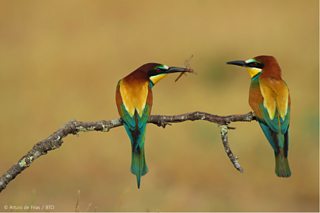
Michaela visited the newly breeding bee-eaters in Nottinghamshire earlier this year. But what can we expect to happen to our UK residents and migrants as the climate changes? Researchers are increasingly investigating the effects that climate change might have on animals and plants. At the British Trust for Ornithology we have investigated how climate change will affect the abundance of over 100 bird species across Great Britain by using annual bird counts undertaken by skilled volunteers in the UK and France.
Our results show that several species (55 of the 124 considered in our study) are likely to benefit from future climate change and, freed from other constraints, we can expect their populations to increase by 2080. In contrast, fewer species (11 of 124) are likely to suffer from climate change. This may look like good news, but in reality six of the 11 species that are expected to decline are already included in the British red list of the birds that are at highest risk of local extinction (grey partridge, curlew, grasshopper warbler, ring ouzel, pied flycatcher, and yellowhammer), and four (red grouse, snipe, willow warbler, and meadow pipit) are currently in the amber list, which includes the next most critical species. This highlights how climate change will more seriously hit those species that are already of conservation concern. Also, several of the species forecast to benefit from climate change are in serious decline, due to other pressures like habitat loss and degradation, they may not have the capacity to respond positively.

Michaela meets birders whilst filming the bee-eater film for Autumnwatch
"Six of the 11 species that are expected to decline are already included in the British red list of the birds that are at highest risk of local extinction"
Among the 124 breeding bird species considered, we included birds that might take advantage of the warming climate and colonise Great Britain. To achieve this, we combined data from the UK Breeding Bird Survey with data from its French counterpart (the Suivi Temporel des Oiseaux Communs). This meant we could consider species and climatic conditions that aren’t yet present in Britain. This showed that some species, such as melodious Warbler and Bonelli’s Warbler, will likely find favourable climatic conditions in Britain in the future.
However, for some potential colonists, such as bee-eater or crested lark, it was difficult to find a consistent relationship between climate and how abundant the species are, so we were unable to make firm prediction. We’ll have to wait and see if the changing climate will be to their liking.
