
Milder than most of northern Europe, the British Isles are a warm-ish winter home for a multitude of birds which flock into our orchards, estuaries, lakes and gardens.
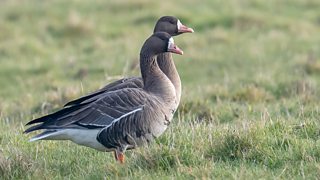
Russian white-fronted geese by Ted Smith on Flickr
Russian white-fronted goose
Thousands of Russian white-fronted geese spend the winter on our estuaries every winter, pouring in from their Arctic breeding-grounds to graze lush grass and sedges on wetlands near safe roosting sites. This winter more than usual they have arrived in south and east England. They were diverted from the Netherlands by strong easterly winds and heavy fog in late November and have turned up in unexpected places. One even appeared in Regent's Park in Central London. Russian white-fronts yap noisily like small dogs as they fly. On the ground you can identify them by their white “forehead” and black marks on the belly. Their bills are pink and they are slightly smaller and more elegant than the much commoner Canada and greylag geese.
Small numbers of the much rarer Greenland white-fronts also visit us, wintering mainly in Ireland and western Scotland, they have orange bills and are slightly darker.
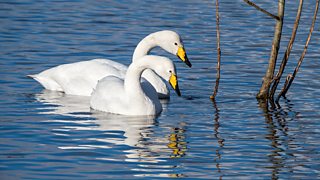
Whooper swans by Maria H on Flickr
Whooper swan
Few winter sights and sounds are more thrilling than the whooping and bugling calls of a skein of whooper swans on a cold winter’s day. Nearly all of Iceland’s breeding population of 30,000 whooper swans spend their winter in Scotland, Ireland and Northern England. At up to 11kg for a male bird , known as a cob, whoopers are among the world’s heaviest flying birds, but unlike our resident mute swans, their wingbeats don’t make that familiar throbbing sound as they fly. They travel here in family groups , the parents teaching their grey cygnets the best routes and feeding and roosting places. In late March and April they head north again to their Icelandic summer territories.
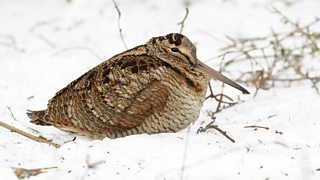
Woodcock by Richard Ives on Flickr
Woodcock
Woodcocks are wonderfully patterned wading birds which are superbly camouflaged when they rest on a leafy woodland floor. Many breed here, but the British Isles are a winter refuge for up to a million Woodcock from Scandinavia, the Baltic area and Russia. We know from birds fitted with transmitters in winter in the UK that some breed as far east as the Siberian taiga (conifer forest) over 3,000 miles away.
They often arrive in large numbers in late November at a full moon which is still known in places as a “Woodcock Moon” and spread out through the British Isles, resting by day in woods and feeding at night in fields and marshes, probing for worms with their long bills. They are almost impossible to see on the ground by day, but can see us well because their large eyes are placed high on their heads to give them a 360 degree view. Your first view of a woodcock is often a heart-stopping moment when it dashes up from the woodland floor and flies rapidly away in a flash of russet wings.
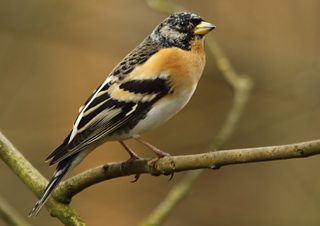
Brambling by Paul Farmer on Flickr
Brambling
Check your chaffinches carefully....one of them could be a brambling. Bramblings are the northern equivalent of our chaffinch and breed in birch woods in Scandinavia and Russia. They head south in autumn and some make it to the British Isles where they feed on seeds, especially tree-seeds such as beech mast. This varies from year to year, so if there’s a shortage of beech mast on the Continent, more birds travel to the UK where they often turn up on bird-tables. Where food is abundant, massive flocks can gather. The biggest ever bird flock recorded anywhere in the world was a flock of bramblings that roosted in a Swiss valley in the winter 1951/52 and contained an estimated 70 million birds... Almost the entire European population.
Look closely at flocks of chaffinches for any that show white rumps when they fly. Also check for the soft orange and tortoiseshell patterns of bramblings and listen for their nasal twanging calls as they take flight. And don’t forget to keep a sharp eye on your bird table.
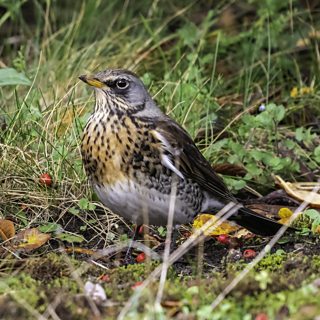
Fieldfare by Jeff and Jan Cohen on Flickr
Fieldfare
Fieldfares are spectacular birds, bigger than song thrushes and smaller than mistle thrushes. They make a hoarse chuckling call as they fly and when you see them well, show a slate-grey head and rump, blackish wings and a dark chestnut back. Their chests are heavily streaked in black with a warm amber glow. In milder weather fieldfares, birds which breed in Scandinavia and south into France, rove open fields looking for worms and other small creatures, but they will often invade orchards and gardens with fruit trees. You can attract them to your garden by putting out windfall apples. Competition for food can be fierce in harsh weather and there are several records of fieldfares killing each other in battles over a tasty morsel. One even drank its unfortunate victim’s blood, a sign that food really was scarce. On the breeding grounds, these feisty thrushes nest close together and gang up on predators by defecating together over their enemy - a defence that often works!
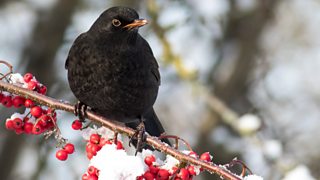
Blackbird by Carl Taylor on Flickr
Blackbird
You may see more blackbirds in your garden or local park in winter. This is because blackbirds visit our gardens more in hard weather, but also because large numbers of Continental blackbirds visit the British Isles in winter. Many of these birds are from northern Europe and Scandinavia, fleeing cold weather and when they arrive they cause consternation among the residents which is why you may see lots of skirmishing and hear loud chinking calls at dusk when they go to roost. Territorial urges break down in winter though, so they tend to tolerate each other. It’s not always possible to identify these Continental birds but they are usually more restless when they arrive than the local birds. A BTO study of Blackbirds visiting a Norfolk village asked people to record sequences of colour-rings on the bird’s legs and showed that in a single day over 70 Blackbirds visited a single garden and over 400 birds had been ringed there, proof that we know “our” Blackbirds less well than we think.
