
Like nowhere else in Britain, a dramatic, dynamic and diverse place, the Cairngorms hold some of Scotland’s most precious species, some being both scarce and elusive. In particular, this unique place is home to six rare invertebrates whose habitats are threatened across the UK.
Luckily, an incredible team of conservationists and volunteers are building a future for them by seeking out and encouraging protection of their habitats. The Kentish glory moth, pine hoverfly, silver stiletto fly, shining guest ant, dark bordered beauty moths, and small scabious mining bee will be the next superstars at centre stage in the Cairngorms. But have you heard of them?
Kentish glory
Once much more widespread, the Kentish glory is now restricted to suitable habitat in the Highlands of Scotland, flying in areas of young birch from April to mid-May. To help survey the species, an artificial pheromone was created to mimic that of the female, which can be used to attract male moths to chosen areas. This method expanded our understanding of the distribution of the species by over 100km2 across the region.
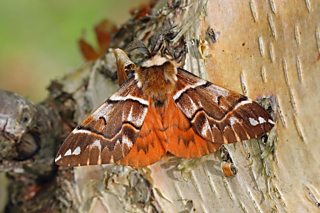
A Kentish glory moth. Photo by Nigel Voaden via Flickr.
Pine hoverfly
The pine hoverfly is one of the most endangered animal species in the UK. It relies on ancient Caledonian pine woodland, particularly a naturally diverse, mosaic woodland that has open areas, where the flies can bask in the sun, and broadleaved trees where the flies can feed as adults. The Cairngorms is the only known place in the UK where this species lives. The hoverfly is exceptionally difficult to spot, but in recent years we have been able to observe larvae in specially created rot holes.
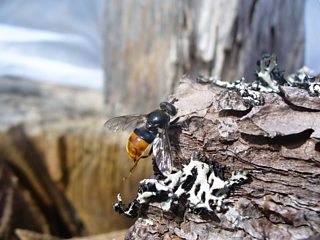
A male pine hoverfly. Photo by Ellie Rotheray.
Northern silver stiletto fly
Moving away from the Scots pine and toward the riverside, we find the habitat of the Northern silver stiletto fly. River shingle are the vegetated banks made of sand and stone that form naturally in and beside rivers and this habitat is home to an array of specialist wildlife. It is the chosen hang-out spot of the stiletto fly, so-called because of its stiletto knife-shaped body. The larvae feed below the sandy surface of the bank and hunt other invertebrate larvae, using venom to stun them first. Like grouse, male silver stiletto flies form ‘leks’, dancing, swooping and shimmering in the sun to compete for female attention.
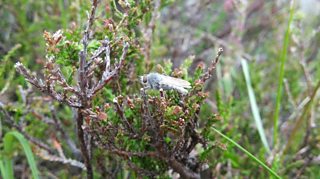
A northern silver stiletto fly. Photo by Tom Churchyard.
Shining guest ant
This is the tiniest, shiniest ant you’ll ever see. This species takes advantage of the many upsides of living in a wood ant nest: it’s warm, well defended, and the wood ants bring in a steady supply of food. Wood ants aren’t so keen on sharing their space though, so the shining guest ant has a unique strategy to ensure they are left alone. A distasteful substance is produced on its body ensuring that if they are grasped in the jaws of a wood ant, they are quickly dropped again.
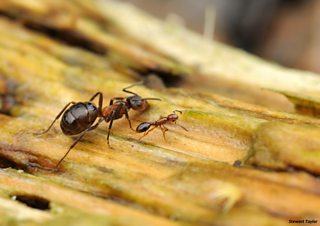
This is the tiniest, shiniest ant you’ll ever see. Photo by Stewart Taylor.
Dark bordered beauty moth
The dark bordered beauty moth does an excellent job of blending in, disguising as a yellowing leaf amongst the aspen suckers it feeds on (further south, in England, it might prefer a creeping willow). As you might have guessed, it has a thick dark border along the edge of its wings, and it is quite a beauty! As aspen has become scarce and natural forest diversity has struggled, this species has sadly suffered as its niche habitat has reduced.
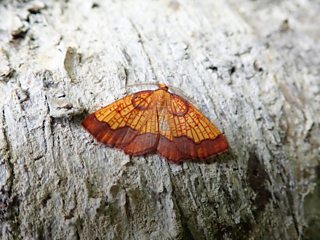
A dark bordered beauty moth. Photo by Mary Laing.
Small scabious mining bee
Have you ever seen a bee in cowboy chaps? The small scabious mining bee covers her legs in white pollen until you are almost certain that she must be in a wee white pair of trousers. This bee is reliant on a specific source of protein, pollen from devil’s bit scabious, and they collect nectar from other wildflowers. This specialised diet means that as the natural environment deteriorates, and we favour cut grass over our native flora, this species, along with all other pollinators, is at particular risk.
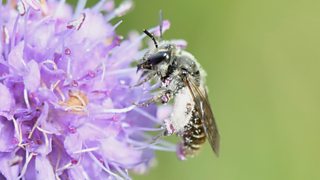
A small scabious mining bee. Photo by Peter Stronach
While they may seem to make up a small part of our natural landscape, every single species is important for maintaining a strong and resilient environment. We’re working to protect these remarkable species to continue to maintain the biodiversity that is essential for our planet and ourselves.
Click here to find out more about the RSPB's work across the UK.
