
By Paul Stancliffe, Media Manager at BTO
So far, this spring seems to have been a very long one. The incredibly warm latter half of February, a consequence of a plume of warm air that originated in Africa, heralded the arrival of very early swallows and house martins, with birds quickly getting as far north as Shetland before the month was out. Every February sees one or two swallows and martins, outliers gambling on good weather and lack of competition for the best breeding sites. If the weather fails the gamble won’t pay off and the birds will either perish or, if they have the resource to, double back south and try again later in the spring.
February 2019 was different than normal in the number of swallows and house martins to arrive. The norm is for a few swallows to be seen in the south of the country with perhaps the odd individual further north, but on some days in February this year it seemed that almost every county had at least one swallow and sometimes several together – it was very easy to think that spring had come early.
Fast forward to mid-March and a cold northerly airflow had set in, effectively bringing migration to a crawl, if not a standstill. The northerlies seemed to last forever and even saw a return to snow and ice in the north of the country and, by mid–April people were beginning to ask where our swallows were. The simple answer to this; probably held-up further south and awaiting a change in the weather. The main arrival period is in the first week of April, reaching its peak a month later, in early May. However, according to BirdTrack, they have lagged by about two weeks this year and appear to be around in lower numbers, not getting close to the historical average.
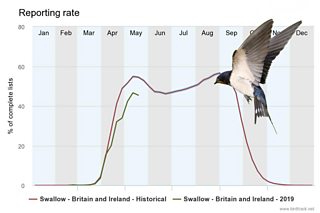
How many swallows have been seen this year compared to historic records? Provided by BTO
So what might be happening? It could still be that some birds are held up further south, although the weather in the last week has been OK for any swallows to make the final push north – indeed there was a large arrival of swallows and house martins on the Isles of Scilly but numbers still appear to be on the low side. It is still a little too early to tell for sure but it could be that the numbers remain low, pointing to either problems in the overwinter areas or problems on the route back; only time will tell.
This isn’t the whole picture, some summer migrants, particularly some of those that spend the winter in the Sahel, the arid zone just to the south of the Sahara, arrived here on time and in the sort of numbers we would expect. Whitethroats are a classic Sahelian migrant to the UK and the BirdTrack reporting rate looks very different to that of the Swallow, matching the historical average pretty closely.
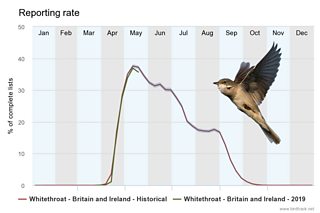
How are whitethroat numbers comparing this year to historic records? Provided by BTO
The sand martin is another species that winters in the Sahel and its BirdTrack reporting rate looks similar to that of whitethroat, in that it arrived pretty much on time and in expected numbers.
These mixed fortunes are not unusual, in the 80’s the whitethroat and sand martin populations crashed as a consequence of a severe drought in the Sahel. A colleague of mine was in Kenya a couple of weeks ago and the country is currently in the grip of a drought – maybe some of the countries our swallows pass through are suffering similar conditions. In drought conditions invertebrates become very thin on the ground.
The last few weeks have seen quite a bit of easterly and south easterly airflow, this has resulted in birds that were making their way into eastern and north Eastern Europe getting drifted across the North Sea to Britain. At times black terns seemingly appeared on almost any suitable waterbody, often accompanied by a few little gulls. More recently, we have experienced one of the best showings of red-spotted bluethroats, with numbers well into three figures.
Over the next few weeks and months data will pour into the BTO and it is this that will give us a better idea of just how our summer migrants are faring.
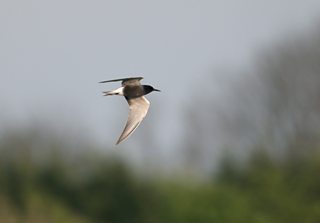
Easterly and southerly airflows have resulted in birds like black terns getting drifted across the North Sea to Britain. Photo by Graham Catley
