Montagu’s harrier update

Guest blogger
Mark Thomas, Montagu’s harrier species lead for the RSPB recalls events in July 2016 when Martin Hughes-Games joined the team trying to catch and satellite-tag an adult female Montagu’s harrier in Norfolk.
It was all rather secretive, a flight arrived at Heathrow, off got two scientists armed with a net, a very long ruler and a £5000 tracking device!
They were whisked off into the night, arriving in deep rural Norfolk pre-dawn.
This was not going to be any old day; it was going to be special. At a pre-arranged lay-by on the edge of a common several cars began to assemble. Introductions took place, fine details were discussed and months of arrangements came together. Winterwatch were in town, hard to believe on that warm summer morning.
During the past three years eight adult Montagu’s Harriers had been fitted with satellite tags by a partnership between the Dutch Montagu’s Harrier Foundation, RSPB and The Sound Approach. This partnership relies on specialist volunteers and enthusiastic farmers.
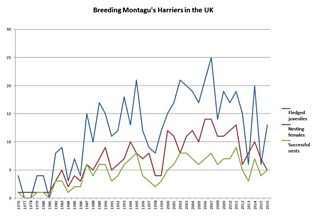
Montagu’s harriers are the UK’s rarest breeding birds of prey with just five pairs in 2016. They return to the UK in late April and raise their youngsters within agricultural habitats. Numbers have fluctuated over recent years with an overall decline, we need to understand why in order to put measures in to place, this became more urgent after 2012 when the population took a dip to just three successful nests. We suspected our harriers wintered in Africa but we didn’t know exactly where, what migration route they take or the threats they face.
Arriving at a location that had been kept ultra secret throughout the previous two months, the first birds came in to view, two beautiful fledged juveniles with their striking orange underparts. Both occasionally undertaking in a quick mock aerial fight with each other before returning to the ground and awaiting the next delivery of food from the adults. Suddenly the male appeared high from the right, clearly carrying prey. This was Roger, a bird we had tagged the previous summer. Last year Roger had been paired with three different females and had probably found the situation a little bit too much to handle! This year he had one female and was providing really well for his family.
After the prey had been delivered and the juveniles had fed then a net was quickly erected by Raymond and Almut from the Dutch team with Martin Hughes-Games helping. A stuffed bird of prey was then placed directly in front of the net. The team then retreated to a nearby car and the waiting game began. After a short while the adult female arrived, she immediately noticed the intruding bird of prey in her nest field and made a direct attempt to attack it. She dived at speed but deftly avoided the net at the last minute. A couple more passes and then she was in. The car quickly spilled its occupants with Raymond at full speed followed by Almut and Martin in bronze position!
Raymond expertly removed the harrier whilst Almut took the net down. The team regrouped at the car and the bird was quickly ringed and colour ringed with a ring bearing the initials CP (sorry Chris Packham!). A series of measurements were taken and the bird was then weighed. She was found to be a 3 year old adult in great condition. Finally Raymond held the harrier whilst Almut fitted the lightweight satellite tag. The Dutch team are world experts at fitting tags to Montagu’s Harriers, having previously done this over 75 times and all across Europe as far as Belarus. All of the tagging is carried out under special license by the BTO.
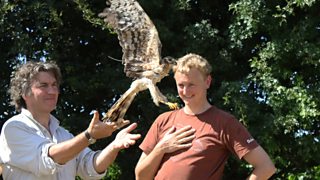
Martin had the pleasure of releasing the bird which was named Sally. The tag on Sally immediately started giving signals to the team on the ground – success!
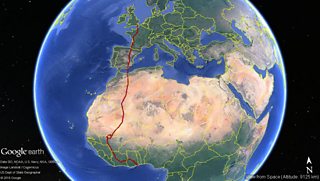
Little did we know at that moment that Sally was going to be a superstar, not only did she successfully raise her family, migrate safely via the Atlas Mountains to Africa but she is also the bird that has travelled the furthest south out of all the previous tagged birds. She is currently in Ghana, some 2,250 miles from Norfolk! Interestingly her mate Roger is in Senegal near to another of our tagged males Mark who has bred for the past three years in SW England.
Overall, the project data is highlighting the fact that mortality is occurring on migration and on one occasion before an adult left the UK with the circumstances suggesting illegal persecution.
Our knowledge of UK Montagu’s Harriers has taken a huge step forward and we hope to visit Africa in the near future with our Dutch colleagues to learn even more!
You can follow the progress of the birds on twitter @ukmontagus and via the RSPB tagging page.
Mark Thomas
RSPB
