Ringing recoveries reveal all

Lee Barber
Bird Ringing Recoveries Officer, BTO
RSPB Arne is surrounded by Poole Harbour which offers a fantastic feeding resource for thousands of waders and wildfowl in autumn and winter. Additionally, during the autumn, thousands of birds, such as swallow, osprey and cuckoo, pass through on their migration south.
Bird ringing is a great way of finding out how long birds live, where they come from and where they move to. Each bird ring carries an address with a unique number, so that if a ringed bird is encountered again, its history can be traced. During 2015, 28,479 birds were ringed in Dorset by BTO licenced ringers (see the online reports), giving an insight into what some of ‘Dorset’s’ birds are doing.
One of the most numerous waders in Poole Harbour is the dunlin. These little birds travel vast distances every year from their Arctic breeding grounds to winter in the UK, France or Iberia. This map shows where Dunlin has been found, after being ringed in Poole Harbour. One particular bird was caught by a ringer in Lincolnshire 10 years later!
A wader that you are unlikely to see on the mud flats is the woodcock. After being ringed near Arne in February 2014, a woodcock was unfortunately shot 2,850 km away in Ivanovo, Russia in April 2015. Assuming this bird came from Russia originally, it had probably flown around 10,000 km in its lifetime.
Adding colour rings to birds can provide an easy way of recording ringed birds. This year the BTO received two reports of colour-ringed spoonbill visiting Arne; these birds had originally been ringed in the Netherlands and Denmark. We also have reports of two colour-ringed avocet originating from Orfordness, Suffolk.
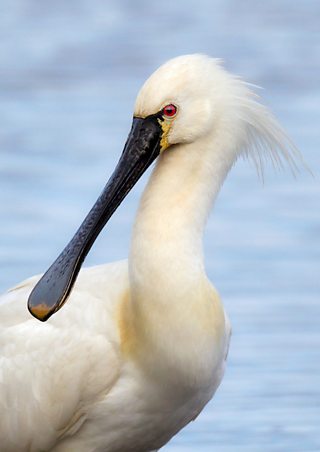
Spoonbill. Taken by Paul Hillion/BTO
It’s not only the larger birds that undertake interesting movements. Many finches, such as siskin, are renowned for their migratory movements. . One bird that was ringed near Arne was found dead at Crosshill, South Ayrshire (543 km north) and another was caught by a ringer 800 km away in Afferde, Germany. For more on siskins read the BTO DemogBlog.
Goldfinch can also travel large distances; one was caught by a ringer near Newcastle, Northumberland after being ringed two years earlier at Woolgarston, Dorset.
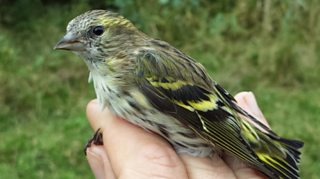
Female Siskin. Taken by Lee Barber/BTO
Most records of ringed birds come from other ringers catching previously ringed birds; however, everyone can play their part in helping to understand bird migration by reporting any ringed wild bird at www.ring.ac.
