
In Lord of the Wings we saw the golden eagle and white-tailed eagle go up against each other, but how do you make sure you know who you’re watching? In this blog, Sarah Harris will help you recognise both eagles, as well as some key identification features for the harrier species.
Eagles are big – really big. Golden eagles having a wingspan about 70% larger than that of a buzzard, whereas white-tailed eagles are famously described as a ‘flying barn door’. Both inhabiting north and west Scotland, they are classic confusion species. It’s nice to think the clue is in the name, but golden eagles have white in their tail base until they are around five years old and white-tailed eagles have a buff, occasionally hinting gold, head and neck as adults. On sighting a flying eagle, silhouette is often the place to start.
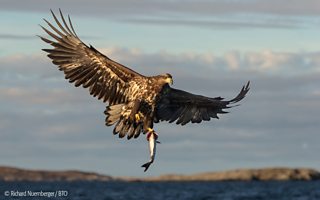
Both white-tailed and golden eagles can cruise by almost anywhere in their key home ranges; it is a case of keeping an eye on the sky! Golden eagles can often be picked up quartering hillsides on the side the wind is blowing onto (rather than the sheltered side), using the updraft of wind to their advantage as they drift back and forth not far from the ground at all, in search of prey.
It is always worth scanning skerries out in bays and headlands along the coast for white-tailed eagles, as these impressive birds do enjoy sitting about (although if on a telegraph pole, it’s much more likely a buzzard!).
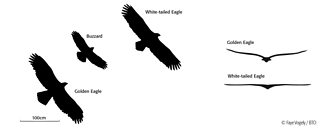
If you think you are watching a harrier, it will most likely be quartering back and forth, hunting. Unlike the eagles, which will most likely be seen against a bright sky, a different identification tactic may be exercised as you will more likely be identifying the species by plumage characteristics rather than silhouette, as the birds hunt below the skyline.
If you are based south of the Scottish border, the harrier you are most likely to encounter is marsh harrier. North of the border, and with a bit of luck, you just might clock a hen harrier. Marsh harriers are a heavier bird than hen, which are a slighter shape – although neither could be described as ‘bulky’! Harriers on the whole are described as long-tailed and long-winged and all hold their wings in a ‘V’ in flight.
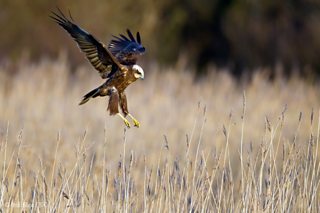
Immature and female marsh harriers are uniformly dark with a pale golden cap and chin, whereas immature and female hen harriers are mottled brown with an obvious, broad, white rump. In brown birds, the rump is always a good starting place; look for the white on hen harriers. On closer views, the barred tail of female and immature hen harriers can be visible and as the ages are often not often separable in the field these are often referred to as ‘ring-tails’. Adult male marsh harriers show a brown mantle and forewing whereas hen harriers are uniform grey above with black wing-tips.
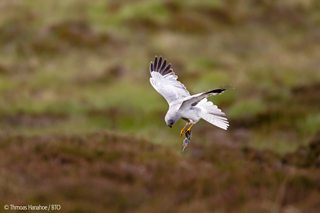
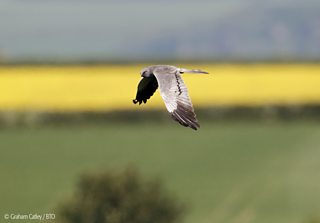
The montagu’s harrier normally has fewer primaries (only three to four) on show.
There is no quick cheat to raptor identification, but it helps to know the situation in which you will be seeing the birds, i.e. overhead silhouettes of eagles, or harriers against a dark backdrop allowing plumage characteristics to be seen and used in identification. It helps studying the differences using field guides before venturing out in the field. Of course, nothing beats being out there gaining practical experience! You can also learn more at.
