
A shimmering layer of frost greeted much of the UK as we opened our curtains this week, while a blanket of snow already covers much of Scotland and our uplands, so you might be forgiven for thinking that winter is well and truly here. But is it really?
Taking your clue from the weather may be the most obvious way to notch off the seasons, but there are several methods to work out exactly when autumn finishes and winter begins… and its not as simple as you might think.
Meteorological winter
Possibly the simplest way of working things out, it's the meteorological definition that has winter in the British Isles starting on the 1st of December. There are four clearly defined meteorological seasons in the UK, made up of splitting the calendar into four periods, each three months long. Each season splits neatly within the Gregorian calendar, making it easy for seasons to be compared to monthly statistics around snowfall, rain and hours of sunshine. It’s this definition that Met Office uses.
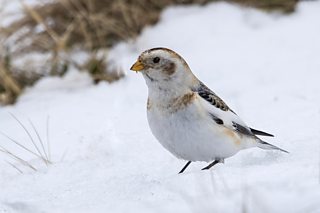
A snow bunting in its namesake habitat. Image by Bill Richmond.
Ecological winter
Under this definition, the British Isles have been in winter for a good few weeks now. It is considered ecological winter once the first frost is visible, normally after a cold night when temperatures have fallen to close to O°c.
Astronomical winter
Many hail the 21st December, the winter solstice, as the start of winter. It's on this date that the Earth's northern hemisphere is pointed at its most extreme angle away from the sun. This means that the days are at their shortest, and the nights at their longest. On this date you will be looking to turn your lights on at 15.53 in London, whereas its 16.01 for those that live in Holyhead in the far west of Wales. However, if you're way up north in Lerwick on Shetland the sun will set at 14.57 after rising only 5 hours 49 minutes and 16 seconds earlier.
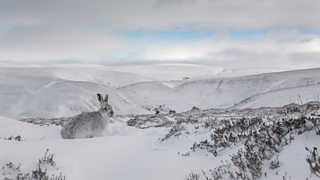
A mountain hare captured after heavy snowfall. Image by Raymond Leinster
Winter
Origin: A word inherited from Germanic.
The season between autumn and spring (generally regarded as lasting from December to February in the northern hemisphere and from June to August in the southern hemisphere), characterised by cold weather, long nights, the absence of leaves on deciduous trees, and the hibernation of certain animals.
Also: the colder half of the year, including the cooler parts of spring and autumn, as contrasted with summer.
Source: Oxford English Dictionary
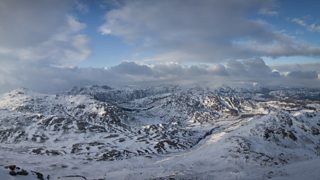
A wintry scene on the Cumbrian fells by dpb images.
Around the world
Sweden
For many, Sweden is a land of snowcapped mountains, white-dusted forests and pristine frozen lake – to some extent it IS winter in our imaginations.
So how do the Swedes define their winter?
Lemmart Wern, a climotoligist at the Norrköping-based Swedish meterological institute, said "Winter begins when the tempreature drops below 0°c for more than five consecutive days, we say that winter has begun on the first of those five days."
Climate data suggests this usually happens around mid-November.
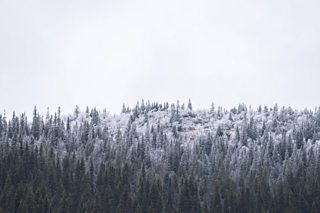
Snowfall on a Swedish forest by Tommy Andersson.
East Asia
In East Asian countries winter traditionally begins on 7th November, when the sun reaches the celestial longtitude of 225°.
Jude Law, a journalist working at the Hong Kong based South China Morning Post, said "In the Chinese lunar calendar there are special days which indicate the change of weather. The year is split into 24 solar periods, Lidong being the 19th and symbolising the start of winter."
Watch: winter in Japan
Polar opposites
Of course it's only actually approaching winter in the northern hemisphere, south of the equator summer is well on its way. That’s all down to the way the Earth is tilted on its axis, meaning that as it moves around the sun different parts of the planet are closer to the sun at different times. So as temperatures climb in South Africa, Australia and Argentina; at the South Pole the local penguins will soon be basking in 24-hour daylight for a few weeks.
Keep Dreaming
That means for those south of the equator, the dream of a white Christmas has to stay exactly that, a dream.
In Australia, Christmas Day falls in the middle of summer.
This week, temperatures in the Aussie capital Canberra are expected to reach a balmy 29°c - a real contrast to highs of 4°c in London, 3°c in Cardiff, 5°c in Belfast and 2°c in Edinburgh!
If you're planning for sledging on Christmas day, there are already predictions on whether it'll be a white Christmas.
