
Carnivore recovery in Britain and Ireland
By Joshua P Twining, Queens University Belfast and David G Tosh, National Museums Northern Ireland
On a crisp Autumn morning a grizzled adult male pine marten named PM03 awakes from his slumber under the shadow of an ancient lime tree. He cautiously pokes his head out from his resting place to see what awaits him in the picturesque setting of the Crom estate in County Fermanagh. The woodland he calls home has been forested for at least four hundred years, a rarity in Britain or Ireland, which like much of the world have been dramatically transformed by humans in recent history.
PM03 tentatively puts a paw forward, he bobs his head low taking in the smells of his world, listening for danger, planning his next move. With only the sounds of the waters of Lough Erne lapping against the nearby shore to accompany him, he bounds gracefully from his resting spot.
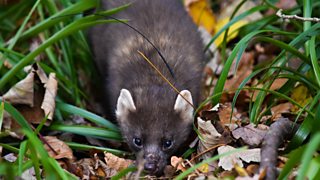
PM03, an adult male pine marten, carrying the scars of defending his territory against rival males, keeps low to the ground on leaving his resting spot in the Crom Estate, Co. Fermanagh.
The tranquillity of his surroundings are suddenly shattered by a hard, yet rhythmic “chuck”, “chuck”, “chuck” the alarm call of a small red sentinel perched above him in the towering lime tree. A red squirrel has had its morning collecting moss to pad its drey interrupted by PM03’s emergence and it stares down at the pine marten, calling and flagging its tail in furious flashes of crimson. Startled by this interruption, PM03 bounds away disappearing into a nearby bramble bush. Thanks to the ever-wary red squirrel, all the other forest residents know to be on high alert, there is a predator on the prowl.
The impact of returning predators
The triumvirate of three of our woodland animals, the red squirrel, pine marten and grey squirrel has seen a flurry of research in recent years. Much effort has been expended investigating the potential of the pine marten to naturally control grey squirrels and in turn help the native red squirrel recover from what was once considered unavoidable extinction from much of Britain and Ireland.
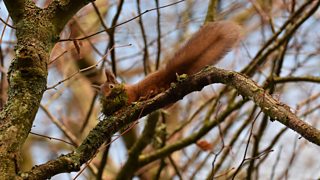
A red squirrel, while taking a mouthful of moss to its drey, spots PM03, the squirrel begins to alarm call and tail flag to warn other red squirrels of the potential danger.
For the first time in recent history, parts of Europe are witnessing the recovery of carnivores. Wolves, lynx, bears, and wolverines are returning to landscapes to which they have long been absent. Here in Britain and Ireland, carnivores are also recovering, with the polecat, the otter and the pine marten silently reclaiming their ancestral homes across our beautiful isles.
Britain and Ireland have a history of maligning and persecuting predators, resulting in a landscape devoid of their presence. Such actions may have inadvertently facilitated the spread of invasive species such as the grey squirrel. Despite their small stature, little predators like the pine marten, should not be underestimated, as research is revealing they provide big benefits to the ecosystems they inhabit.
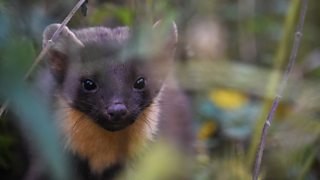
The European pine marten is a native predator in Britain and Ireland which is under-going recovery throughout the U.K. after a long history of decline, but its not out of the woods yet.
Legal protection and increases in forest cover initiated the recovery we are now witnessing in pine marten populations which is resulting in a decline in grey squirrel populations. It appears that American grey squirrels, which haven’t evolved alongside pine martens, (https://royalsocietypublishing.org/doi/10.1098/rsos.191841), are oblivious to the threat this tree climbing predator poses. It looks like pine martens raid squirrel dreys in the spring and summer when female grey squirrels are restricted to dreys to care for their young (https://link.springer.com/article/10.1007/s42991-020-00031-z).
The future for pine martens
The interactions between the pine marten and squirrels are revealing some unexpected benefits of healthy native predator populations. It is likely that as more carnivores recover, or are reintroduced, what we are witnessing with the pine marten in Britain and Ireland, will be the first of many examples of the wide ranging benefits carnivores provide still to be discovered.
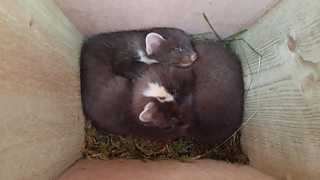
Two baby pine martens, approximately three-months-old, curled up together sleeping in a den box, as part of on-going conservation work to improve the suitability of our forests to the pine marten and reduce the potential for human-wildlife conflict.
Despite the benefits carnivore recovery can provide, their future presence across the whole of Britain and Ireland is not guaranteed. Predators are not welcomed by all, and the road to recovery can have many twists and turns along the way. If predator recovery is to be successful it requires support across the board. Input from, and dialogue with all interest groups alongside evidence-based conservation and wildlife management practices is a minimum if these recovering carnivores are to have a chance.
Find out more about the British Ecological Society's work.
