James Harding-Morris talks us through the Big Schools' Birdwatch, starting in January.
What is the Big Schools’ Birdwatch?
Big Schools’ Birdwatch is about to celebrate its fifteenth birthday – but if you’ve not heard of Big Schools’ Birdwatch before I’ll give you a little bit of background detail.
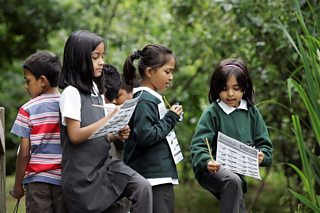
It’s the educational version of the RSPB’s Big Garden Birdwatch – designed for teachers to take part in with their classes. Rather than happening over a single weekend at the end of January, Big Schools’ Birdwatch takes place over the entire first half-term after the Christmas break; in 2016 from 4 January to 12 February. The major audience is primary schools (5 – 11 year-olds) but we have a growing audience of early years (under 5’s) and secondary schools (11+) and last year 90,000 pupils and their teachers took part across the UK.
Credit: rspb-images.com
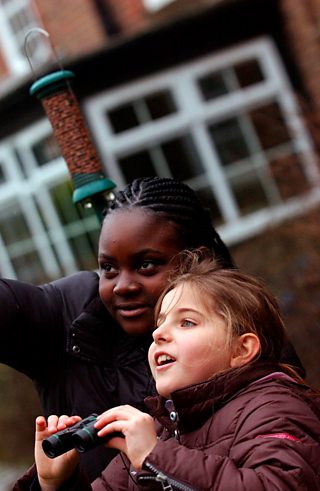
Big Schools’ Birdwatch serves two important aims. Firstly, it generates data. Obviously, we don’t expect children to be as precise as adults with their identification skills but the data is still useful for looking at broad trends in more common bird species – starlings, blackbirds etc.,
Secondly, and in my opinion, most importantly, Big Schools’ Birdwatch gives children an opportunity to get outside and engage with nature local to them. Research has shown that children are increasingly disconnected from nature, which is linked to poorer physical and mental health. Furthermore, if children grow up without experiencing or enjoying nature – are they likely to care enough to protect the natural world in the future? Why protect something you are disengaged from?
Credit: rspb-images.com
I want you to think for a moment. Think back to the first moment in your life that you remember being astounded and impressed with nature. What was it? Seeing a sparrowhawk for the first time? Watching a caterpillar in your garden?
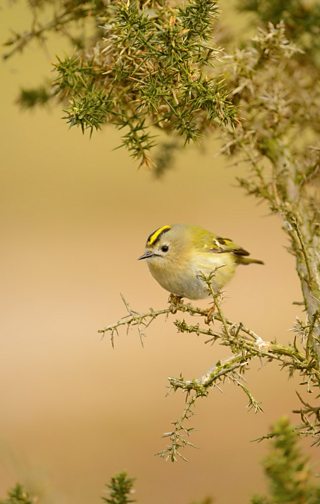
I think it’s likely that whatever it was that you were thinking of happened in childhood – and it seems that childhood is the time in which most people develop a feeling of connection with nature. Big Schools’ Birdwatch provides this opportunity to children. We’re not definitively saying that we are fostering a life-long love of nature through this activity – but we’re trying, and, for some children, Big Schools’ Birdwatch might be that first moment that they see a goldcrest, or a siskin, and fall in love with the natural world.
Credit: rspb-images.com
My favourite Big Schools’ Birdwatch moment – the bird that got away!
We sometimes get slightly more unusual birds reported during Big Schools’ Birdwatch. Every year we usually get a couple of herons recorded, a few little egrets, as well as ever growing numbers of ring-necked parakeets and red kites. However, back in January 2015 I got a an email from a school saying they had seen a black duck – and I don’t mean a dark-coloured mallard; they said they had seen an American black duck, Anas rubripes.
To my shame, I immediately doubted them. I mean, a black duck is basically a mallard seen in bad light, isn’t it? I wasn’t sure how to respond – so, naughtily, I decided to leave it until the next day to reply to.
It was only when I opened the email again the next day that I noticed that the school in question was located right down at the tip of Cornwall. My mind suddenly flashed – hadn’t there been a black duck reported on the Isles of Scilly recently? I quickly searched online and, lo and behold, a black duck had been seen on Scilly regularly up until the day before; as in, the day that it stopped being reported on Scilly was the day that the school had claimed to see one in Cornwall...
I immediately emailed the school back and asked them if they had taken any pictures. They replied they hadn’t. I encouraged them to see if the duck was still on the local pond. I waited with bated breath, only to receive a further message saying the duck had gone. Was it a black duck? I suppose we’ll never know for certain, though the circumstantial evidence is tantalising. It’s certainly taught me to have greater trust in the skills of people taking part. Because of my mistake, the rarest bird in Big Schools’ Birdwatch history will always be dwarfed by the enormous question mark hanging over it.
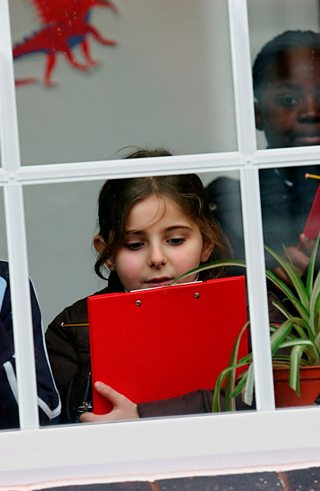
Credit: rspb-images.com
How can you help? We want as many children, classes and schools taking part in Big Schools’ Birdwatch as possible. If you are a teacher – wonderful! Sign up here to take part.
If you’re not a teacher but you have children – wonderful! Tell your children’s teacher all about Big Schools’ Birdwatch and direct them to our website: rspb.org.uk/schoolswatch
If you’re not a teacher and you don’t have children and you want to help – wonderful! If you know any teachers or governors then please impress onto them the value of taking part in Big Schools’ Birdwatch.
You could also consider following us on Twitter @RSPB_Learning and sharing details of Big Schools’ Birdwatch with all your followers.
We want 2016 to be the biggest year in Big Schools’ Birdwatch history. With your help I’m sure we can do it.