Autumn bird migration news: Storm force transatlantic migrants
Post categories: Migration news
 |15:21 UK time, Friday, 16 September 2011
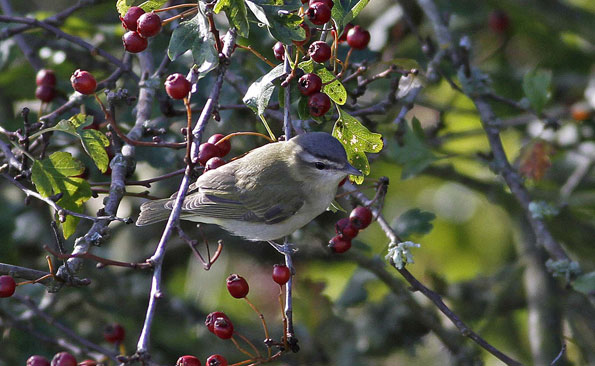
The red-eyed vireo arrived after a journey of 5,000km © Joe Pender
At this time of the year, storms can often bring birds to Britain and Ireland from far-flung places, and as the tail-end of hurricane Katia lashed our western shores earlier this week, it brought transatlantic migrants with it. Over 60 buff-breasted sandpipers arrived, with a single flock of 14 seen on Loop Head in County Clare, Eire.
They were not alone, over 30 pectoral sandpipers and a single solitary sandpiper were also found. The latter sharing the Isles of Scilly with the only American landbird to arrive, a red-eyed vireo, which was found on St Mary's on Tuesday. This bird, about the size of a dunnock, will have travelled at least 5,000km to get here.

The pectoral sandpipers, a transatlantic migrant © Ashley Fisher
So what effect has this had on migration here? The strong winds during the early part of the week effectively brought migration to a halt for many of our smaller birds. Now that the winds have died down, migration will again be in full swing, with hirundines (swallows and martins), pipits and finches making up a large part of any movement. The BirdTrack reporting rate for swallow shows this increase well as birds are counted at migration watchpoints.
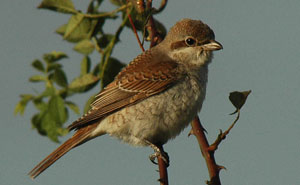
The red-backed shrike might arrive on in the east Neil Calbrade/BTO
Most of the action this week has been in the west but with the light south-easterlies forecast for Friday, the eastern side of the country could be the place to be, with wryneck and red-backed shrike a strong possibility on an early weekend walk. By Saturday lunchtime and in to Sunday the strong westerlies are due to return, swinging focus back to the west, where we could have a repeat performance of the early part of this week.
Question of the week: What causes falls of migrants?
During ideal conditions for migration (light winds and clear skies) migrant birds have little problem following a predetermined heading towards where they want to migrate to. However, for long distance migrants the conditions can change during their migration and they can be drifted off-course by the prevailing winds and find themselves over the open ocean.
Once over the ocean it seems that a migrant bird is unable to compensate for the original drift that got it there in the first place, and they continue in the direction that the wind is taking them until land is found. Or they perish in the sea, as many migrants in this situation must do.
Once on land, a migrant is able to once again re-orientate and head off on the original course, albeit sometimes in a very different part of the world, the red-eyed vireo on the Isles of Scilly this week is a prime example of this. (This was beautifully caught on camera by mpgoodey, a member of our photo group)
Of course large numbers of birds can be caught-up in bad weather events and can literally fall out of the sky once land is found, resulting in large falls of a variety of species seeking shelter and food. One of the most famous falls occurred in September 1965 on the east coast, involving 15,000 common redstarts, 8,000 northern wheatears, 5,000 pied flycatchers, 3,000 garden warblers and many others.
Birds can also occur in falls when they encounter heavy rainfall and will drop from the sky to seek shelter until the rain has passed.
Have you noticed any birds leaving yet? Anything unsual or suprising? As always, we'd love to hear, so post a comment below.

Comment number 1.
At 22:14 16th Sep 2011, Daisyjan wrote:Theres some great sightings there!
I live in South wales and we get the odd migrant blown inland. I will go and have a look this weekend.
Complain about this comment (Comment number 1)
Comment number 2.
At 09:12 18th Sep 2011, Mutley60 wrote:Great article. The last of our swallows and house martins, I think they must have gone Friday, no sightings since, sadly :( No - change that, just spotted some - they are getting up late! :)
Complain about this comment (Comment number 2)
Comment number 3.
At 07:50 19th Sep 2011, sarah1xc wrote:This comment was removed because the moderators found it broke the house rules. Explain.
Complain about this comment (Comment number 3)
Comment number 4.
At 20:02 19th Sep 2011, jenniesaur wrote:When I came home today there was a humming bird drinking the nectar from the flowers in my front garden!
I've never seen one so close before, I tried to get a picture but it was moving too fast and I couldn't get close enough! :(
Complain about this comment (Comment number 4)
Comment number 5.
At 12:06 20th Sep 2011, Charlie wrote:We had a manx shearwater in our garden last night. Completely bizarre! We live in the middle of Hampshire so certainly not something you would expect to see. Must have been thrown off course by the recent storms. My 9 year old son, who is mad about wildlife (and I guess is one of the "Springwatch generation") identified it immediately as the "sea bird that lives in burrows on Skomer and makes that eerie noise". The RSPCA have just collected it and hopefully it will be on it's way again soon.
Complain about this comment (Comment number 5)
Comment number 6.
At 17:00 20th Sep 2011, BirdTrack Organiser wrote:#4 Assuming you live in the UK jenniesaur, the most likely explanation for what you saw is a Humming-bird Hawk-moth. Real hummingbirds are found in the Americas and have never been known to cross the Atlantic but their hawk-moth counterparts do a very good impersonation: https://www.youtube.com/watch?v=-eJxlExq-xc
Nick Moran
Complain about this comment (Comment number 6)
Comment number 7.
At 17:03 20th Sep 2011, BirdTrack Organiser wrote:#5 What an incredible record Charlie - that must have given you a surprise! I received a report of a shearwater that flew into an aircraft hanger in Oxfordshire the other night; sadly that one didn't make it but sounds like yours has a good chance of making a full recovery. Nick
Complain about this comment (Comment number 7)
Comment number 8.
At 18:17 22nd Sep 2011, Gavin Unsprung Producer wrote:Hi everyone thanks for all your comments. Keep them coming.
@Charlie, that's a brilliant encounter, and we're all very impressed with your son's knowledge. We'd love to see any images you got of the bird or even some video. Could you upload images at our photo group https://www.flickr.com/groups/bbcautumnwatch/, for videos keep an eye out for the video uploader that will be going live on the site early next week.
Thanks everyone,
Gavin
Complain about this comment (Comment number 8)
Comment number 9.
At 18:22 23rd Sep 2011, englishcondor wrote:I'm having trouble finding this African bird on the internet on many shows in Africa especially meerkat manor there is this repetitive call in the background like a coh caw coh caw and I don't know what it is
Complain about this comment (Comment number 9)
Comment number 10.
At 18:41 23rd Sep 2011, englishcondor wrote:I just hope the maltese hunters go easy on the Honey buzzards, Turtle doves and many other migrants this autumn.
Complain about this comment (Comment number 10)
Comment number 11.
At 17:50 26th Sep 2011, Charlie wrote:Gavin re:8 I have uploaded 3 images to flickr and hope I've done it right. There's a comment with one which should give a bit more info. Hope this helps. Charlie
Complain about this comment (Comment number 11)
Comment number 12.
At 22:41 9th Oct 2011, owlbox wrote:we have a owl box with 3 young barn in thay all doing well we also have a badger set near them we have a camera in the owl box and can watch them but want some advice on the badger camera can you advise
Complain about this comment (Comment number 12)