Autumn bird migration news: Exciting times
Post categories: Autumnwatch, Migration news
 |15:22 UK time, Friday, 23 September 2011
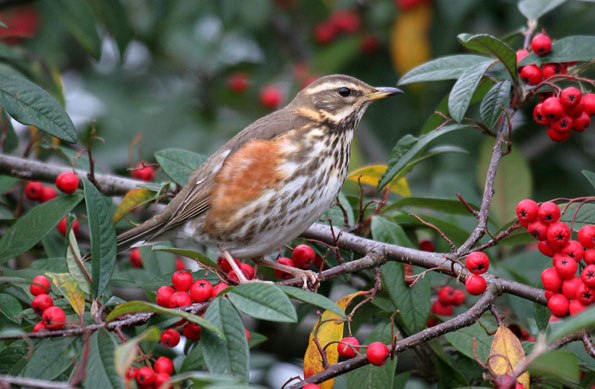
The redwing, a sure sign winter is round the corner © John Harding/BTO
Many of our summer visitors have taken advantage of the relatively settled conditions since hurricane Katia lashed our shores to begin the long journey south. The weekend saw the biggest movements of swallows so far this autumn, with an estimated 40,000 being counted at one south coast watchpoint in just a few hours.
The settled conditions have been perfect for observing visible migration, counting flocks of birds as they fly overhead, and there has been an obvious increase in the numbers of meadow pipits and wagtails, with both pied and yellow wagtails featuring more as the week has progressed.
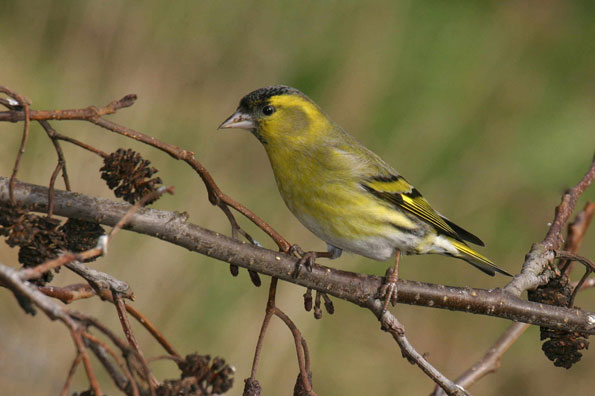
The finches, like this siskin, have been moving in earnest © Johh Harding/BTO
Finches are also beginning to move in earnest, with siskin being the most obvious; we have noticed an increase in the number of siskins flying over the BTO headquarters here in Norfolk, which is reflected in the BirdTrack reporting rate across the country.
Redpolls, goldfinches and linnets are also on the move in smaller numbers, particularly along the east coast. The Met Office is forecasting a hint of southeasterly in the wind for this weekend which could well trigger a larger movement of all of these species. If the weather report is correct, conditions could be perfect for observing visible migration, particularly in the east and south, whilst further north the forecast showers could result in localised falls of pipits, wagtails and finches.
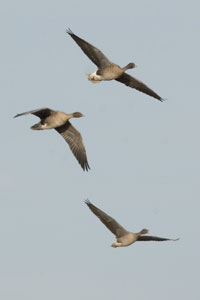
Pink-footed geese © C Mills/BTO
Small flocks of geese have also been a feature of the week and have mainly involved pink-footed geese and brent geese, a real sign that winter is just around the corner, and as if to confirm this, the first redwings and fieldfares have arrived in the north. (Editor's note: there's been a few sightings of fieldfares on our Facebook page.)
So what might we see during the next week?
Geese and finch numbers will continue to build, visible migration ought to continue in the same vein as this last week, and we should also see, and more importantly hear, redwings arriving. Now is a great time to get out in the garden after dark and listen for these largely nocturnal migrants going over, uttering their distinctive 'tseep' calls.
It will probably be much quieter on the rarity front with the more settled conditions, but we are heading into the last week in September, traditionally the time when great rarities from the east can occur. Thinking (too?) positively, I'd like a bimaculated lark on Blakeney Point, whilst Nick is angling for a pallas's sandgrouse on Scolt Head Island!
America is still providing most of the rarity interest at the moment though, and not surprisingly the west of the country received the lion's share. The Isles of Scilly have played host to four American landbirds, with northern waterthrush, black-and-white warbler and Baltimore oriole all joining the red-eyed vireo that was present last week.
The north hasn't been completely left out of this American bonanza though. A swainson's thrush and an American buff-bellied pipit were found on Shetland and a sandhill crane in Aberdeenshire.
Question of the week: What makes a rarity rare?
Silly question? Not really, because there are several factors involved in determining how rare a particular species is in a UK context. We're talking about migrants as opposed to rare breeding species (though you probably worked that out from the title of the blog!) - and it's not just about numbers.
As you might expect, breeding distribution relative to the UK plays an key role. As a rule of thumb, migratory species that breed in northern Europe and western Siberia are more likely to turn up here than those breeding further afield. Population size is also important. Even though species like roller, ortolan bunting and aquatic warbler are strong migrants and breed not that far away, all three have suffered serious population declines and have become increasingly rare in the UK in recent years.
Migratory tendency matters too. Take last week's red-eyed vireo for example. Although this species breeds in North America, there are more than 150 records in the last 50 years. In contrast there have been just eight crested larks over the same time period, despite the fact they breed in France, Belgium and the Netherlands.
The difference is that red-eyed vireos migrate to South America every autumn (or should we say 'fall'?) putting them at risk of displacement by bad weather, whereas your average crested lark starts to get a bit panicky if it leaves the field where it hatched. OK so maybe that's a bit of an exaggeration but you know what we mean...
Finally a species' habits have an impact on its rarity status. You won't be surprised to hear that seabirds spend much of their time at sea, making them naturally harder for land-loving birdwatchers to find and identify than their terrestrial counterparts. And some birds, such as Locustella warblers, are just naturally very shy and furtive... many a birdwatcher's autumn conversation has turned to the question of just what volume of such birds pass through undetected each year.
Have you noticed any birds leaving yet? Anything unsual or suprising? As always, we'd love to hear, so post a comment below.

Comment number 1.
At 10:31 25th Sep 2011, Mike Davis wrote:Today is lovely day why not go and take the dog for a walk and walk of that Sunday Roast why not at the same time just look around you and see the Nature around you the birds singing the leaves and the Autumn smell's, the fishermen sitting by the lake duck quaking and be at one with God I will
Complain about this comment (Comment number 1)
Comment number 2.
At 11:42 30th Sep 2011, BASRATH wrote:just started feeding birds in my garden the last 2 years so bit of a novice! Had finches at my feeder last few months during the summer but the past wk they have vanished. I live in belfast so just wanted to know if they migrate in autumn?
Complain about this comment (Comment number 2)