Autumn bird migration news: A seabird spectacular
Post categories: Autumnwatch, Migration news
 |15:11 UK time, Friday, 9 September 2011
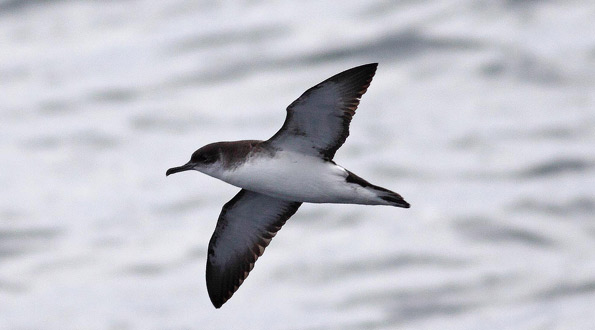
Manx shearwater © Joe Pender/BTO
The westerly gales that have been battering the coasts from the Cornwall to the Outer Hebrides have resulted in some spectacular seabird counts, in particular the rarer shearwaters. During the week, over 7,000 sooty shearwaters, 2,500 great shearwaters and 600 Balearic shearwaters, the latter globally listed as critically endangered, were counted off south-west Cornwall, south Devon and south-west Ireland.
Among these were also numerous grey phalaropes, leach's petrels and sabine's gulls. Large numbers of gannets and, as predicted in last week's post, Manx shearwaters were also seen in good numbers. Some newly fledged young of the latter struggled with the stormy conditions and 491 found themselves 'wrecked' on Newgale Beach in Pembrokeshire. The BirdTrack reporting rate shows nicely the increase of observations of this species.
All four species of skua were also involved in this movement, with Arctic being the most numerous. Again the BirdTrack reporting rate shows this increase.
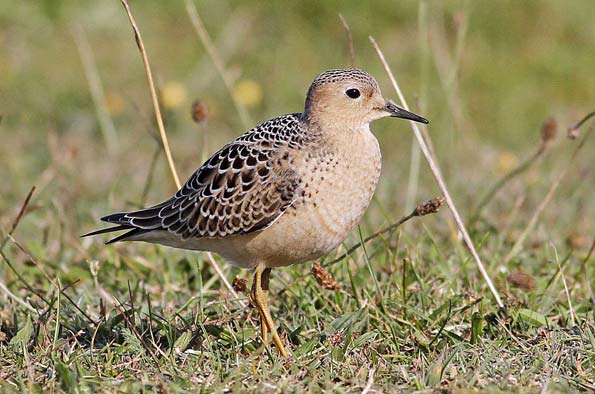
Gales brought a dozen buff-breasted sandpipers to our shores © Joe Pender/BTO
As was to be expected, the fast tracking Atlantic gales brought North American waders with them and over a dozen buff-breasted sandpipers arrived on our shores, with the Isles of Scilly hosting five of them, again the west received the lion’s share but birds have been found at Rye Harbour in East Sussex and Titchwell in Norfolk.
Despite the windy conditions swallows and meadow pipits have been a feature of visible migration watches. Over 12,500 swallows were counted heading south at Spurn Point on Saturday, with almost 8,000 meadow pipits heading in the same direction yesterday.
Swallows gettting ready to leave © Paul Stancliffe/BTO
The first large finch movement was also observed here yesterday with over 600 siskins also heading south.
With the wind set to increase again from the west on Sunday, observers on the west coast could be in for another weekend seabird fest, whilst in the east, finches and pipits should make the most of any lull in the windy conditions.
Question of the week: How do birds cope with the risks of migration?
The very act of long-distance migration has to be one of the most arduous and dangerous activities that a bird undertakes, so what can they do and indeed do they do to minimise the risks associated with long-distance migration.
For those migrants that undertake long sea or desert crossings, it’s essential to store enough fat deposits to fuel these flights and many of our smaller birds spend up to three weeks feeding up and accumulating fat reserves before their departure, some will have more than doubled their normal weight.
Setting off in optimum conditions also helps to minimise the risk of being downed or blown off-course and also maximises the stored fat reserves. If birds encounter worsening conditions, many will make landfall and rest-up and feed-up until conditions improve.
Some birds migrate primarily at night, reducing the risk of predation by diurnal raptors. Flying in the cooler night air also reduces drag and minimises the use of the stored fat reserves.

Comment number 1.
At 22:20 15th Sep 2011, RogerF337 wrote:I was very disturbed by the fact that the RSPCA has taken the Manx Shearwaters to Somerset for treatment and release, after putting down so many! These birds have their own navigation system, which we do not fully yet understand. If they are taken to Somerset and released, surely this will have an adverse effect on their 'homing instincts' and put them in jeopardy for their 10,000 km journey back to Brazil/Argentina/Chile???
Complain about this comment (Comment number 1)
Comment number 2.
At 17:34 19th Sep 2011, BirdTrack Organiser wrote:I can understand your concern, RogerF337, but these birds will be released on the coast and should then be able to quickly reorientate themselves and/or find other Manx Shearwaters. The key aspect to successful release is likely to be the weather conditions; enough wind for the birds to get uplift and not get becalmed but not so much that they have to fight against it. I'm sure the RSPCA will take this into account. Nick Moran
Complain about this comment (Comment number 2)